


Families’ first interactions with the school begin during their children’s early childhood years. This is the time to begin building strong school-home relationships through active, thoughtful family engagement. School leaders, teachers, and family engagement teams should take the time to plan school events carefully to meet families’ needs.
Building Family Engagement Starts Early
The early years of school lay the foundation for children’s education in more ways than one might expect. Pre-K and Kindergarten grades not only provide academic building blocks, but also give families their first impression of what it means to be involved and engaged in their children’s schooling.
When early childhood families feel welcomed, acknowledged, and understood, the more parents buy in, and trust is cultivated. And trust is the foundation for a positive school culture that benefits students for years to come.
Yet even with thoughtful planning and significant effort, parent attendance at events such as back-to-school night, curriculum night, and parent-teacher conferences is often lower than school leaders hope.
Preschool and early elementary programs, in particular, are navigating a complex set of factors that can limit family participation. Understanding these barriers — and designing events and communication with them in mind — is essential to building meaningful family engagement.

Parent Participation in Numbers
The National Center for Education Statistics outlines that during the 2022–23 school year, parents of K–12 students participated in an average of six school-related activities. Attendance at general school meetings or PTA/PTO meetings was the highest. This was followed by participation in school or classroom events and attendance at regularly scheduled parent–teacher conferences.
While according to these statistics 83% of families did participate in school meetings and events, still, 17% of families chose or couldn’t attend school related activities. There are a plethora of reasons why parents may not get involved:
- Parents, especially single parents, who work nontraditional or inflexible hours, may be unable to attend meetings or volunteer in person.
- Families may deal with language barriers or find it culturally challenging to fit in.
- New parents may feel isolated if the group or event seems insular.
- Parents who perceive the school climate as negative, or even hostile, may avoid engagement.
- Lastly, in some cases, parents may not be aware of school groups or events, and how to join.
This post takes a closer look into the reasons and solutions schools may provide for early childhood families who are just getting to know their child’s school.
Unique Family Participation Barriers in Early Elementary
For many families, early childhood is their first real interaction with a school. Families are still figuring out routines, expectations, and what it even means to “be involved.” At this stage, relational trust between school and home is just beginning to form, and families may feel unsure about when and how to engage.
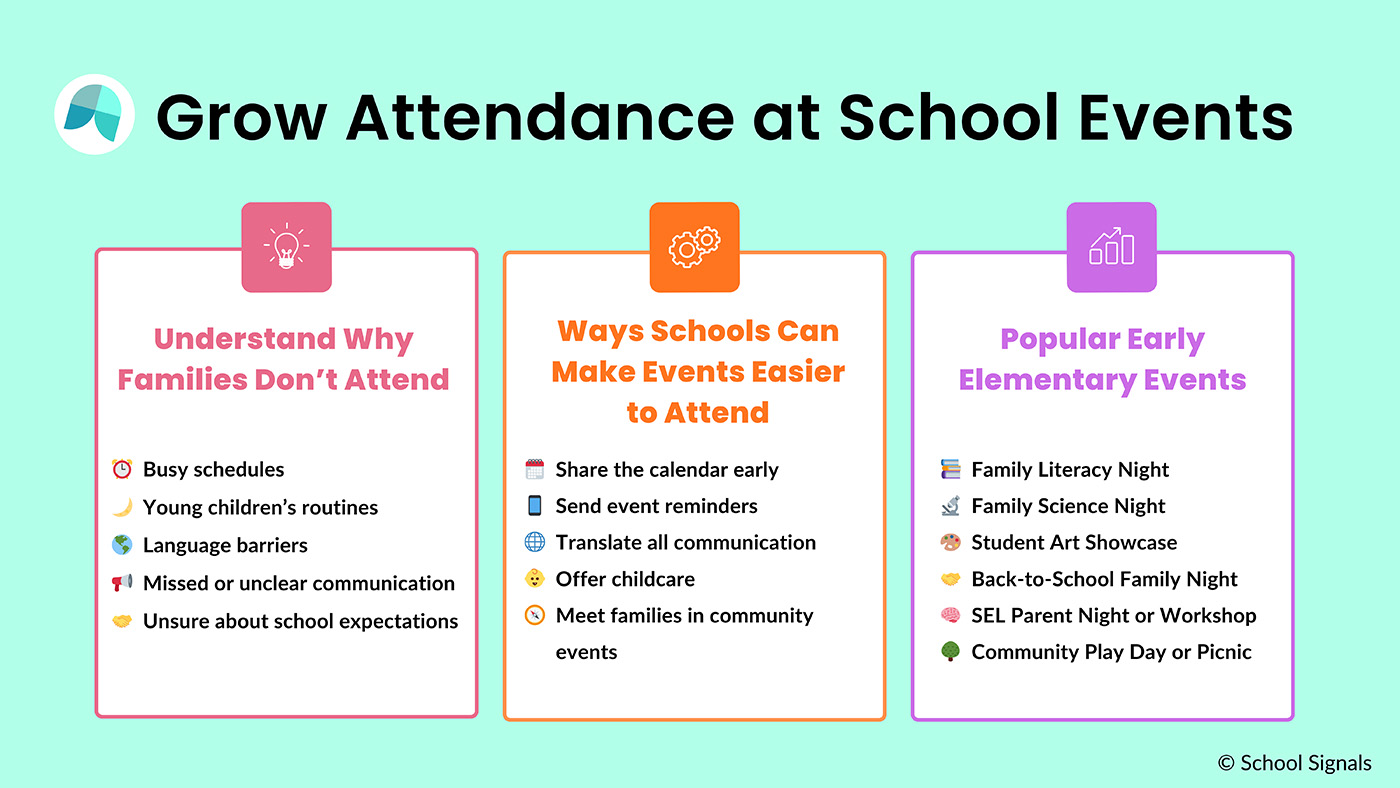
When schools invite early childhood families to events, common barriers to attendance need to be thoughtfully addressed to make participation possible.

Parents’ Time Constraints and Family Life May Hinder Attendance
For families with inflexible work schedules and families balancing demanding work schedules, attending a school event can be a challenge. Families may also already be stretching their childcare limits thin, and asking them to schedule additional time away from their children may prevent them from participating. For preschool parents, events that compete with bedtime routines, require arranging childcare, or are formal in nature, may be complex barriers to overcome. Asking young families to attend formal events becomes more possible when schools provide the right support.
Offer Virtual Event Options
Growing family engagement in events does not always require parents to be physically present at the school. Virtual meeting options ensure that parents with less flexible schedules or childcare arrangements can obtain the information they need.
Offer Childcare for the Event
If the event requires parents to attend, offering child care is a huge plus.
Promote The Event as Child-Friendly
Make sure to communicate that the event is child-friendly, and encourage parents to participate and bring their young children. Mention play areas, activities, or flexible arrival times.
Communicate Event Schedules Early
Parents with young children need time to prepare for the events. Share a school events calendar in advance with explanations of why each event matters to families. Events that are announced early and clearly, and repeatedly mentioned as important, are more likely to attract higher attendance. Schools should stick to the announced schedules and avoid last-minute changes to the event day or time. Using a digital communication platform to remind parents about upcoming events in their home language can be an effective way to boost attendance.
Recognize That Families’ Past Experiences with Schools Can Prevent Buy-In
Parents’ own school experiences or those of their older children may also prevent parent buy-in. Negative experiences can damage trust in schools, administrators, and teachers, especially when families feel they have not been acknowledged or that their concerns have not been taken seriously.
Welcome Families Through Early Outreach
Making school a welcoming space for families begins even before the school year starts, and is especially important for students entering early childhood classrooms. Consider in school communication planning how to best ensure parents are aware of school events. When selecting a school event management software or app, keep families’ language needs and internet access in mind to ensure communication is in a language and format that works for them. Digital school communication platforms can effectively reach families, and personal messages or phone calls build trust and make families feel that schools truly care about their attendance.
Start With Positive, Two-Way Communication
Focus on positive communication and making sure the first messages parents receive are relevant and positive. Make sure that parents have an easy way to respond.
Understand Parents’ Needs
If families feel like the event is not worth their time, they are unlikely to attend. Oftentimes, schools presume to know what families need from an event without actually asking them what they want or involving them as partners. This further dissolves trust, as families feel relegated to the sidelines as observers of their children’s educational journeys.
Get to Know Families’ Backgrounds and Needs
One of the most critical steps to take to promote family engagement is knowing your families–starting with their backgrounds, cultures, languages, family makeup, and socioeconomic status.
As trust develops, families are more willing to share insights into their values, needs, and interests. This can influence how you communicate, the support you offer, and the topics you cover at these school events.
Survey Families to Shape School Events
Family engagement assessment at the beginning of the school year is a strategic forward way to determine what topics and events families are most interested in. The engagement team may find that while a general curriculum night has less parent buy-in, a hands-on literacy learning night, where parents learn games and tips for building their children’s literacy skills, has a potential for more traction.
Gather Parent Feedback After the Event
After a school event, school leaders can send a survey to families to gather feedback on what went well and what could be improved for upcoming events. Don’t forget to survey non-attendees, too; they might have important insights into offerings that could improve family engagement at the next school event. Some questions to consider might include:
- What influenced your decision to attend or not attend the school event?
- What would make it easier for your family to participate in future events? For example,: timing, childcare, virtual options, and language support.
- What was the most helpful or valuable part of this event for you?
- Would you be interested in helping plan or support future school events?
After reviewing the feedback as a family engagement team, create a plan to fill in any gaps that limited parent buy-in this time. Be willing to be flexible with your plans for the rest of the school year, and delegate jobs like community outreach or serving as the teacher liaison to the parent planning committee to teachers willing to take on an additional role.
Focus on Child-Centered and Differentiated Events
Integrate Volunteer Opportunities into Early Childhood Events
In preschool classrooms, especially, there is a lot of prep-work that goes into every event. Inviting parents to volunteer to help with preparation can build engagement in the event itself, and getting a peek into the inner workings of the school can promote trust.
Involve Young Students in Event Planning
Even in pre-K classrooms, students can participate in planning school events. This might look like making decorations, deciding on games to teach their families on literacy night, or putting on a special performance. Knowing that their children have played a role in making this event special can increase parent buy-in and encourage more families to attend. Additionally, students gain agency and pride. For example, student-led conferences in early childhood classrooms give families a clear window into their child’s learning, making the event more meaningful and engaging for both children and parents.
Organize Differentiated Events
Early childhood programs serve families with diverse languages, schedules, school experiences, and comfort levels. Consider tailoring events for specific groups of parents to increase engagement. Maybe an event with families could take place in a local park on Saturday at noon, where families already take their children to play? How about hosting an early breakfast meeting before school? Or how about providing a homework support workshop for families who need it?
Support Strong Parent-Led Initiatives
Providing parent-led initiatives with the tools and space, both practical and digital, within the school helps strengthen families’ voices in the school community. School initiatives shift from being planned for families to being shaped with families, strengthening the relational trust between school and home.
When parents are strongly involved with event planning, they are more likely to tailor events that meet their needs. For instance, a recent social media discussion in a PTA/PTO community highlighted the fact that PTAs should not organize gender-role specific events such as Donuts with Dads or Dance with Dads, but rather extend the invitation to both parents, extended family and/or friends to be inclusive and not to make events tough to attend for some students.
Focus on Interactive Curriculum & Learning Events
Dr. Karen Mapp believes that the most powerful and transformative events re curriculum and learning events that involve parents as partners in their children’s learning. Attendance increases when these events are designed to be interactive and welcoming experiences that center around the child’s experience.
Events related to curriculum and learning showcase families what learning actually looks like and how it can be supported at home.
The Emmanuel Family & Child Development Center, an early childhood program in Kansas City, MO, invites families to a monthly literacy night designed specifically for young learners. Instead of presentations, parents and children participate together in storytelling, guided reading, and simple literacy activities that they can continue at home. The structure is intentionally hands-on and accessible.
Focus on Multilingual Family Engagement
Welcome multilingual families to the school community by providing continued support and tailored events. Families are more likely to participate in small-group meet-ups or sessions that provide resources relevant to their experiences and needs.
An example of strong ELS family engagement comes from Port Washington, NY, where the Port Washington School District organized a family literacy night for ELL families in collaboration with the St. John’s University Project Leader Program. The event brought ample of resources and connections for ESL families including
- Multicultural books to foster literacy skills in both home languages and English for ELL families.
- Educational workshops and resources by dedicated professors, student volunteers from St. John’s, and the Port Washington World Languages Department.
- Connections from local community-based organizations such as CARECEN, the Port Washington Resource Center, Latina Moms Connect, the Port Washington Public Library, the Long Island Japanese Culture Center, Super Soccer Stars, and the Hispanic Counseling Center.
In Seattle, WA, Hazel Wolf K-8 School hosted a multilingual enrollment night to help families enroll new students “to get computer access, help from interpreters, enrollment specialists and staff.”
Early Elementary Family Engagement Events That Strengthen School-Home Partnerships
Thoughtfully designed school events offer opportunities to connect with families and support students. They are part of the school’s family engagement plan to build school-home partnerships.
While private schools may host annual traditions such as fundraising galas, the most effective way to build a community is to offer inclusive and low-barrier events that focus on supporting students’ academics and well-being.
Pre-K and early elementary classes benefit from events that improve families’ understanding of teaching and learning, make them feel comfortable in the school environment, and build relationships with teachers.
Learning events provide a clear entry point for family engagement. They show families how learning works and open the door to participation.
Effective early childhood events involve active children, avoid long presentations, and clearly connect to classroom learning.
Family literacy nights, pajama storytime, and “make and take” workshops give parents a window into classroom reading and language development.
STEM and exploration nights let families experience hands-on math and science learning and encourage discovery together.
Family math night introduces parents to the puzzles and reasoning their children use daily, making the classroom experience clear.
Beyond academics, cultural and community celebrations also strengthen the sense of belonging within the school community. It’s important for families to feel represented in their community.
Heritage nights, cultural showcases, and gatherings help families share traditions and connect with one another.
Events specifically designed for multilingual families strengthen participation among those navigating English-language communication in schools. Bilingual storytelling, small-group literacy sessions, and system workshops help families participate fully as barriers fall.
Additionally, interactive social events strengthen relationships between families and educators. Trust grows through conversation. Game nights, book clubs, and “coffee/breakfast and curriculum” events let teachers and parents connect and deepen relationships.

- A Practical Guide to High School Parent Engagement - April 28, 2026
- How Schools Can Communicate the Value of Social-Emotional Learning (SEL) to Parents - March 10, 2026
- How to Talk to Parents About Student Behavior in Pre-K and K - February 28, 2026