


🔎 Here’s what this article covers:
- Reviews practical family engagement tools and frameworks used in schools and districts.
- Provides ways to assess your school’s current engagement practices and identify gaps.
- Outlines different approaches, from surveys and rubrics to planning guides.
👉 Assessment tools provide a structured way to approach family engagement.
Introduction
Today, due in large part to the influential work of Joyce L. Epstein and Dr. Karen L. Mapp, enhancing family engagement is now a common goal across schools and districts. Family Engagement Plans required as part of Title I or ESSA driven school improvement initiatives also add to the need to organize family engagement. Numerous studies demonstrate that meaningful partnerships with families help reduce absenteeism and strengthen student achievement.
To achieve increased and meaningful family engagement, the school or district needs first to understand where it stands with its partnership building. Is valuing family partnerships included in the school’s mission statement? Are parents invited not just to volunteer but also to shape the school’s policies? Do teachers communicate monthly with families and deliver positive updates? Is the role of homework communicated well to parents, and what steps has the school taken to support families as they raise their children in this digital era? Is the school connecting students and families with community programs? Does the school provide communication in the family’s home language? How do schools include and celebrate their students’ diverse cultures?
A family engagement teams or committees can help with assessing how schools are doing with their family engagement. Third-party consultants can also be invited to help and start programs. This post looks through common family engagement assessment surveys and questionnaires to give practical ideas for family engagement teams to shape their work.

Practical Plans for Important Work
Improved school communication and family engagement do not have to be abstract concepts that are hard to measure or attain. Several family engagement assessment tools and frameworks have been developed by non-profit organizations, university programs, education departments, and private companies.
These guidelines help schools assess and measure their school-home relationship and chart a strategic plan of action to strengthen partnerships. The tools can be used as conversation openers or systematic ways to measure engagement and progress over time.
How To Select and Craft Assessment Questions
Before reviewing any of the tools below, I want to refer to Dr. Karen L. Mapp, who reminds us that school districts need to define the desired outcomes when designing family engagement surveys or choosing which existing survey to go with. Dr. Mapp states, “Design your questions based on the outcomes you want.” (Listen at 14:15)
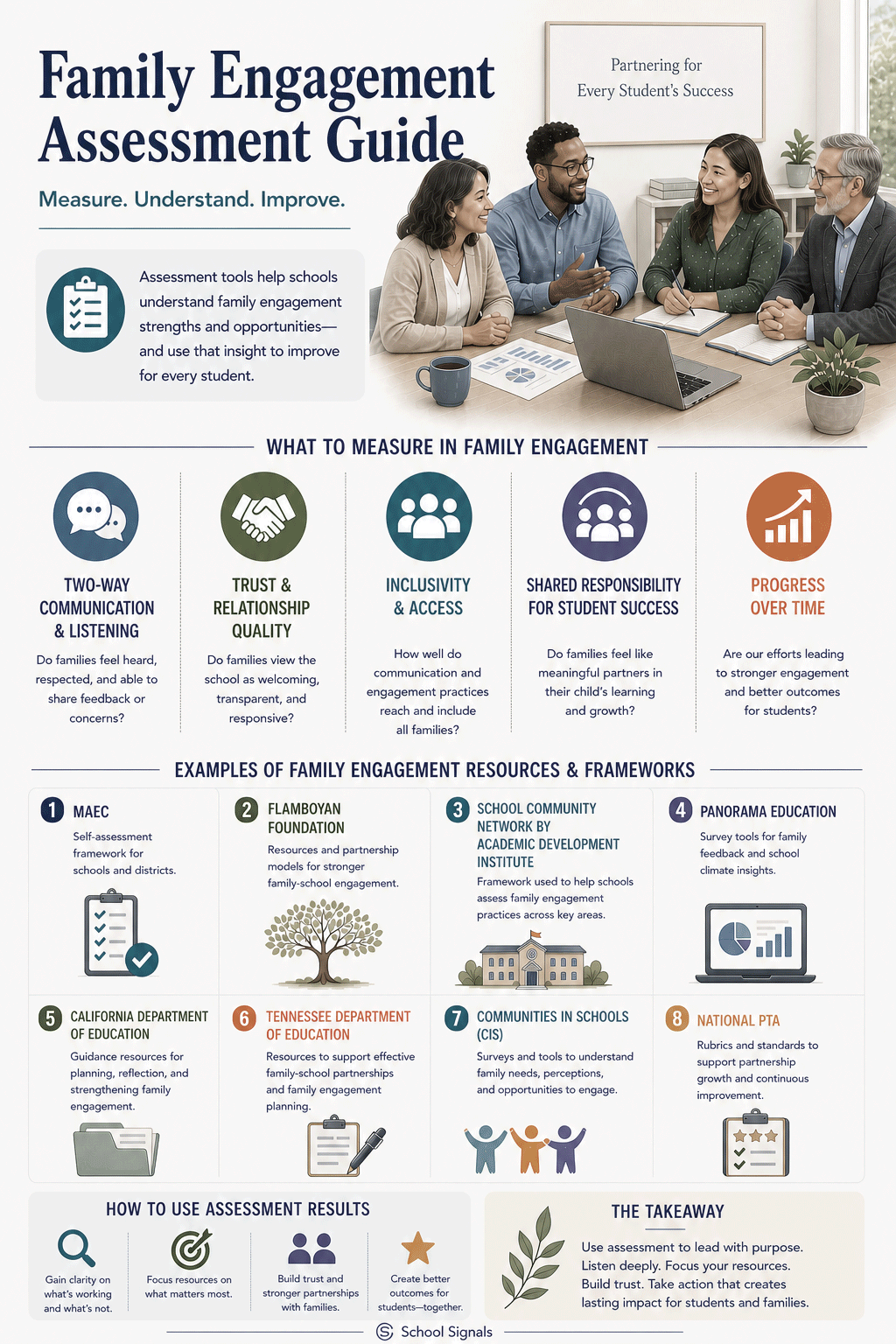
If your focus is to strengthen family engagement and family support, the key areas a family assessment tool should measure are:
- Two-way communication and listening. Questions that ask if families feel heard, respected, and able to share feedback or concerns.
- Trust and relationship quality. Questions that inquire the extent to which families view the school as welcoming, transparent, and responsive.
- Inclusivity and access. Questions that ask how well communication reach families across languages and whether engagement practices are inclusive.
- Shared responsibility for student success. Questions that ask if families feel meaningfully involved as partners in their child’s learning.
Your team may form its own criteria as you look through assessment guidelines and ideas for questions from the following organizations.
1. MAEC: Family Engagement Assessment Tool (FEAT)

I’ve chosen MAEC’s Family Engagement Assessment Tool (FEAT) as the first tool because it is clear and thorough. The Family Engagement Assessment Tool (FEAT) is a self-assessment tool for schools and school districts to reflect on the role of family engagement. It is not a questionnaire for all parents, but rather for the Engagement Team to implement and analyze.
The tool includes 91 questions, divided into nine sections, ranging from how welcoming the school is to how families are provided with resources to support their child’s learning and development. The sections are:
- Self-Assessment on how welcoming the school is
- Self-Assessment on the usability and resources in the school/district website
- Self-Assessment on the inclusivity towards building trusting relationships with families
- Self-Assessment on how learning goals and support are communicated to parents
- Self-Assessment on parent communication: provided practices and opportunities
- Self-Assessment on communicating transitions to the next school year
- Self-Assessment on how the school supports families with knowledge of child development, behavior, and learning
- Self-Assessment on the extent to which families are being invited to school decision-making and policy
- Self-Assessment on how much the school collaborates with community programs.
The questions, thorough and rich, acknowledge parents’ role as caregivers, learning supporters, communicators, and partners with a voice and power to make an impact. A dedicated section of community partnerships aligns with Epstein’s home-school-community sphere model.
Even if your school does not want to assess every section, the tool includes worthwhile questions you may want to ask the parent body in person or via surveys.
The document does include one question that needs to be examined in a critical light:
Does the school/school system use various platforms to communicate with families (e.g., email, phone calls, newsletters, social media, face-to-face meetings, messaging apps, parent portals)?
This question highlights the need for parent communication and for ensuring parents receive it. However, through parent and teacher input, we at School Signals have learned that this approach often leads to fragmented communication and communication overload.
It is not always feasible to post the same message to multiple platforms, and some messages need to be omitted from specific platforms (such as social media) for privacy reasons. Scattered communication to various platforms makes communication unpredictable for parents. Additionally, the use of communication apps such as WhatsApp is often self-organized by a single teacher or a group of parents, without any administrative oversight of who receives the messages. A commitment to using a unified school communication platform, while providing support to parents who are not digitally literate, is a step towards controlling communication volume and understanding who receives messages.
How to Get the Family Engagement Assessment Tool (FEAT)?
MAEC is requesting that you fill out an online form. They will send an automatic email with a download link. Here is the link to the online form: https://maec.org/feat/#pdf
2. Flamboyan Foundation: Family Engagement Partnership (FEP) Program and Other Assessment Tools

Flamboyan Foundation is a family engagement advocacy organization based in Washington, DC, that offers a project-based approach to improving family engagement.
The organization’s flagship program, the Washington, D.C.-based Family Engagement Partnership (FEP), is intended to be implemented with Flamboyan coaches.
It includes 4 phases:
- Phase 1: Relationship Building
- Phase 2: Academic Partnering
- Phase 3: Leadership for Sustainability
- Phase 4: Graduation (completion of the project)
During these phases, schools examine their biases, focus on active listening, and develop strategies to include family voices in school-wide decision-making, all to build two-way partnerships with families.
The organization also offers consultation for schools outside its physical operational area. Additionally, I recommend checking out their website’s resources section. It includes multiple helpful free downloadable tools for family engagement assessment, such as:
- Beginning of Year Relationship Guide (for principals)
- Family Feedback Reflection Tool
- The School Leader Tool
- Ongoing Communication Reflection Tool (for teachers)
Additionally, you can take a digital assessment and access resources:
Reported impact: In 2025, a Johns Hopkins evaluation of the FEP across 12 DC elementary schools found that students whose families received a core engagement strategy (home visits within the FEP model) had 24% fewer absences and were more likely to read at or above grade level than comparable peers. Link
3. School Community Network by Academic Development Institute: Family Engagement Tool (FET)

School Community Network offers an online-based, two-year school improvement process for family engagement developed by the Academic Development Institute. The framework of the Family Engagement Tool (FET) presents the process as a principal-initiated, FET team-run program where the team meets to assess current policies and then set an action plan:
- The school principal first attends distance learning sessions.
- The school principal then forms the school’s FET team that includes staff and family members.
- The distance learning resources are shared with the FET team.
- School policy documents, such as parent involvement policies and homework guidelines, are reviewed by the FET team using the provided School Community Network rubrics.
- The FET team conducts a school community survey. Needs are assessed, and the team creates an action plan.
- Tools, workshops, and rubrics are utilized to plan improvement strategies to meet the set goals.
I suggest contacting the organization for more information, as sample assessment questions and assessment rubric examples are not available online. The info online indicates that the price of the two-year program has been $950. See source.
Reported Impact: Allen Elementary School in Siloam Springs, Arkansas, used FET to improve outreach to non-English-speaking families; the case story on the website notes greater family participation and more parents attending events after they acted on FET-identified needs.
4. Panorama Education with Dr. Karen Mapp: Family-School Relationships Survey

Panorama Education has an extensive survey to gather family feedback. The family-school relationships survey focuses on measuring families’ perceived capacity to contribute to their child’s learning. It was developed with Dr. Karen Mapp and later extended by other experts to specific question areas focusing on student cell phone use, the school’s cell phone policies and perceptions, and the use of AI technologies. The organization recommends selecting between 4 and 7 topics from the list of about 20. The survey is divided into the following sections:
- Family engagement
- School fit
- Family support
- Family efficacy
- Student’s learning behaviors
- School climate
- Student’s grit
- Barriers to engagement
- Roles and responsibilities
- School safety
- School-family communication
- Staff-family relationships
- School attendance
- Cell phones impact
- Cell phone policy impact
- Cell phone policy implementation
- Perception of AI
- Usage of AI
- Knowledge of AI
- AI Priorities: Foundations
- AI Priorities: Tools
- Free Responses
- Background questions
The survey is available for free, and it would work very well as converted to a digital format, such as School Signals online forms, where form filling can be set to anonymous.
5. California Department of Education: Family Engagement Toolkit

The California Department of Education developed a Family Engagement Toolkit in 2017 to help districts and schools have a strong resource to lean on when evaluating, reflecting on, and adjusting their family engagement plans and practices. The toolkit was developed specifically for California school districts, based on a review of 20 districts’ LCAPs, and is promoted by the California Department of Education as a resource “to help districts and schools.”
The toolkit defines strong family engagement as a type in which families can positively impact their children’s learning outcomes and school policies. While the toolkit does not provide exact questions or scales for evaluating existing family engagement, it offers ample examples of both weak and strong family engagement, making it easy to develop parameters and guiding questions. It is ideal for schools and districts that want to meet for reflective self-evaluation rather than a fixed scoring survey. I recommend downloading this rich resource to review with your school’s planning committee.
6. Tennessee Department of Education: Make the Connection: Creating an Effective School-Parent Compact.
Make the Connection: Creating an Effective School-Parent Compact by the Tennessee Department of Education (2018) includes parent survey ideas and a suggested timeline for the School-Parent Compact (Family Engagement Committee). It provides a detailed timeline for the family engagement compact, which extends over 20 months, of which 6 months are for planning work. If the goal of the committee is not just to set a plan but also to review and adjust engagement policies and practices, 1.5 years seems a realistic timeline. According to the guide, a school planning team should include:
• school leaders,
• teachers,
• school support staff (teaching assistants, school counselors, academic coaches, etc.),
• parent/family representatives,
• community members (not required, but best practice), and
• students (as appropriate).
Review this guide, especially if your district’s goal is to form a school engagement committee/team to evaluate and propose ideas and changes.
7. Communities In Schools (CIS): Family Engagement Survey

Communities in Schools is a fantastic non-profit with local chapters that support students and families in fighting absenteeism and providing grassroots support at the school level. In 2020, CIS, together with the American Institutes for Research (AIR), developed a Family Engagement Survey for schools to evaluate family engagement for planning and strategy.
The survey, available in both English and Spanish, includes 21 quantitative questions for families to complete and helps schools identify barriers families face in supporting learning and how inclusive the school feels across five domains (climate, leadership opportunities, communication, etc.). The survey’s multiple-choice questions would work just as well in an online format. I highly recommend this tool for parent-facing questions.
8. Leader Actions Rubric by National PTA

Leader Actions Rubric by National PTA is a thorough documentation and guide for school leaders to assess “their leadership actions toward cultivating a school culture that prioritizes strong family-school partnerships.” After reflections on vision setting, it includes assessing family-school partnership from several standards:
- Standard 1: Welcoming all families into the school community
- Standard 2: Communicating effectively
- Standard 3: Supporting student success
- Standard 4: Speaking up for every child
- Standard 5: Sharing power
- Standard 6: Collaborating with the community
The rubric provides examples of partnership building that look emerging, progressing, and finally excelling. With the plethora of examples, school leaders can use the tool as a quick assessment guide. This guide would work equally well as a reflection tool used in a school engagement planning committee.
The Takeaway
With family engagement measurement tools and guided frameworks, schools can first understand where they are with family engagement, form an engagement team, and create an action plan to be shared with families. Once the plan is implemented, there needs to be follow-up and readiness to adjust the plan.
Whether your school is looking for a step-by-step project implemented together with school-family engagement experts, educational online tools to help set the project planning, or sources for family engagement surveys and ideas for a plan of action, the above organizations have a lot to offer and open many doors.
Comparison of Family Engagement Assessment Tools
The table below provides a side-by-side overview of family engagement assessment tools, showing how each one is used, who it is designed for, and what kind of results it produces.
Family Engagement FAQ
Why is family engagement important?
Karen Mapp defines family engagement as “full, equal, and equitable partnership among families, educators, and community partners to promote children’s learning and development, from birth through college and career” (Source, p.2)
When family engagement is understood at this deeper level, it becomes clear how much is at stake. Modern research consistently shows that strong family engagement — and the commitment it cultivates toward a child’s learning — reduces absenteeism and supports improved academic outcomes.
What are the member roles in a District level Family Engagement Team?
Family Engagement Toolkit – Continuous Improvement through an Equity Lens by the California Department of Education (p. 49) lists the following roles:
- District’s state and federal program staff – 3 members
- Site administrators – 3 members (principals)
- Teachers and counselors – 3 members
- Parent leaders – 3 members
- Community partners – 3 members (representing after-school program, faith-based organization, and business owner)
- Support staff – 3 members
The Tennessee Department of Education’s guide on School-Parent Compact (p. 10) outlines a school planning team members that should include:
- school leaders,
- teachers,
- school support staff (teaching assistants, school counselors, academic coaches, etc.),
- parent/family representatives,
- community members (not required, but best practice), and
- students (as appropriate).
How many members should be included to the Family Engagement Assessment team / committee?
The key is that the team / committee is balanced and represents a wide spectrum of voices. Given the number of different parties in a team, at least six roles, it is unlike that a team of under 10 representatives would have a diverse voice.
The Tennessee Department of Education’s guide (p. 6) reminds that “school/district employees who are also parents at the school cannot be counted as true parent representatives on any school team or committee.”
Family Engagement Toolkit – Continuous Improvement through an Equity Lens by the California Department of Education (p. 49) recommends 18 members for a district level team.
Should the Family Engagement Team/Committee survey parents?
Outreach and research methods may vary. A survey is an established way to get information and analyze trends but focus group interviews can be equally valuable if not more. The committee itself with its diverse body represents multiple voices and experiences.
Joyce L. Epstein suggests forming a one-year action plan for school-parent partnerships, and upon completion, measuring the successes of the program and identifying shortcomings. Feedback can be gathered throughout the year after school events and parent activities, and a larger evaluation may be conducted every few years district-wide. Since wide-scale surveying may take ample resources, Epstein suggests smaller-scale focus group interviews to gather parent feedback. (source: School, Family, and Community Partnerships – Your Handbook for Action by Joyce L. Epstein and Associates)
What type of questions should family engagement survey ask from parents?
Family engagement surveys should ask parents about several core areas: whether they feel welcomed and connected to the school’s mission; how clearly school policies, curriculum, and expectations are communicated; how accessible and easy the school is to communicate with; whether they have meaningful opportunities to contribute feedback or participate in decision-making within the appropriate scope of their role; and whether the school builds strong partnerships with community programs that support student learning.
What information do schools review beyond parent surveys?
Schools look beyond surveys when they try to understand family engagement. For example:
- Many schools track how families join school activities because this shows real participation. Some districts assess whether families attend meetings and conferences as part of their planning.
- Schools also pay attention to how communication works. Written guides for family engagement discuss the need to assess whether school messages and family response patterns are working.
- Across school improvement guides, analysts recommend examining attendance and participation data, as well as feedback, to understand where efforts are strong or weak.
In plain terms: Schools watch who shows up, how families respond to communication, and what patterns emerge over time.
What are the signs that a school’s family engagement approach needs to change?
Schools look for simple signals that something isn’t working well:
- If fewer families take part in events over time, that is a sign that current engagement is not reaching them. Official family engagement guides list attendance and participation patterns as key, observable indicators.
- Schools also watch for repeated feedback themes, like the same confusion or questions showing up again and again. Guidance for building engagement programs suggests using data and family feedback to identify areas that need improvement.
- If communication doesn’t lead to understanding or participation, this may also show where engagement needs adjustment, as described in practical school engagement resources.
Repeated low turnout, repeated confusion, and weak response patterns signal that schools may need to change their engagement approach.
How long does the family engagement committee/team work?
The Tennessee Department of Education’s guide (p. 18) provides a great timeline for family engagement compact that extends for 20 months of which is 6 months of planning work. If the goal of the committee is not just to set a plan abut also review and adjust the engagement policies and practices, 1.5 years looks to be a realistic timeline.
Does our district or school need to use family engagement consultants?
Family engagement consultation from community organizations and independent consultants can help to kick start the planning and support the implementation steps. They may work with your district virtually or in-person.
Who requires underperforming schools to create School Improvement Plans (SIP) that include addressing family engagement?
ESSA (Every Student Succeeds Act) is a federal law signed into law by President Obama in December 2015, replacing the No Child Left Behind Act (NCLB). It governs how public schools in the United States are held accountable for student outcomes.
ESSA requires states to identify underperforming schools and ensure those schools develop and implement improvement plans. These plans must include evidence-based strategies, involve stakeholders such as families, and be monitored over time for progress.
ESSA does not provide a specific template for improvement plans. Instead, it sets the requirement, and states translate that requirement into structured planning frameworks. These plans are commonly referred to as School Improvement Plans (SIP), but the names vary by state:
- School Improvement Plan (SIP) — Used as the standard term across many states: Florida, Georgia, Illinois, Massachusetts, North Carolina, Pennsylvania, Tennessee
- Continuous School Improvement Plan (CSIP) — Washington
- School Comprehensive Education Plan (SCEP) — New York
- Texas Improvement Plan (TIP) —Texas
- Local Control and Accountability Plan (LCAP) —California
- Michigan Integrated Continuous Improvement Process (MICIP) — Michigan
- Consolidated Improvement Plan (One Plan) — Ohio
These state-level planning frameworks, based on ESSA, define for districts what schools must document, including how they engage families as part of improving student outcomes.
What are Title I requirements for family engagement plans?
Under Title I, Part A of the Elementary and Secondary Education Act (ESEA), schools and districts receiving federal funding are required to develop and implement a written family engagement plan.
At a minimum, Title I plans are expected to include:
- Annual meetings to inform families about the school’s Title I program and their rights
- How information is provided in languages and formats that families can understand
- Opportunities for families to participate and be involved in the school, including planning, meetings, advisory input, or school events
- A description of the school–parent compact and an outline of shared responsibilities for student success
- How the school or district builds capacity for engagement, including guidance and support for both staff and families
- Details on how engagement is evaluated annually, such as surveys and feedback loops
Title I defines what must be included in the family engagement plan; it does not prescribe exactly how schools should implement engagement or what makes up effective engagement. As a result, plans can vary widely in the detail they provide on communication practices, ways to increase participation, and commitment to ongoing assessment.
What do family engagement plans look like in public schools/districts?
A family engagement plan typically outlines:
- How schools communicate with families (methods)
- How parents can participate (meetings, events, or advisory roles), and
- How engagement efforts are reviewed over time.
Most school and district family engagement plans follow a similar structure, often shaped by Title I requirements and district expectations.
For example, Runge ISD’s Family Engagement Plan outlines annual meetings, communication expectations, and shared responsibilities of its school–parent compact.
Similarly, Red Wing Public Schools’ plan outlines how families are informed, how staff support parent involvement, and how accessibility is addressed.
Engagement plans vary in how they describe ongoing engagement, feedback loops, and success measurement. Some plans go further in describing feedback and evaluation.
For instance, Yi Hwang Academy’s engagement plan includes detailed list of parent engagement events held each year. It also references surveys and input meetings to gather family feedback and inform updates to the plan.
A structured family engagement assessment helps schools systematically identify where their engagement may need improvement, where participation is strong, and the areas the engagement team needs to work on. It adds depth to the engagement plan and ensures it is created intentionally, with a focus on real, identified priorities.
Are family engagement plans required for private schools?
Many private schools create their own plans or structured approaches. The engagement plans, shaped by the school’s mission, community expectations, or accreditation standards, help guide communication, participation, and partnership building with families.
Private school approaches can vary more in structure and detail. Still, most private school plans include communication methods and practices, families’ opportunities for involvement, and shared expectations between families and the school.

