

Introduction
In the elementary classrooms of my childhood, I remember that there was nothing cooler than your mom being the “Room Mom.” She was the person who organized our class parties, came to read stories to us, and stuffed our take-home folders every Friday afternoon. Our resident room mom seemed like a permanent fixture in our classroom, a part of school as expected as art class on Wednesdays or P.E. every Friday.
While the room parent role remains in action, opportunities to volunteer in school and modern classrooms have expanded. As family systems and the workforce change, the ways that parents and other adults volunteer in our classrooms shift too.

Volunteers Build a Sense of Community
One of the biggest impacts volunteers have on schools is helping to build a sense of community. A regular volunteer is another caring adult that a child is eager to see each day. The relationships they build with students can create a deeper sense of connectedness and motivation, which consequently improves their engagement in school. While a volunteer’s presence may not magically improve reading scores, they might be a motivating factor to get students to school, where they have the opportunity to learn.
Parent volunteers also serve as a vital link between schools and the local community. They gain a unique perspective on their inner workings, the many hats that teachers wear, and the school’s needs. As a result, they can become community advocates, seeking out donations and garnering support from local businesses and leaders. They can also bring their own expertise to classrooms, sharing about their jobs and personal experiences.
Long-Term Mentor Relationships Are Impactful
The research also shows that some styles of volunteering are more effective than others. Namely, in 2013, research from Bayer, Grossman, and BuBo show that developing deep, long-term mentoring relationships like those established by Big Brothers Big Sisters of America have a greater impact on students than other types of volunteerism. The same study shows that creating some structure around the volunteering opportunities, like having a planned activity, also has a positive impact on students. Strong relationships with a caring adult lead to increased self-esteem and school engagement from students, which has a rippling effect on students’ trust in their teachers and other school personnel. As the researchers note, “Not every adult can be a good tutor, but many of them could help students academically by being a caring presence” (p. 32).
Parental Involvement in the Classroom Improves Student Achievement
Some studies have shown that combining active forms of parental involvement, like volunteering in classrooms paired with working with their children on skills at home, have direct impacts on student achievement. Rebecca Marcon’s 1999 study of D.C. preschoolers and their parents found that children of highly-involved parents performed better on district report cards as well as on the Vineland Adaptive Behavior Scale.
Research by Leslie Morrison Gutman and Carol Midgley in 2000 determined that parental involvement may also serve as a protective factor against the influence of other elements, like low socioeconomic status, on academic performance. This is especially true when parental involvement is supported by a sense of connectedness to school or a positive student-teacher relationship.
Volunteers Free Up Teachers Do Their Work
In his 2000 article Do Classrooms Really Need More Volunteers?, researcher Brian Brent shrewdly noted that the volunteer’s role is to supplement, not supplant the role of the teacher or administrator.
This is an excellent way to view the role of the volunteer. Some of the best volunteers in my Pre-K and kindergarten classrooms were there to provide behind-the-scenes assistance, like scaffolding social-emotional skills such as turn-taking and respectful communication during free-choice centers. With volunteers supporting students in this way, I was better able to focus my attention on academic small groups and assessments, which benefitted my students’ progress in the long run. Volunteers also provide teachers with necessary breaks by taking on duties like monitoring the lunchroom or supervising at recess. While there may not be research on this exact phenomenon, any teacher can tell you that a 20-minute mental/physical reset is vital to making it through the day!
How to Plan and Communicate Volunteer Opportunities
Inviting families to decision-making meetings at the school, sending home learning ideas, welcoming them into the classroom as visitors, and communicating regularly are ways to actively engage parents in their children’s education.
Researcher Karen Mapp defined this in 2002 as “the joining process” in which parents feel welcomed, their talents honored, and their involvement in their child’s education valued and celebrated. Sometimes, this is enough to heal wounds from parents’ own school experiences and build trust in schools as a whole.
Survey Parents for Their Interests
Ask parents about their interest in volunteering, availability, profession, and skills. Engagement teams may scope the interests and motives formally with a family engagement assessment survey or teachers and PTO leader can ask about parents’ interests with a quick practical questionnaire.
The survey results guide school leaders, parent organizations and teachers when they seek out parents’ help. For example, if a parent is a geologist, they might help with a unit about rocks. Or, if a parent is a mechanic, they might help with a lesson about physics.
Use an App For Volunteer Coordination
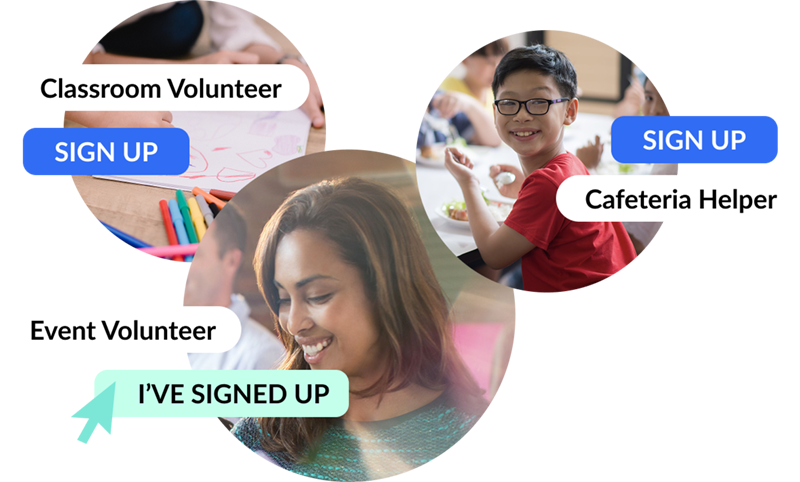
Select a school communication platform/app that includes volunteering component. Look for the following features:
- Parents can sign up without needing to register with a third-party system
- The system supports both one-time and recurring listings
- Time-based and asynchronous role-based volunteering options are available
- Required online forms are posted contextually
- The platform allows all stakeholders to create volunteer opportunities and coordinate the volunteer calendar (school leaders, teachers, PTA/PTO leads, family engagement specialists, school communication managers)
Provide Training for Ongoing Volunteers
For committed volunteer opportunities, a training may be required. For instance, if parents will be volunteering multiple times as a tutor or reading buddy, consider providing training. This way, parents can build the skills they will need ahead of time and feel confident in their role. Communicate both the requirements and the offered support when posting a volunteering opportunity.
Communicate the Requirements for Background Checks
Communicate clearly what the requirements, timelines and procedures are for background check submissions.
Communicate Expectations
Private and Charter schools may expect families to commit to an agreed number of volunteer hours. These requirements are best to communicate in a positive, community building light, highlighting the benefits of the opportunities. The communication style needs to be clear and concise to avoid misunderstanding on the rules and expectations on what constitutes as volunteering and how the hours need to be reported to the PTA/PTO or school.
Gather Feedback After Volunteering
Improve volunteer opportunities by following up with parent volunteers about their experiences. Check that family engagement assessment questions include questions to collect this feedback. Or provide a brief feedback form when parent submits their volunteer hours.
Practical Ideas for School Volunteering
The opportunities for parents to volunteer should be diverse. Some parents may be unable to take time off work to volunteer as a weekly reading buddy, but can help in other ways, like taking prep-work off of teachers’ metaphorical plates. Learn about how to improve event planning to strengthen parent engagement.
Mentoring Programs
Creating a strong, caring relationship with another adult can be pivotal for a young child’s life, and mentoring programs specifically have been shown to be effective in promoting academic success as well as positive self-esteem. Mentor-student activities can be as simple as setting out board games or sports equipment for the pairings to play with and bond over. Because this form of volunteer programming requires some additional screening for student safety, it might be helpful to partner with university volunteering groups or programs like Big Brothers Big Sisters of America to get started.
Classroom Volunteers
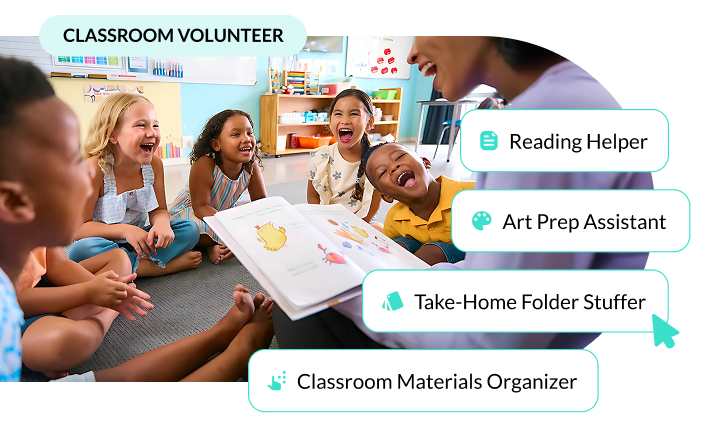
Volunteering in the classroom is rewarding for both parents and students. Students are eager to welcome visitors into the classroom. Based on parents’ interests, create a schedule that allows weekly volunteering opportunities in class. Use a paper-based or an online signup feature to maintain and manage schedules. Encourage one-time volunteering opportunities to recurring opportunities.
From copying worksheets to cutting out laminated cards, teachers have a lot of lesson preparation to do. Parents can take on some of this work, lightening the load for teachers.
A school may have more direct needs for a special assistant in a class. The volunteering may include contributing to a language class or helping with practical tasks such as organizing papers and filling folders.
Reading Buddies
New and struggling readers can benefit from one-on-one support. With little training, parents can help students get extra practice reading. Parents can coach students to read, boosting their fluency and reading comprehension.
Simply listening to students read is a great place to start. Parent volunteers can also talk students through reading comprehension questions. Working one-on-one can boost student confidence and motivate them.
Cultural Learning
Bring the world to the classroom with parent volunteers who can share about their cultures.
Many parents have traveled extensively, lived abroad, or moved to the USA from another country. These parents are an incredible knowledge resource and an inspiration for students to learn more about the cultures and countries these parents have first-hand knowledge of. If the class is studying a specific topic that aligns with parents’ cultural knowledge, invite parents to share their experiences. Or the class may schedule a special session to study a particular country and its culture.
Parent volunteers might prepare a short presentation including a traditional meal, traditional clothing, photos, a lesson on a foreign language, and more.
At all grade levels, taking time to learn about other cultures opens student’s minds. Along with a presentation, teachers can assign age-appropriate work such as writing a report or creating a poster. Older students might plan and film a podcast including an interview with the parent volunteer.
In one kindergarten classroom, the children enjoyed a lesson on Japanese calligraphy given by a mother of Japanese heritage. This lesson not only inspired children to learn more about Japan but also increased their interest in writing beautifully.
Math Tutoring
Parents can support children who need help in math. The teacher might train parents to work with children using a math game or math manipulatives. This can free up the teacher to work with other small groups. Many parents may also be skilled in math and can help older students work through equations or solve geometry problems.
Sharing Parent Expertise
Parents may be able to share lots of professional expertise in technology, history, science, and more. In the younger grades, parents can give presentations to children about a variety of topics. For example, a nurse might offer a presentation about hygiene and handwashing.
Career Speakers
In older grades, parents can provide insight into different careers. Students might ask questions about the realities of different professions such as nurses, doctors, radio hosts, engineers, and more! Invite a parent to talk about their profession and career. Before the meeting, students may prepare questions. There is nothing more inspiring than hearing directly from a parent.
Chaperones for Field Trips
Parent volunteers on field trips are essential, even for older grades. With an extra pair of eyes and hands, teachers can more easily handle unforeseen situations while away from school. Plus, chaperones can help make field trips more educational. Parents can help motivate students to ask questions and take notes while on field trips.
Support for Sports and Extracurricular Activities
Extracurricular activities like the soccer team, band, or chorus all involve various events. Parent volunteers can help plan, set up, and run events such as concerts and tournaments. Parents can help sell tickets and hand out programs. Additionally, parents can support teachers during the event to keep students organized backstage or while waiting for their game to begin.
PTAs and PTOs
Parent-Teacher Associations and Organizations provide an organized way for parents to be involved and help make decisions at the school. More importantly, through PTAs and PTOs, parents can support school needs. Volunteering can be organized through the PTO, creating an easy way for parents to get involved.
Teacher Appreciation Committees meet around a meaningful mission of organizing concrete ways to show teacher appreciation. The roles may include communicating the needs to parents and volunteering on particular tasks during allocated times.
Lunchroom Monitor / Cafeteria Volunteers
Many schools invite parents to volunteer in the lunchroom or school cafeteria. Online signup and scheduling are of great help. A parent can help coordinate students to their tables, help younger ones open hard-to-open packages, and help clean up. This volunteering work is concrete and highly appreciated in schools.
If your school connects with local non-profits, such as a Food Bank, to help distribute weekend meals for those in need, invite parents to help coordinate the efforts.
Multilingual Volunteers
Multilingual parents can be an incredible resource in providing administrative and translation services to the ELL community in the school.
Event Volunteers
The school’s special events call for parent volunteers. Halloween parties, Winter parties, Valentine’s Day parties, and Egg Hunts are familiar parties that need parents’ help to organize them. Parents may contribute time and supplies, and their presence will live up and connect the community.
PTA/PTO Initiated Fundraisers
Encourage parents to join the school’s Parent-Teacher Association (PTA) or Parent-Teacher Organization (PTO). Membership in a parent organization is a clear path to parent volunteering and participation. Schools rely on PTA/PTO fundraising. Parents can use their social media platforms to spread the word about fundraising events and extend their reach beyond the school’s circle. Participating in a fundraising event is a direct way to engage and give back.
Band or Marching Band Assistants
The music teacher or band lead can use a hand and help from a parent with a passion for music.
School Dismissal Assistants
Directing traffic and helping students navigate their way during afternoon school dismissal is an important volunteer position.
Media/Communications Volunteers
Parents may contribute their professional skills by taking on administrative tasks as community admins for social platforms, newsletter creators, or school news curators.
Men’s Groups
Consider hosting special social events for dads. Many schools recognize that men are significant in supporting a positive school culture. More than 5000 schools have joined a national The Dads of Great Students (Watch D.O.G.S) program that promotes positive male role models for the students.
School Beautification Committees

Interconnected with sharing special skills, parents may set an example of ecological awareness and caring for the grounds. They may organize events for various beautification projects such as a composting program, repairing and painting, setting up raised garden beds and planters, planting trees, setting up wildflower gardens, maintaining flower beds and public grounds, etc.
Parenting Support Groups
Parenting is not easy. Creating parenting workshops, themed lectures, and book clubs around parenting topics shows the ongoing school’s support for parents.
The Takeaway
A school represents a community and, as such, should have multiple interaction points and ways for parents to contribute, volunteer, and give back. Detailing volunteering opportunities with easy sign-ups, providing flexible schedules, and fostering an open-door policy with an understanding of each home’s unique circumstances can increase parent engagement.
Educating students and creating a positive school culture takes many hands. With parents helping, the workload is lighter for all. Plus, students flourish when their parents are active and involved. How will you use parent volunteers at your school?
Resources
The Importance of Parents Volunteering at their Children’s School. By Adam S. Weissman, Ph.D – CFI & WCF President and Chief Psychologist. Link
School-Based Mentoring Programs: Using Volunteers to Improve the Academic Outcomes of Underserved Students Link (PDF)
Positive Relationships Between Parent School Involvement and Public School Inner-City Preschoolers’ Development and Academic Performance, by Rebecca A. Marcon Link
The Role of Protective Factors in Supporting the Academic Achievement of Poor African American Students During the Middle School Transition, April 2000, Journal of Youth and Adolescence 29(2) Link (PDF)

- A Practical Guide to High School Parent Engagement - April 28, 2026
- How Schools Can Communicate the Value of Social-Emotional Learning (SEL) to Parents - March 10, 2026
- How to Talk to Parents About Student Behavior in Pre-K and K - February 28, 2026