


Introduction
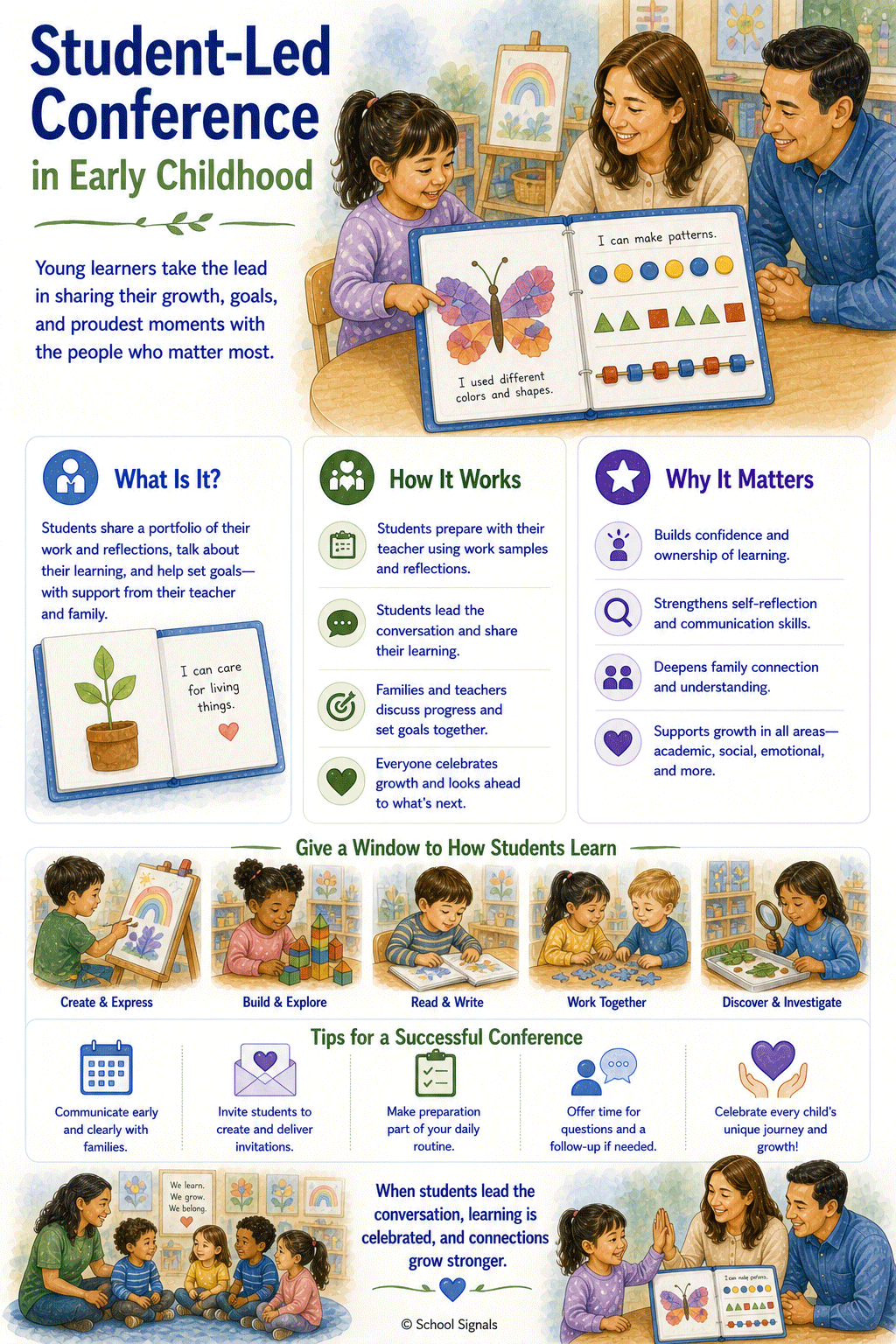
A new parent-teacher conference style has emerged in the past few years: student-led conferences. While these conferences have proven to be highly effective, it’s not a style that every school or family is familiar with. We’re here to bridge that gap with an introduction to student-led conferences in early childhood education and how they benefit everyone involved.

What Is a Student-led Conference in Early Childhood Level?
Student-led conferences provide every student with an opportunity to shine.
A student-led conference in early childhood education is one in which young students take the reins (with a little support, of course). In this conference style, young students and teachers first collaborate to prepare a portfolio of work samples and reflections on their learning, which the students then share with their families.
The presentation process itself is meant to be conversational. Family members can ask students questions and make (positive!) comments on their work. Students explain how their work demonstrates their understanding of concepts or skills. Toward the end of the conference, students, family members, and teachers discuss students’ progress so far during the school year and future goals. Students might come prepared with a few goals they’ve identified or invite their families to help co-create goals based on the progress they’ve seen.
Finally, after the student-led portion of the conference, family members and teachers can chat about any remaining questions or concerns. Sometimes, a teacher may set a separate time to talk without the student’s presence or send home assessment data for the parent to review independently.
The Preparation for an Early Childhood Student-Led Conference
In early childhood grades, preparation revolves around simple portfolios, play-based tasks, and hands-on examples from the classroom routine. A page of a focused portfolio often include a photograph or work sample with a brief description of what it demonstrates about the student’s development and the particular standard it addresses. These portfolio items should not only be limited to academics but also highlight how students have grown in their social-emotional and motor skills.

Incorporate Conference Prep Into Your Daily Routine
As an early elementary school teacher, I know that you may be thinking, “How in the world can I fit all of this into my teaching day?” Preparing for a conference doesn’t have to be an extra task to tack on–here are a few suggestions for how to incorporate conference prep into your daily routine:
- Write reflection pieces as a morning journal
- Practice conversation skills with a partner at the Morning Meeting
- Assemble portfolios during quiet time
- Practice at the centers they will be sharing with parents during regular rotations
- Select writing samples and practice reading them aloud during small groups
- Set out parent invitation supplies in your writing center
- Share portfolios with partners during Book Buddies
Things become even simpler if you can get a whole group of teachers, or even your whole school, to buy into the student-led conference model. Administrators will know that this prep work is vital to your classroom learning routine, and teachers can band together to prepare. Staff meetings can become opportunities to share assessments and portfolio contents across classrooms. Hopefully, your team will be laying the groundwork for this process to continue for years to come!
How Do You Get Parent Buy-in?
Parents might initially balk at the idea of a student-led conference, especially if they’re unfamiliar with the model.
School leaders should explain the model to parents school-wide. Teachers may send home a flyer or post information to their Classroom communication hub few weeks before conferences is a great way to start explaining the benefits to parents.
The communication may be as simple as a bullet-point list of the basic ingredients of a student-led conference.
Unified school communication platforms and apps should include a parent-teacher conference sign-up feature. For instance, in School Signals, administrators and teachers can create a conference sign-up. You can integrate a pre-conference online form for parents to fill out during the sign-up with topics they’d like to discuss on conference night. If parents still express concern, it may be best to give them the option of scheduling a follow-up conversation by phone or in person.
Having students write and deliver invitations to parents can also communicate how much work their children have put into this.
One of the most important things about student-led conferences is ensuring that parents attend. It can be heartbreaking for a child to prepare so thoroughly and not be able to share their work with the people they love! The best way to achieve buy-in is to communicate clearly and to do it early.
What Are the Benefits of a Early Childhood Student-led Conference?
The student-led conference style has gained popularity in the past few years because the benefits are clear–particularly to teachers.
Increases Young Students’ Ownership Over Their Learning
Early childhood student-led conferences provide every student with an opportunity to shine. Students get to choose the work that they are most proud of to include in their portfolios, whether that’s an incredible piece of artwork or a well-written journal.
Teachers also report that student accountability and ownership over their learning process increases exponentially when they have the opportunity to lead their conferences. Knowing that they will have to be the ones to share their progress with their families can promote engagement and improve attentiveness to their work.
Increases Young Students’ Skills in Self-reflection
Drawing a picture to explain a story or demonstrating a new skill is actively showing what students know rather than trying to perform. These moments build confidence as they allow young students to communicate understanding in ways that feel natural and empowering,
Increases Young Students’ Confidence

Student-led conferences in early childhood also develop children’s real-world abilities. Throughout the process, they build skills in self-evaluation and self-reflection, organization, persuasive and expository writing, and speaking and listening. These conferences also promote goal-setting, which is a crucial skill for the rest of their school years into adulthood.
Provides a Window to Parents on How Students Learn
Families and teachers alike can also get a better picture of students’ actual understanding through the student-led conference model.
Instead of just looking at assessment data, parents get an authentic glimpse into their children’s knowledge and how they apply it. In early childhood classrooms, in particular, teachers can more clearly communicate how students demonstrate learning through play through photographs and portfolio artifacts.
Increases Parents’ Involvement in Their Children’s Education

Finally, student-led conferences are a space for children and their loved ones to share focused, quality time with one another. It’s an event that can and should build students’ self-esteem and confidence, especially when family members express words of affirmation and encouragement along the way. Parental involvement is a key factor in students’ growth and development, and student-led conferences can be a catalyst for families’ participation in their children’s education.
A Look Inside of Early Childhood Student-Led Conference
Preparing for the Conference
During the week leading up to Show What You Know Night, my Pre-K class was abuzz with anticipation. We had been adding to students’ portfolios all year, including everything from special art projects, to photos of the children at play, to weekly journal pages. During small groups, I met with 2 to 3 students and let them mark their favorite pages with sticky notes; then, they practiced sharing those pieces with one another.
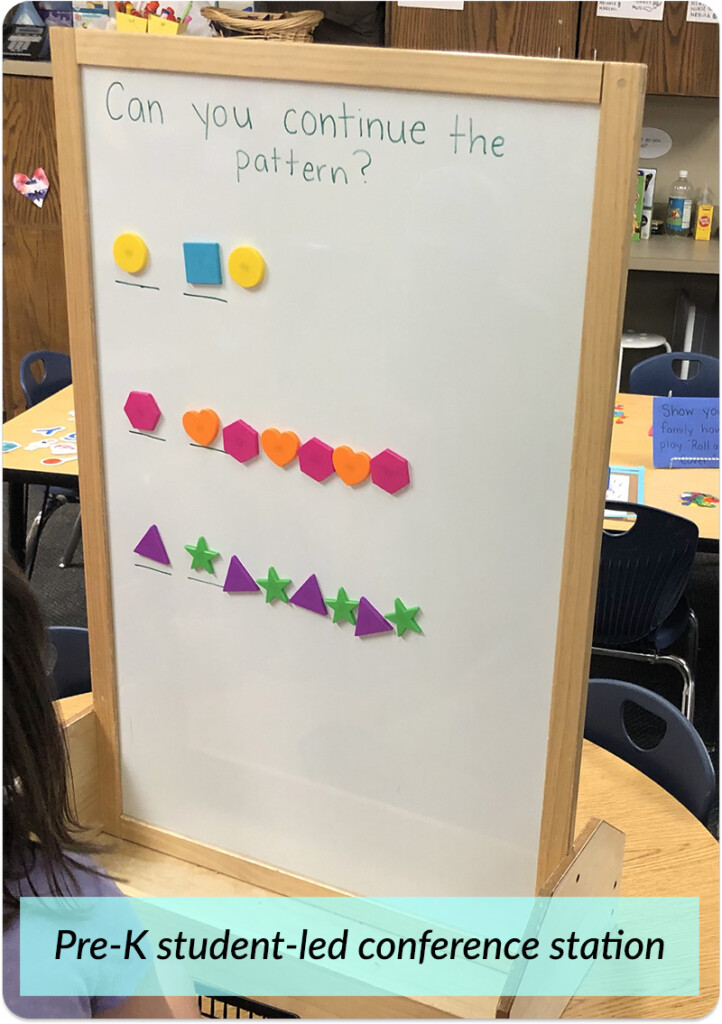
My teaching assistant met with her small groups and helped students fill out self-evaluation pages, where they colored in emojis to show how they felt about aspects of school. At the same time, the other students moved through learning centers and practiced the skills they would later demonstrate to their parents. For my early elementary little ones, this looked like making patterns with magnets, matching alphabet letters, and building their names with manipulatives.
In our art center, we decorated a huge sign together to welcome families to conferences and hung it outside our door.
Meeting with the Families
I handed their parents a game board of all the tasks to complete with their students during conferences.
That evening, young learners and their grown-ups started trickling in. When they entered, I handed their parents a game board of all the tasks to complete with their students during conferences. As they completed each item, they marked it off on their board with a sticker. Early elemntary students sat down to share their special portfolios with their adults, who were so thrilled to see all of the progress in their drawing and writing throughout the year. Students then took them through the centers that had practiced that week and told them about their favorite place to play during free-choice time. Finally, they introduced their family members to our class pet, Dragon, and told them a few facts they’d learned about our leopard gecko.
Before the families left, I briefly chatted with each parent to check-in. Overwhelmingly, they were so glad to have had the opportunity to see their students’ learning in action. I gave each of them a brief overview of some assessment data and then sent them home with a packet of more specific information about the letters, numbers, and shapes that their child could identify. Each early childhood parent also left armed with some handouts with ideas for supporting their students’ learning at home. The children, for all their hard work, traded in their game boards for a yummy treat.
Following Up After the Early Childhood Student-Led Conference
In my experience, student-led conferences don’t end when families leave the classroom. It’s important for teachers to follow up intentionally after the conference, even when families don’t reach out with questions right away. In early childhood, learning is developmental and ongoing, and families benefit from continued communication that helps them make sense of what they observed during the conference.
After conferences, I’ve found it helpful to reach out with a brief follow-up—whether that means summarizing goals that came up, sharing additional context about a child’s work, or offering space for families to ask questions privately. These small, proactive steps help build trust and family partnerships.
For educators thinking about how to structure this next step, this guide on how to follow up after a parent-teacher conference offers practical ideas for keeping communication open after conferences conclude.
Collecting Parent Feedback Through a Reflection Form
Another simple but valuable step after student-led conferences is gathering parent feedback while the experience is still fresh.
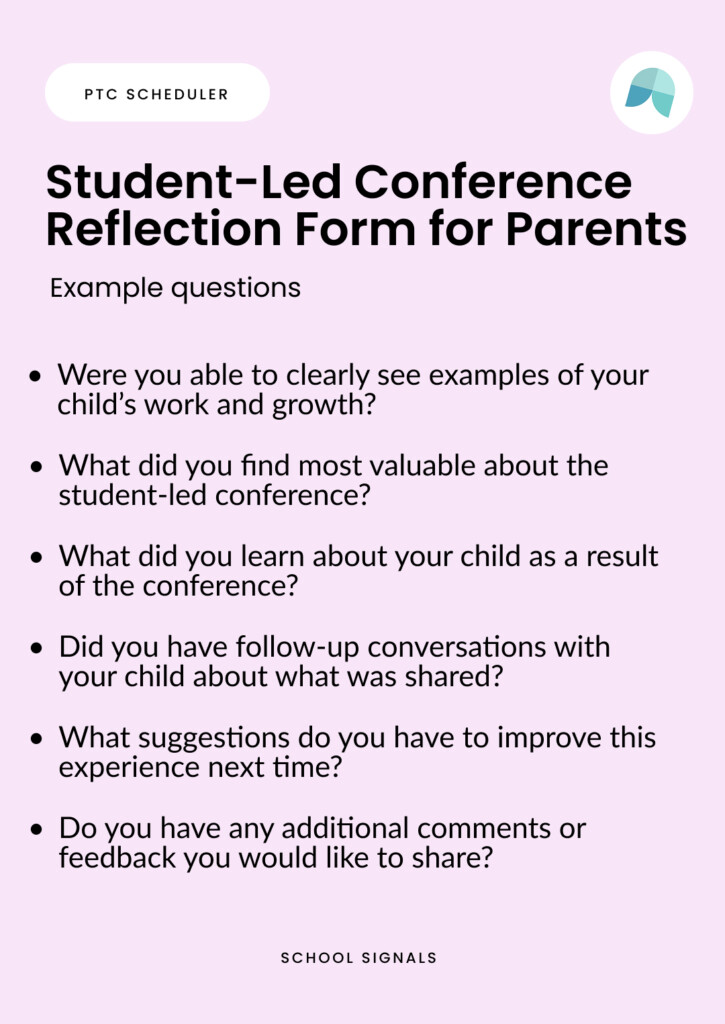
A short reflection form gives families an opportunity to share what stood out, what they learned about their child, and how the experience could be improved. For schools, this feedback provides insight into how well the conference format is working and where adjustments may be needed.
In early childhood settings, where much of the learning is observational and developmental, parent reflections can also help teachers understand what families are noticing—and what may need further explanation or support.
A reflection form might include questions such as:
- What did you find most valuable about the student-led conference?
- Were you able to clearly see examples of your child’s work and growth
- What did you learn about your child as a result of the conference?
- Did the conference help you better understand how your child is learning at school?
- Did you have follow-up conversations with your child about what was shared?
- What suggestions do you have to improve this experience next time?
- Do you have any additional comments or feedback you would like to share?
Parents’ responses can guide future conference planning while also reassuring families that their voice is an important part of the process.
Teacher Observations After the Student-led Conference
After conferences, I noticed that my students seemed more intrinsically motivated to learn.
After the conferences, I noticed that my students seemed more intrinsically motivated to learn. I was pleasantly surprised by my students’ devotion to this whole process. It was evident that they took their work incredibly seriously and had great pride in their accomplishments. Ultimately, I sent this class off to kindergarten with loads of confidence, much of which I attribute to this general enthusiasm for learning they developed from student-led conferences.

Student-Led Conferences in Early Childhood: FAQs
Are all early childhood students capable of participating in student-led conferences?
Yes! All children are capable of selecting their “best” work and sharing why it is meaningful to them with their families, especially with a bit of practice and support. Even in Pre-K, students can demonstrate their learning through student-led conferences by sharing daily center activities or identifying letters, numbers, and sight words.
How do teachers and early elementary students prepare for a student-led conference?
- Teachers and students build a simple portfolio together.
- Teachers help students choose work that shows learning progress.
- Students include work samples, photos, and short reflections.
- Teachers integrate conference preparation into daily classroom routines.
- Students talk about their work during journaling and group time.
- Students rehearse activities they will demonstrate to families.
- Teachers coach students on how to explain what they learned and why it matters.
- Students share their portfolios with classmates before the conference.
- Students create a welcome sign or simple display to greet their families.
What reasons or positive impact should schools highlight to parents about the early childhood student-led conference model?
Schools should emphasize that parents gain a more complete picture of what their child knows when they observe learning in action. Compared to pencil-and-paper assessments, watching children demonstrate skills through play provides a richer, more well-rounded understanding of their learning.
Is the student-led conference model included in early childhood teacher education?
It depends on the program. While some early childhood education programs still emphasize traditional assessments and conferences, student-led conferences have been used for decades. Many early childhood programs highlight them as a more developmentally appropriate approach for the early grades.
How does the early childhood student-led conference model strengthen school-family connections?
The early childhood student-led conference model helps teachers communicate the “why” behind play-based teaching and learning. When families observe learning through play, they are more likely to understand and support developmentally appropriate instructional practices. Parents are also more likely to participate when their child is actively part of the event.
What are some key activities to do in a Pre-K student-led conference?
In a Pre-K student-led conference, some key activities often include:
- Reading their parent a typical morning message
- Demonstrating a common classroom center
- Sharing favorites in the classroom
- Engaging in a collaborative art project with family members
- Sharing a portfolio or work samples
- Sharing information from self-assessments
- Goal-setting for the rest of the year
Activities vary based on student age, classroom structure, and preparation time.
How many minutes should a Pre-K or Kindergarten student-led conference last?
An early childhood student-led conference should last about 30–45 minutes. This time allows families enough time to engage with learning activities and discuss portfolios or work samples without overwhelming young students or rushing the experience.
How should teachers follow up after the early childhood student-led conference?
Teachers should communicate their willingness to follow up after the conference by email, phone, or private message if families have additional questions. Following through on commitments and collecting feedback with a Student-Led Conferences Parent Reflection Form can help build trust and ensure families feel informed and supported.
What if the student refuses to talk or participate during the PreK student-led conference?
To build confidence, practice the tasks the Pre-K student will demonstrate ahead of time so that they know what to do and have experience doing it. Model for parents how to ask an open-ended question with a positive, supportive tone or how to work alongside their child in a center to help scaffold the activity.
Resources
Focused Portfolios: A Complete Assessment for the Young Child by Gaye Gronlund and Bev Engel – A book describing how to assemble portfolios to document students’ growth and development.
Having Students Lead Parent Conferences – An overview of the student-led conference process from Edutopia.
Implementing Student-Led Conferences in Your School – A presentation for sharing this conference style with school stakeholders.
Washington Heights Expeditionary Learning Learning School Student-Led Conference Faculty Handbook – A comprehensive handbook with checklists, scripts, and an overview of each person’s role in a student-led conference.
Wildwood World Magnet School Portfolio Assessment Manual – A manual for creating student portfolios, including an example student reflection form.


- A Practical Guide to High School Parent Engagement - April 28, 2026
- How Schools Can Communicate the Value of Social-Emotional Learning (SEL) to Parents - March 10, 2026
- How to Talk to Parents About Student Behavior in Pre-K and K - February 28, 2026