

SEL is a new subject, and parents may have concerns. This post examines the sources of these concerns and how school leaders and SEL teachers can address them. Communicating clearly with parents about the benefits of SEL, hosting a hands-on, low-barrier SEL night, gathering parent feedback, and providing materials and consistent updates on what students are learning are ways to address concerns and secure parent buy-in.
Introduction
When your school is implementing an SEL program, you have to get parents on board so that they can support the learning at home, and be aligned with what is being taught at school.
The Collaborative for Academic, Social, and Emotional Learning (CASEL), a nonprofit organization that focuses on advancing social-emotional learning (SEL) in schools, emphasizes that family partnership is a core part of SEL implementation.
In its district implementation rubric on how to evaluate SEL programs, CASEL emphasizes that districts should create opportunities for families to collaborate and participate in SEL activities. Families should be also given opportunities to provide feedback (preferences and needs) on how the SEL is implemented at school. These data, CASEL states, are used to improve family partnership strategies.
This post outlines ways school leaders and teachers can communicate the value of SEL to gain parents’ buy-in. We provide clear guidance on how to strengthen SEL acceptance in schools and how to collect parent feedback, and align with CASEL’s recommendations.

What Prevents Parents’ Buy-In to Social-Emotional Learning
Effective implementation of a social-emotional learning curriculum relies on collective understanding and trust between parents and schools. But parents may express hesitations or question why SEL is part of school’s curriculum:
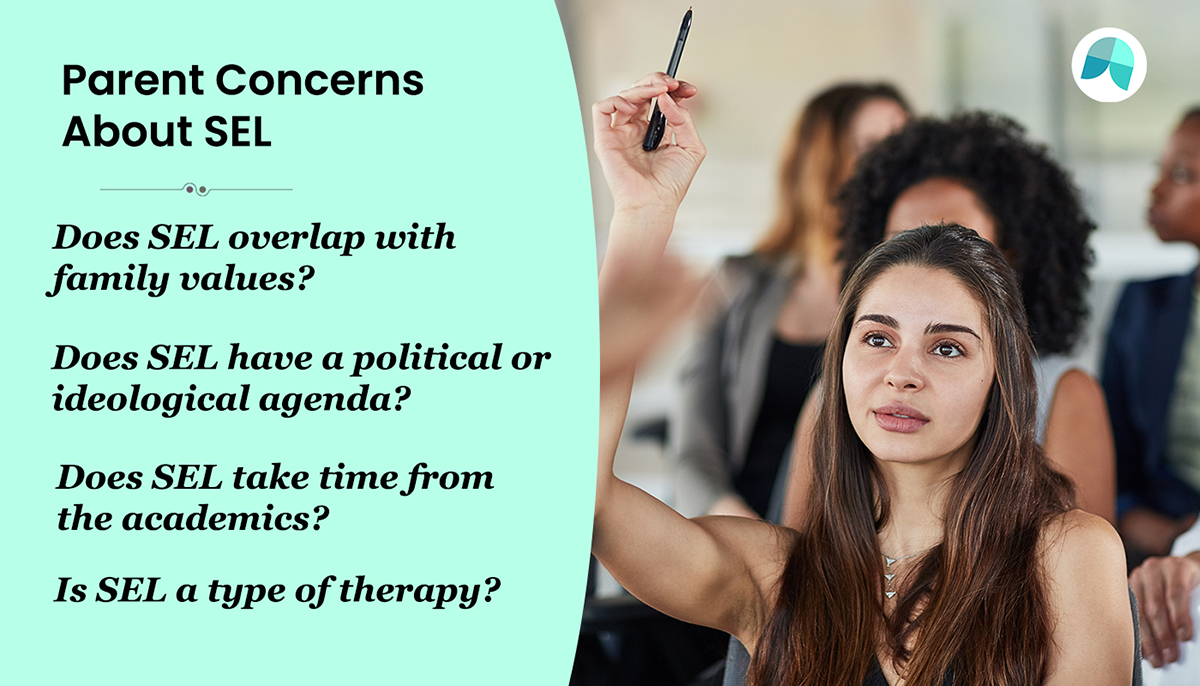
- Parents may feel reluctant to “turn over” social-emotional learning to their child’s school, confusing it with morals or values that are deeply personal and vary from family to family.
- Parents may also be vocal about the perception that social-emotional learning reflects a political or ideological worldview rather than focusing on children’s development. These concerns sometimes arise when families encounter debates about SEL in public discussions or in social media.
- And, many parents may be concerned about social-emotional learning taking up academic time in the classroom.
- Parents may also feel that SEL is a type of therapy and intrusive as such.
Lack of information and communication can breed distrust between parents and schools, especially when parents arrive with misconceptions about what social-emotional learning actually is. Growing parent buy-in for social-emotional learning initiatives takes long-term communication, thoughtful planning, and reflective practice. Communicating what social-emotional learning looks and sounds like to parents is crucial in gaining parent buy-in and trust.
How to Build Parent Buy-In for SEL
Explain the Research-backed Benefits of SEL
Your school is likely choosing a strong SEL program to support academic learning, strengthen the school culture, and promote positive peer interactions. Communicate to families the reasons behind the SEL curriculum so that they can be part of this reasoning.
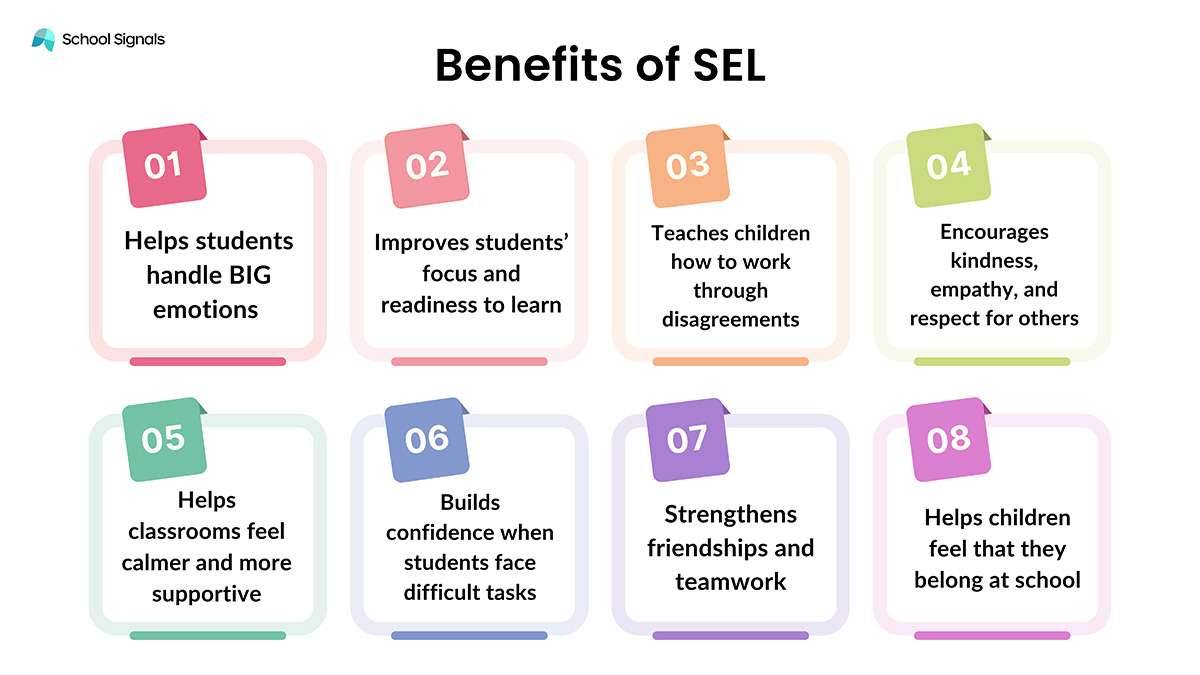
It’s important to explain why your school has chosen SEL for its curriculum. Adopting SEL stems from practical challenges that affect both classroom learning and student well-being. Articulate both the current “problem” and research-backed ways in which SEL helps address it. Educators frequently point to several benefits of SEL:
- SEL teaches how to manage big emotions: Students getting tangled and frustrated with their big emotions, unable to cope, is a hindrance to academic learning.
- With a batter handle on big emotions and study skills, SEL supports better academic performance.
- SEL reduces classroom disruptions: Classroom behavior affects all students. Focusing on conflict resolution skills, cooperation, and teamwork creates a calmer classroom environment.
- SEL supports academic learning: SEL teaches skills such as perseverance, self-management, and responsible decision-making that are all needed to develop grit and accountability over one’s academic work.
- SEL improves peer relationships: SEL helps students practice empathy, communication, and collaboration; these are important components in bullying prevention.
- SEL helps to transform school cultures: SEL teaches students to embrace differences as a strength of a community.
- SEL reduces absenteeism: SEL has been identified as an evidence-based way to reduce absenteeism.
- SEL prepares students for life beyond school: SEL teaches skills such as teamwork, emotional awareness, and responsible decision-making that are important for future work and community life.
Address parent concerns in the light of research-backed findings. For instance, first-time elementary school parents may be anxious about their children’s learning and eager for the academics to begin. If parents express hesitations about delaying academic learning, provide support to your educators by reinforcing the idea that students who develop strong social-emotional skills such as self-regulation, responsible decision-making, and perseverance, the more their children will be able to approach academics with confidence and focus. And children with strong prosocial skills will be less distracted by peer conflicts and more engaged in learning.
 Use Clear and Consistent Language
The Collaborative for Academic, Social and Emotional Learning (CASEL) defines social-emotional learning as ”process through which all young people and adults acquire and apply the knowledge, skills, and attitudes to develop healthy identities, manage emotions and achieve personal and collective goals, feel and show empathy for others, establish and maintain supportive relationships, and make responsible and caring decisions.”
While this definition may be a great starting point for school leaders, it can feel overwhelming or overly academic for busy families. That’s why it’s important to translate these ideas into clear, everyday language that parents can easily understand and relate to.
In your back-to-school team meetings, it’s essential to work with your educator team to develop a common language surrounding social-emotional learning. Social-emotional skills will be revisited in each grade level and developed over time, so consistent use of concepts across the elementary school years makes the curriculum more cohesive for students and families. When the concepts differ, explain to parents how the same skills are taught developmentally-appropriately in each grade.
Create a Communication Plan for the SEL Program
Create a communication plan that lists all family engagement opportunities that the district/school will provide for families during the school year. Include:
- Who is responsible for the communication
- What will be communicated
- In which channels the communication takes place, and
- When the communication and SEL event takes place
- Note also why the communication is important; what is the wanted outcome.
You can create a separate SEL communication plan or include the SEL as a component to your school-wide communication plan. You can use digital planning tools, or create a Google sheet/Excel file in the simple table format.
Include SEL to Your School’s Vision Statement
Your school’s vision statement is a great place to highlight a strong emphasis on social-emotional values, as it shows families that the selected SEL program or curriculum is the result of intentional planning and preparation. An example of SEL included in the school’s vision statement comes from the Lowell School, a progressive co-ed pre-K through 8th-grade school in Washington, DC. The school states as a part of its vision statement, “Lowell students thrive because we are committed to progressive pedagogy, where our multidisciplinary academic program and our social-emotional curriculum are inextricably linked.” The Ideal School of Manhattan, New York, NY, states in its vision statement, “Our curriculum actively promotes inclusion, teaching students to recognize bias, resolve conflicts, and collaborate effectively.”
Share Practical Information About Your SEL Approach
- Provide families with a clear, easy-to-read definition of SEL that your school subscribes to
- Provide interested families with the resources to learn more about SEL, such as print-outs or a link to the CASE SEL Framework.
- Provide parents with the grade-level-specific SEL curriculum that focuses on the outcomes of learning.
- Make sure ESL families understand the translated information.
Use Parent Surveys to Understand Perception and Build Trust
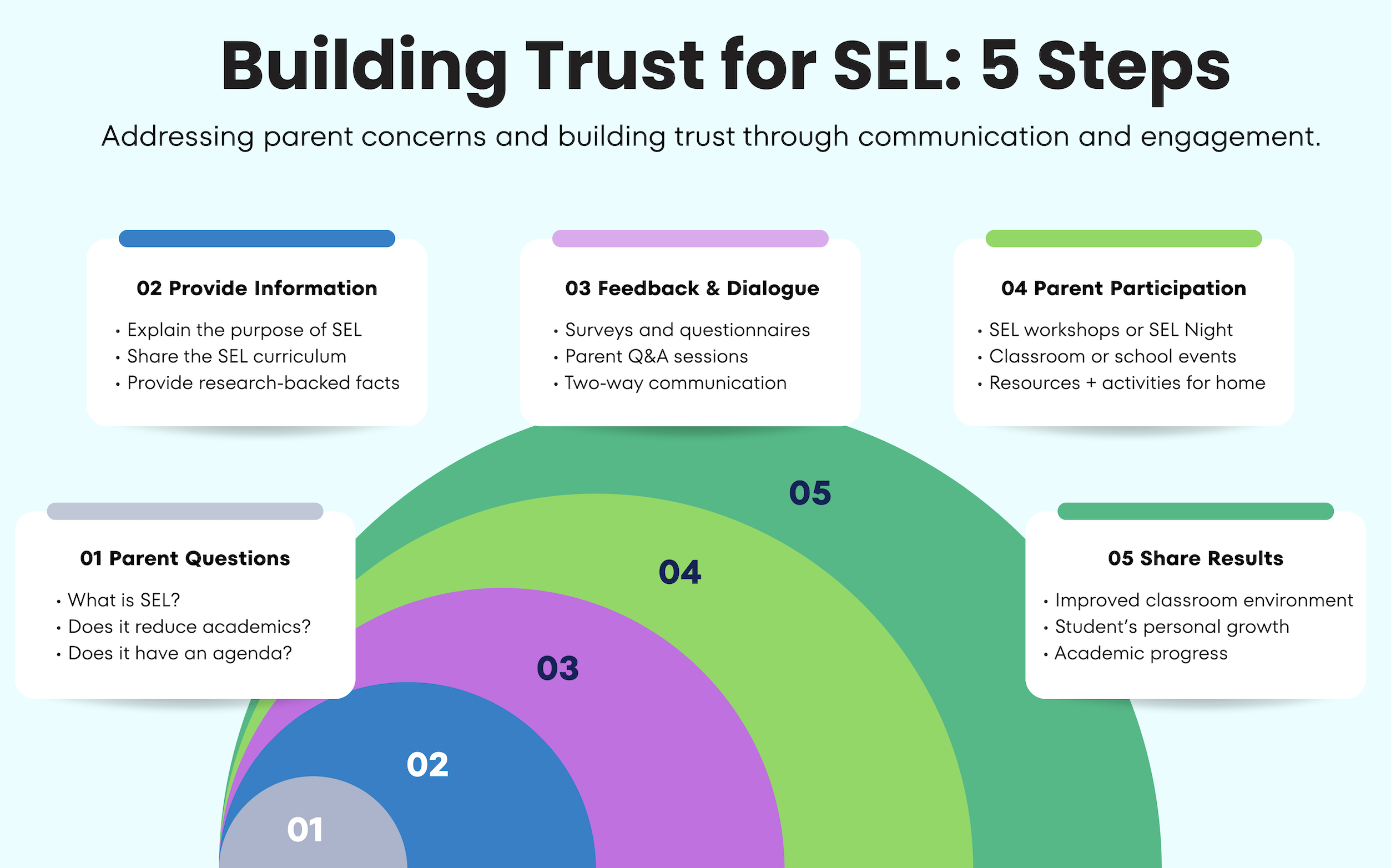
Did parents read the materials provided? Do they understand the curriculum? An initial survey of parents can help set the tone for your social-emotional learning initiatives. By sending a survey, you make it clear that you want to connect with parents about social-emotional learning, listen to their concerns, value their input, and thereby build trust. Gather information on families’ initial perceptions of social-emotional learning. Design a survey to include- A self-rating of their current knowledge,
- Statements about SEL that parents label as true/false to measure their knowledge
- Questions or concerns parents have about SEL.
Align Communication With Specific SEL Topics and Themes
Share upcoming themes and resources in classroom newsletters and or internal classroom communication posts. For instance, if you’ve decided to focus on a certain skill each month, you announce it with your parent communication tool, incorporate role-playing skits into your school assemblies that address the skill, and send home resources for practicing the skill at home. Provide parents with educational resources, such as NAEYC’s Message in a Backpack, to help families support continued growth at home in developmentally appropriate ways. As learning moves forward, provide parents with practical resources on each topic.
Host a SEL Workshop for Parents
Offering a social-emotional learning workshop can help maintain parent buy-in. Continuing to reiterate the importance of social-emotional learning keeps it at the forefront of everyone’s minds and can communicate a welcoming attitude towards parent questions and discussion. In your workshop planning, you can specifically target the areas that parents had the most questions about in your back-to-school surveys. In Valleydale Elementary, Azusa, CA, parents gathered for the Parent SEL Monthly Workshop Series, and learned about self-awareness to support their children’s social-emotional growth. Early childhood programs and Head Start Centers also use a framework such as the Conscious Discipline, developed by Dr. Becky Bailey. Because the model begins with adult behavior and emphasizes adult self-regulation and relationship-based discipline, it is fitting for parent workshops. For instance, in Anchorage, AK, Kids’ Corp created a workshop for families to learn about the approach. Parents received a shoutout in Facebook, “Congratulations to our parents who finished the first round of the Conscious Discipline Parenting group of the school year! We had an amazing time learning and growing with you!”
Invite Families to a SEL Family Night
Where SEL workshops may be more lesson-style sessions for parents, SEL Family Nights are child-friendly events for the whole family. The goal of an SEL night is to provide easy, low-barrier hands-on opportunities for families get to know SEL themes and practice mindfulness together. The night might include:- Practicing mindfulness with guided breathing technique exercises such as “balloon breathing” or “5-finger breathing.”
- Together creating a craft that helps to regulate emotions such as a fidget toy or a stress ball.
- Reading SEL books together.
- Playing an SEL themed board game.
- Participating to a team-building SEL game activity such as ‘Red Light, Green Light’, ‘Emotions Mixup, or Emotional Chains.
Integrate SEL Into Curriculum Night
You can also incorporate a smaller social-emotional skills workshop into your curriculum night. During the workshop, invite families to explore any resources from your chosen social-emotional learning curriculum. Dive deeper into what students are learning by having educators lead a mock social circle or inviting parents to share in an art project to explore a feeling or idea. Create a table display of the different books that teachers use to introduce social-emotional concepts to students. Participating in these activities can give parents a clearer perspective on the types of hands-on learning their children are engaging in. In early childhood, this interactive workshop is also an opportunity to share feeling charts, videos, examples of breathing exercises, examples of a cozy corner, and other resources that parents can use at home to support their early learners.
Maintain Ongoing Two-Way Communication
As families gain a better understanding of the social-emotional learning curriculum their children are receiving, keep buy-in going. Many social-emotional learning curricula include ready-made parent letters that can be shared via school communication tools. Encourage parents to ask questions and add comments that you can share with the community.
Incorporate SEL Into Parent-Teacher Conferences
Encourage educators to emphasize children’s strengths and areas to grow in social-emotional learning during parent-teacher conferences. Invite parents to share what they are seeing at home or in outside activities–many times, in new environments, children will deploy a different set of skills or needs.
Invite Parent Participation Through Classroom Involvement
Once parents are more comfortable with the social-emotional learning curriculum, invite them to be a part of it! In early childhood, some easy ways for parents to be involved in their child’s classroom include reading aloud to the students or leading art lessons. Continuing to involve parents and keep classroom doors open for volunteer opportunities builds trust. And, when other parents see their peers getting involved, buy-in naturally follows.
Evaluate Progress Through End-of-Year Parent Feedback Survey
It’s helpful to bookend the school year with a survey gauging parents’ perceptions of social-emotional learning after a year of experience with the curriculum. This second survey will help your education team consider the effectiveness of your communication, the workshop, and general parent education on social-emotional learning initiatives. Your team can review results for each grade level, enabling vertical planning to deepen parent understanding and buy-in as their students progress from the early childhood years to later elementary classrooms.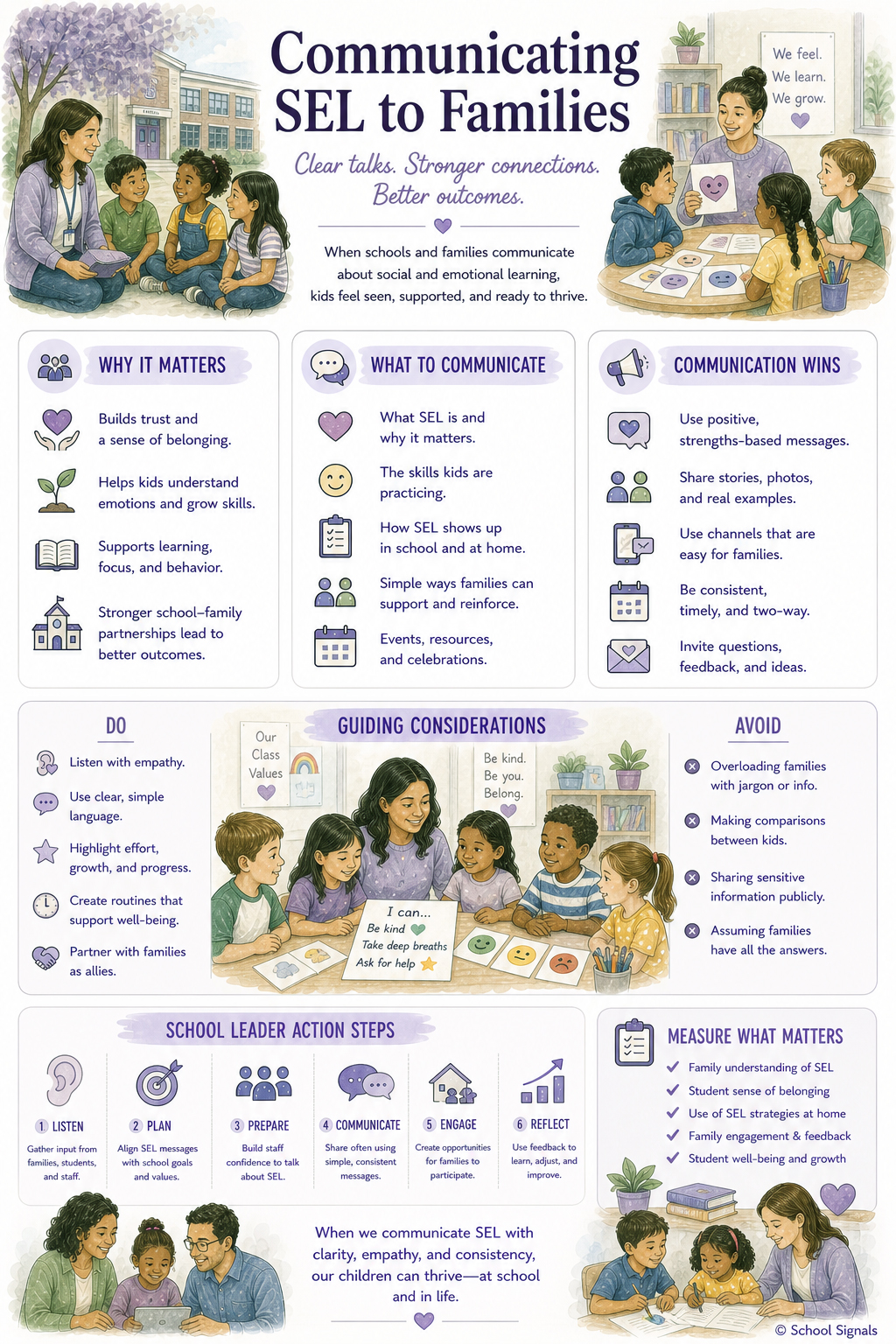
Conclusion
When schools involve parents in social-emotional initiatives from the very start, trust and buy-in grow. Early and consistent communication, targeted workshops, and inviting parents to contribute can demystify social-emotional learning for parents and others unfamiliar with it.
Questions School Leaders and Educators Have About SEL
School leaders want to know how SEL can reduce behavioral issues, build character, and align with the school’s vision. Teachers may have questions about how to select and implement SEL in their classroom. Below is a quick checklist for answers.
What Topics Belong to Social-Emotional Learning?
Social-emotional learning is commonly organized into five core areas (often referred to as the CASEL 5):
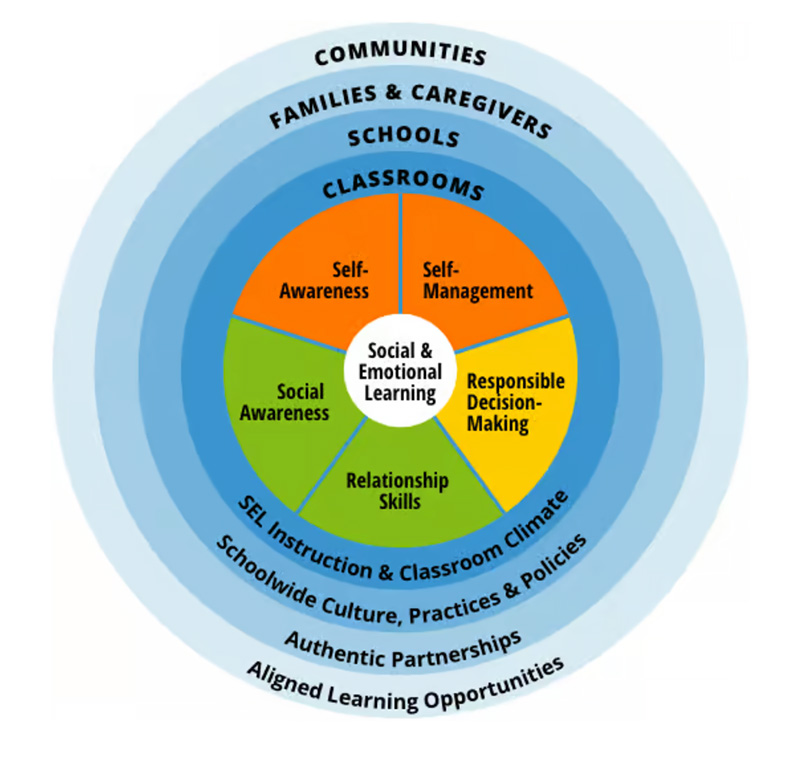
1. Self-awareness – understanding one’s emotions and identity
2. Self-management – regulating emotions and working toward goals
3. Social awareness – understanding others and showing empathy
4. Relationship skills – building and maintaining healthy relationships
5. Responsible decision-making – making thoughtful, ethical choices
Who Benefits from Social-emotional Learning, and How?
- Students: SEL programs not only improve children’s academic achievement by up to 11%, but also pay dividends, creating more understanding, empathetic, self-aware members of our communities.
- Educators: Social-emotional learning improves educators’ general well-being. Teachers who implement SEL in their classrooms report lower job-related anxiety, stronger relationships with their students, and greater job satisfaction.
- Families benefit from integrating SEL topics into their home environment and from creating mindfulness around the topics covered in SEL.
- School Leaders: Social and emotional learning fosters self-reflection and empathy, and thereby can help build inclusive school cultures that recognize the strengths of all students.
Is SEL Research-Backed?
A growing academic literature has linked SEL as a method to improve behavioral issues and be a preventive approach. Specifically, Learning Policy Institute in its 2023 report, Evidence for Social and Emotional Learning in Schools, summarizes “12 independent meta-analyses covering hundreds of studies of school-based SEL programs”, that emphasizing the following benefits:
- promotes the development of social and emotional competencies.
- facilitates positive, prosocial behaviors and positive relationships with others.
- reduces disruptive behavior problems and emotional distress.
- increases students’ engagement in learning
Many SEL curriculums state that they are evidence-based which means that the company has conducted their own research on the effectiveness of their programs.
What Does SEL Look Like in the Classroom?
Social-emotional programs use teacher-led activities to help students learn new emotional vocabulary and practice SEL skills.
- Teach children a specific strategy for emotional regulation, such as counting to ten or a breathing technique.
- Utilize targeted read-alouds to help children build a theory of mind; the concept that others may have experiences, beliefs, and desires that differ from their own.
- Teach coping through modeling, helping children use appropriate words and strategies to address issues such as sharing, peer conflict, embarrassment, and disappointment.
How Do Leaders or Teachers Choose an SEL Program?
Teachers often consider several practical factors:
- alignment with CASEL competencies
- grade-level fit for their students
- lesson length and classroom time requirements
- training requirements for teachers
- district approval and available funding
These factors often determine whether a program is realistic for a school to adopt.
What are the Popular Social-Emotional Learning Programs Used in Schools?
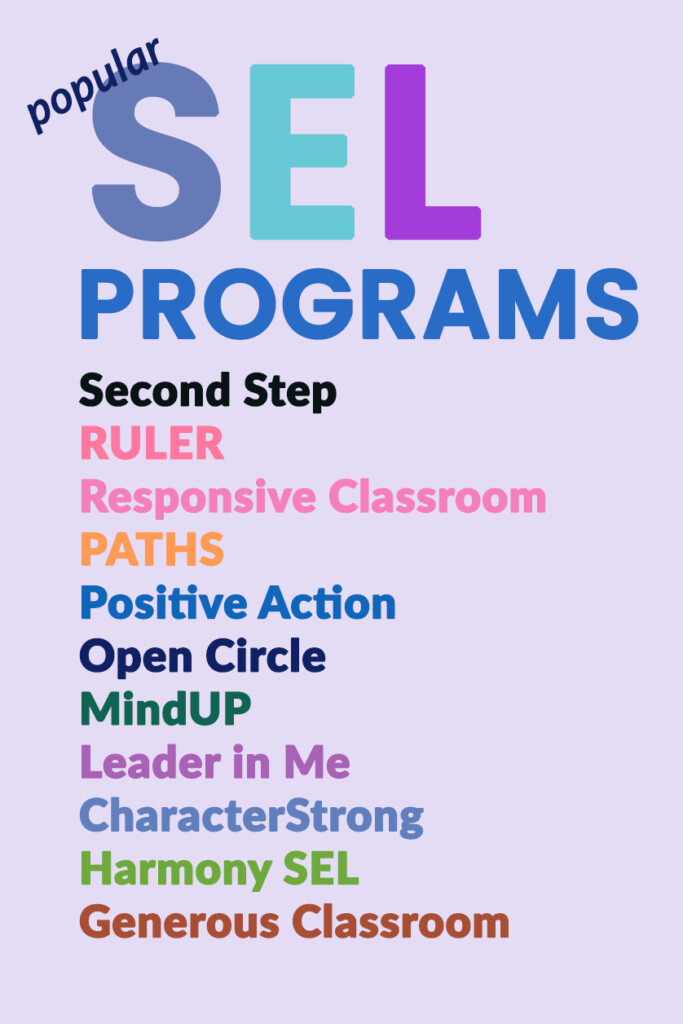
1. Second Step
Focus: Emotion management, empathy, and problem solving
Second Step is a structured lesson-based SEL curriculum used in many elementary and middle school classrooms. Second Step was developed by the nonprofit Committee for Children, an organization focused on child development and bullying prevention. The program has been studied in multiple evaluations and is recognized by the Collaborative for Academic, Social, and Emotional Learning (CASEL) as a SELect program, meaning it meets standards for evidence-based SEL curricula.
Example districts/schools that use Second Step: Los Angeles Unified School District (LAUSD); Sue E. Rattan Elementary in Anna, TX; Balmoral Elementary School in Crete, IL
2. RULER
Focus: Emotional intelligence and emotional vocabulary
RULER is an evidence-based, school-wide framework developed by the Yale Center for Emotional Intelligence that integrates SEL into school culture.
Example districts/schools that use RULER: Newburgh Enlarged City School District
3. Responsive Classroom
Focus: SEL integrated with teaching practices and classroom routines
Responsive Classroom is a teaching approach and professional development model that integrates social-emotional learning into everyday classroom practices.
Example districts/schools that use RULER: Shepherd Elementary School, Washington, DC
4. PATHS (Promoting Alternative Thinking Strategies)
Focus: Emotional awareness and self-control
PATHS is a structured SEL curriculum designed primarily for elementary grades.
Example districts/schools that use PATHS: Everett Public Schools, Everett, MA (for PreK through 2nd Grade)
5. Positive Action
Focus: Emotional awareness and self-control
Positive Action is a comprehensive SEL and character development program. It is often implemented across an entire school.
6. Open Circle
Focus: Communication skills and classroom community
Open Circle is a discussion-based SEL program. Teachers conduct short classroom meetings called “Open Circle Meetings,” typically lasting about 15 minutes and held twice per week. During these sessions, students work through curriculum lessons focused on communication, self-control, and social problem solving.
7. MindUP
Focus: Mindfulness and emotional regulation
MindUP is a SEL program that combines mindfulness practices with lessons about attention and emotional awareness.
8. Leader in Me
Focus: Leadership and personal responsibility
Leader in Me focuses on student leadership, responsibility, and school culture using the 7 Habits framework. While it was not originally designed as an SEL program, it provides a framework for character development.
9. CharacterStrong
Focus: Character development and belonging
CharacterStrong is a K–12 SEL curriculum and school culture program designed to help students build skills such as empathy, responsibility, perseverance, and relationship-building.
10. Harmony SEL
Focus: Classroom relationships and cooperation
Harmony SEL is an evidence-based SEL program for grades K–6. The program includes a parent app; however, the Harmony at Home app is not a direct extension of the classroom curriculum. Instead, it is a companion resource built on the same SEL concepts.
11. Generous Classroom
Focus: Character development and generosity based on Christian values
Generous Classroom is a SEL curriculum used primarily in Christian private schools. it connects social-emotional skills with values such as empathy, gratitude, and generosity. Lessons encourage students to reflect on how their actions affect others and their community.

- A Practical Guide to High School Parent Engagement - April 28, 2026
- How Schools Can Communicate the Value of Social-Emotional Learning (SEL) to Parents - March 10, 2026
- How to Talk to Parents About Student Behavior in Pre-K and K - February 28, 2026