


Introduction to School-Community Partnerships
Community partnerships are a tangible way for schools to open doors and integrate with the community. Partnering with local non-profits, businesses, universities, and civic groups provides invaluable windows for students and families to integrate with a local community for knowledge, skill-building, and a sense of belonging.
Joyce L. Epstein’s model on building family partnerships emphasizes how education is not shaped by school alone but also by family and local communities. To educate students, schools need to connect families and communities so that all spheres together provide support and knowledge to guide children.

Building Community Partnerships
A good partnership is not an add-on or a feel-good event; it supports the work the school already sets out to do, and ties the three spheres -school, family, and community- together.
Community partnerships should integrate with learning goals: Partnerships move learning beyond the four walls and into the community. XQ’s guidance for building alliances in high schools puts it simply: the sweet spot is where rigorous learning meets an authentic community need, so students do real work with real partners and see their learning matter.
Schools should pick meaningful partners who can open doors to projects, expertise, and public audiences. Dr. Karen Mapp notes initiatives falter without authentic, trusting relationships between schools, families, and community groups. “If you skip over the step of building authentic and trusting relationships with your families and the community… initiatives don’t have a strong foundation,” she states. Schools that take time to build trust—listening first, co-designing, and communicating clearly—tend to get more durable support and better engagement when the partnership launches. (Source)
Benefits of School-Community Partnerships
- Connects students with mentors and community
- Expands student support networks
- Boosts motivation and belonging
- Applies learning to real life
- Strengthens academic skills with additional support
- Builds parent trust
- Supports funding and staffing gaps
- Strengthens family engagement
School-community partnerships connect students with new mentors, interesting places, and community needs. A supportive community can boost both students’ motivation and a sense of belonging. Students gain firsthand experience of how the subjects they study apply in the real world while working with adults and mentors who take an interest in their learning.
For parents, trust in the school grows when they can see the school actively creating meaningful opportunities for their children through school-home partnerships. Parents see how the difference their children’s school is making by connecting their children with real-world partnerships that inspire, support learning, and strengthen their identity as community members.
Schools commonly struggle with funding issues and even a teacher shortage. Community partnerships are powerful as they allow schools to access resources, expertise, mentoring, and services at low or no cost, while extending students’ sphere of influence to a community of caring, trusted adults beyond the school.
Community partnerships can also boost family engagement by connecting families to programs and providing additional resources. Read about a school leader’s perspective on community programs’ impact to family engagement.
What criteria should schools use when selecting and forming a community partnership?
Catherine Hands (2015) from Brock University recommends that schools first identify clearly their goals for collaboration, making sure the partnership is tied to real student, family, or school needs rather than just convenience.
Schools also need a shared vision for how community members, educators, students, and support staff will work together in ways that benefit all parties and encourage two-way communication.
Finally, schools should decide how they will evaluate the partnership by comparing actual activities and results with the intended goals. To justify any community program and get buy-in, it’s essential to assess whether the collaboration is meeting expectations and should continue or be adjusted.
Read full report: Creating Links between the School and the Community Beyond its Walls: What Teachers and Principals Do to Develop and Lead School-Community Partnerships
Inspiring School-Community Partnership Examples
I want to highlight with this post the positive value stemming from a wide range of partnerships that real schools across the country are engaged with. A partnership may take place annually, with the entire school community anticipating the day, or it may occur weekly. Some opportunities take place during the school day, while others take place in evenings and weekends when families have more flexibility to join. When families are invited to join, the value of the partnership is easily communicated to them. Let’s dive across the country and look into how school communities engage with local non-profits, universities, municipal members, and members of the broader community.

Partnering with University and Non-Profit Literacy Programs
Literacy and mentoring programs are powerful tools to connect students with the community. An example of a university initiative comes from the University of Pennsylvania (Penn), which in 2023 created a GSE tutoring initiative that pairs students in the School District of Philadelphia with Penn students and community members for individually tailored tutoring sessions in reading and math. “Penn GSE tutors bring a wealth of knowledge and fresh perspectives that complement our teaching strategies, providing additional, catered support tailored to each student’s needs,” said Stephanie Juris, a first-grade teacher at Henry C. Lea Elementary School, in a news article. (Source)
Non-profit organizations such as Reading Partners form partnerships with elementary schools and provide volunteers to meet with students. One of these partnerships is actively taking place in Tulsa, OK, where the Union Public Schools has partnered with the program and seen a significant boost in students’ reading levels. (Source)
And in Denton, TX, United Way of Denton County’s Early Childhood Literacy Initiative connects community volunteers with young students in local Title I schools. Volunteers serve as Reading Buddies, visit preschools for read-alouds, and help stock a Read-Aloud Library with donated books. (Source)
Partnering with STEAM Initiatives
An example of a university’s support comes also from Denton, TX, where Texas Woman’s University (TWU) collaborated on a STEM project with Hill Elementary School in Little Elm by donating a hydroponic garden tower for the school’s special education classroom. “This partnership advances TWU’s mission to foster inclusion, innovation, and infrastructure in STEM education,” stated Diana Elrod, PhD, who heads the Office of STEM Collaborations and Initiatives at TWU. (Source)
Partnering with Law Enforcement

As part of civic studies and keeping conversations open with local law enforcement, many schools host special events with the local police. Students at East Lake Elementary School in Massapequa, NY, wore blue and welcomed dozens of visiting officers for conversations about safety and service, turning the day into a relaxed “thank-you” meet-and-greet. “We want students to know how special and important police officers are, and understand how they protect us,” said Ms. Farrell, a co-chair of a LEAD (Law Enforcement Appreciation Day) committee. (Source)
And what occurs when the Springettsbury Township Police Department in York, PA, shows up at the Panther Perk, a student-run coffee shop? – Coffee with a Cop event. (Source)
Partnering with Big Brothers Big Sisters
Big Brothers Big Sisters doesn’t need an introduction to most. While families may apply to their program, schools can advocate for these opportunities, too. Mentoring may take place in sporting events, schools, and communities. Wilkinson Elementary in Irwinton, GA, is one of many schools connected with the Big Brothers Big Sisters program. (Source) The program gives students steady support from trusted adults and strengthens their social and emotional growth.
Dedicating Hours for Civic Engagement
For many schools, civic engagement is integral to the school’s mission and culture. For instance, Boston Latin School in Boston, MA, requires students to complete 100 hours of verified community service outside of school before graduation. Students who go beyond 250 hours “will be recognized by the Boston Latin School community by wearing a green cord at graduation.” (Source)
Partnering with Athletic Clubs & Youth Programs
School athletics are often made possible through partnerships with local sports clubs, and this model is widespread across New York. For example, in New York City, the NYC DOE’s CHAMPS program teams up with groups like New York Road Runners, the Jr. NBA, and the USTA to give students structured opportunities before and after school.
In Laredo, Texas, United Day School was thrilled when some coaches and college basketball players from the Austin Spurs visited the school, taking over the gym class for some basketball coaching. Marvis Odia, basketball coach and player at Our Lady of the Lake, stated, “That’s all it’s about, making sure these kids have a good figure to look up to, have good morals, and have a good head over their shoulders” (Source).
Celebrating the Knowledge of Grandparents
For many schools across the country, inviting grandparents for a morning in school is a yearly tradition. The event may be called Grandparents’ Day or Grandparents and Special Friends Tea.
Martin Luther King, Jr. Elementary in Albany, GA, has a long tradition of bringing elders into the school community for activities and lunch with students. “It’s a chance for our students to celebrate the love, wisdom, and support their grandparents bring to their lives… having grandparents involved in school activities strengthens that bond,” states Principal Johnathan Johnson. (Source)
Northwestern Elementary School in Zachary, LA, calls it the sweetest day of the year, when grandparents join the students. A Facebook wall full of pictures showcases their pride!
Partnering with Parent Organizations
East End Elementary School in Easley, SC, is an example of a proactive school that thrives on community partnerships. The school provides a connection to the Strengthening Families Program that runs weekly classes where parents and children practice communication, set boundaries, and build emotional skills. Fathers of East Elementary connect through their local All Pro Dads chapter, where fathers with their children have “fun activities” and “meaningful talks” during breakfast at the school cafeteria.
Joining Cultural Community Events
Community events provide excellent opportunities for schools to demonstrate their mission of cultural inclusiveness in action and bring awareness to their work in the community. The Hispanic Heritage Month is a great example of such an opportunity. In Southlake, TX, Clariden School hosts a booth at the Southlake Hispanic Heritage Festival. In Denton, TX, you can meet staff and students of Selwyn School at Denton’s annual Day of the Dead Festival, where students participate in the playful coffin race, racing down Hickory Street. Before the festival, students have worked for weeks on their own heritage-themed coffin, combining woodworking and STEM skills.
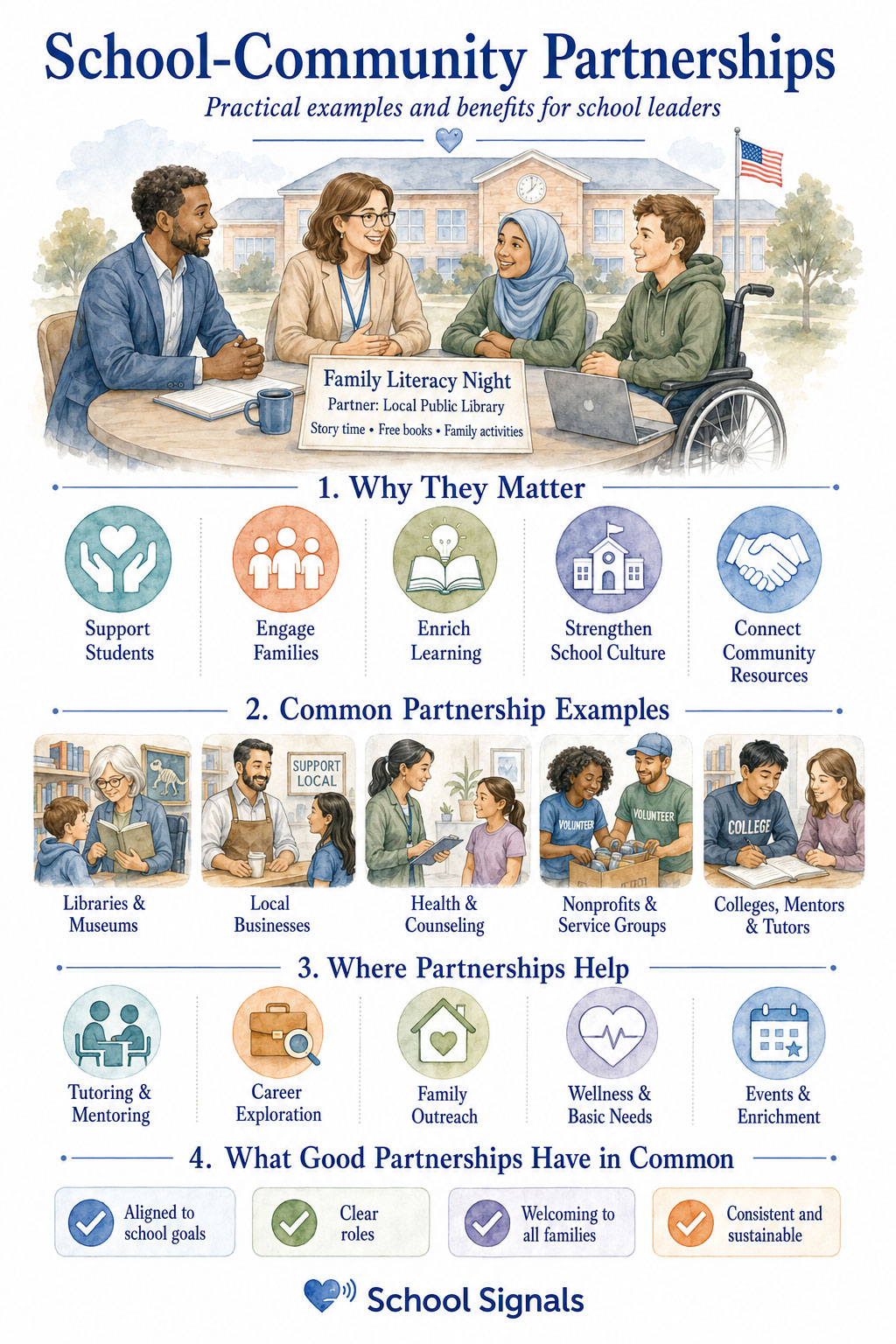
Summary of Various School-Community Partnership Types
The Takeaway: Shared Community Responsibility
In this post, we’ve traveled from Laredo, TX, to Philadelphia, PA, and New York City, NY. We’ve visited literacy programs and youth sports partnerships, had coffee with the cops, and checked on parent programs. One word stands out when I think of how to capture the beautiful landscape of community partnerships: Responsibility.
Through community partnerships, we see children not just as students but as community members, making us responsible for supporting them. Families are an integral part of communities and can build a more trusting relationship with schools when they know that schools care beyond the walls and truly see their children as community members who will make a difference now and in the future. As the basketball player Marvis Odia of Our Lady of the Lake put it, the heart of this work is ensuring kids have strong role models, good morals, and steady guidance.

FAQ on School-Community Partnerships
What is a School-Community Partnership?
A school-community partnership is an intentional, ongoing collaboration between a school and members or institutions of its surrounding community, such as families, local organizations, nonprofits, businesses, faith-based groups, and civic institutions.
School-community partnerships help schools strengthen academic support, address student and family needs, expand enrichment opportunities, and build a more connected and resilient school community. The partnerships also benefit community organizations and local businesses by aligning their work with schools.
Long-term partnerships typically yield stronger academic support, while short-term, regular partnerships can still positively contribute to school culture and a sense of belonging.
Community partnerships are powerful because they allow schools to access resources, expertise, mentoring, and services at low or no cost, while extending students’ sphere of influence to a community of caring, trusted adults beyond the school.
Why are school-community partnerships meaningful?
Community partnerships increase students’ social capital (Hands, 2015). They highlight to students that they have an important place in the local community and that community members are present to support students and their families. Children feel more connected to the real world, which also opens possibilities for meaningful integrated learning and project-based learning. When students participate in community projects, they act as active agents who can see that their contributions make a difference. The interactive reciprocal nature of community partnerships makes them so special.
Is the idea of community partnerships supported by education research?
Joyce L. Epstein has devoted much of her academic work to detailing the importance of community partnerships in child development and students’ educational outcomes. Communities are the third sphere of influence in Joyce L. Epstein’s family engagement model. Epstein sees partnerships that include not just students and the school, but also families, as the most transformative way to impact students.
How can schools handle communication with community program leaders and members?
The School Signals Programs feature is designed for communication between program mentors and members. Schools can create a communication hub for the program and provide specialized user accounts for community users, with limited access to the school’s communication platform.
Community leaders, volunteers, and program members post updates for families to the program’s communication feed, message privately when needed, and post all required forms and documents to the same hub.
The programs come to life through private social posts and photo sharing. If the program takes place after school hours, practical logistics are also organized, and special program events with RSVP are shared with families.


- Building Trust with Inclusive School Communication - September 13, 2026
- School Signals Introduces Student Portfolios for Personalized Family Engagement - June 23, 2026
- 10 Communication Challenges We’re Hearing from School Leaders - June 6, 2026