


How the Three C’s Support a School Communication Strategy
As a parent and teacher, I know first-hand how many misunderstandings can be avoided through good communication. From unclear homework deadlines to a lack of clarity about expectations for students, any number of problems can arise.
Despite good intentions, school communication can be elusive. How can you make sure that your school communicates effectively with families? One approach is to use the three C’s to check on your school’s communication style. The three C’s can serve as a helpful guideline for communication when forming a school communication strategy.

What Are the Three C’s of Communication?
Communication experts John Maxwell and Joe McCormack have written about how effective communication depends on several key principles known as the Cs of communication. Although there are variations on the three C’s of communication, they often include the following elements.
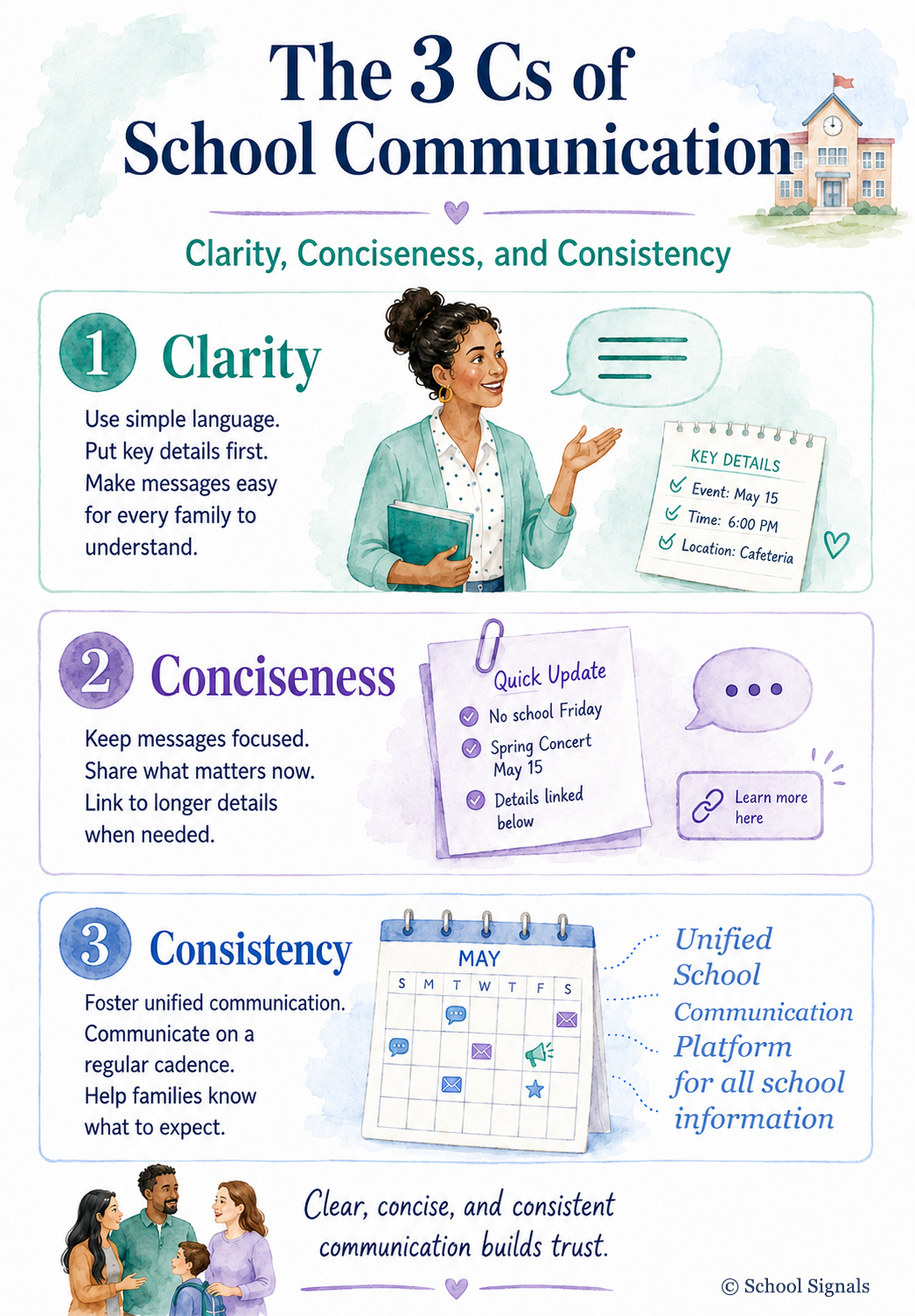
#1: Clarity
Talk to people, not above them.
Clear communication helps people understand messages and limits the chances of misunderstandings. In the school setting, clarity is essential for all messaging. Key areas to consider are schedule changes and student performance. Provide language translation for ESL families.
When a school schedule changes, it can be helpful to think through different scenarios. For example, if there’s an early dismissal, will buses pick students up at that earlier time? Also, will after-school programs still run? Communicating these details from the start can help things run smoothly and avoid follow-up questions.
Clarity means avoiding the use of jargon, technical terms or phrases that are not shared by many. Like many professions, the field of education comes with acronyms that are not used in common language. Learning standards, testing organizations and project-based curriculum often carry acronyms that most parents only learn after being exposed to them for a few years.
Teachers may discuss student’s SEL skills, PBL courses, IEPs, or ELA curriculum; these are not common terms for new parents or immigrant parents navigating their way in a new school system. As the famous author and orator John Maxwell said, “Talk to people, not above them.”
Clarity is also about whether families can actually access and understand the message. Accessibility directly affects how clear a message feels to different parents. Clarity means a school communication strategy that provides messages in formats that are accessible to all families. For instance, paper-based communication may be necessary for families who are digitally inexperienced, and a follow-up call can help families who say their messages get lost. Making information easy to access supports stronger school–home communication for everyone.
#2: Conciseness
You don’t need to speak a long time to say a lot.
Both parents and teachers are busy. Avoiding repetition can save everyone time while also making your message clear.
Maxwell once said, “You don’t need to speak a long time to say a lot. It’s not the number of words you use; it’s the impact you make with the words you use.”
Some topics, such as student behavior or academic needs, may require communicating with richer channels such as meeting in person. However, keeping messages short and to the point is ideal for routine messages.
#3: Consistency
Great communication begins with connection.
Surveys state that parents wish for school-parent communication to be frequent and consistent. Regular communication is essential to create trust. Oprah Winfrey boiled down this idea when she said, “Great communication begins with connection.”
Schools and families need consistent communication throughout the school year to build this connection. The communication should cover all key areas, from student performance to administrative updates.
Consistent communication should engage and activate parents and not rely on generic or canned messaging. One principal in Montgomery, Alabama, held monthly informal parent meetings to talk through new ideas or concerns. Another unique idea at the school where I taught was an open house. We used the opportunity to show parents how our Montessori curriculum worked first-hand. Teachers demonstrated lessons, and parents could ask questions or try using some of the materials. Read more about the importance of parent communication in Montessori.
Inconsistent messaging can result in confusion and distrust whereas a proactive, unified, and consistent communication style helps transmit trust. Both administrators and teachers should communicate in a consistent way according to the school’s communication plan that may follow the recommendations put forward by the school’s family engagement committee.
#4: A bonus “C” is Courteous
Fostering a respectful communication tone with parents builds trust. Whether communicating administrative updates or discussing a student’s progress, being courteous and kind can bridge the gap between home and school.
Frequently Asked Questions on School Communication Strategy
1. What is a school communication strategy?
A school communication strategy creates shared expectations for communication. It outlines the decisions a school makes about who communicates, where information lives, how often families hear from the school, and what happens when something is missed or misunderstood. It should be based on identified communication goals set by family engagement teams.

2. How is a school communication strategy different from a communication plan?
A school communication plan is a practical implementation of the strategy. Strategy answers a deeper question: why do we communicate? A plan answers more of a surface-level question: How do we communicate? What gets sent, when, and by whom.
3. Why do some schools struggle to maintain a clear and consistent communication strategy over time?
A clear communication strategy may be hard to maintain if it lacks a deeper, value-rooted answer to the question “why.” All stakeholders need to share the school’s mission to communicate and engage as outlined in the strategy.
If the strategy fails, a school might want to examine whether the reasons are fragmented values or simply a lack of appropriate resources to communicate clearly, consistently, and concisely. If the communication plan stemming from the strategy is impossible to follow through on, everyday practices stop supporting it, and the strategy itself loses credibility.
4. What role does clarity play in a school communication strategy?
Clarity is about whether families actually understand what the school is asking them to do. Well-intentioned messages can fall short if they use internal language or acronyms. Within the three C’s framework, clarity means removing those assumptions and making expectations visible, especially for families who are new, multilingual, or navigating school systems for the first time.
5. Why is conciseness so difficult in school communication?
Schools have a lot to communicate: schedules, policies, reminders, and updates. Conciseness is about deciding what families need to know now versus what can live elsewhere for reference. As part of the Three C’s, conciseness helps schools reduce overload without sacrificing understanding.
6. How does consistency affect trust in a school communication strategy?
Families build trust through predictability. When messages arrive in familiar places, at expected times, and in recognizable formats, families feel oriented — even when the information is new.
Consistency helps families trust that they’re seeing the whole picture rather than fragments. Inconsistent communication, by contrast, forces families to hunt for information and erodes confidence over time.
7. How can schools improve communication without sending more messages?
In practice, schools improve communication when they commit to clear routines that families can rely on. What often makes the most significant difference is cleaning up where information lives and who is responsible for saying it. When families know which messages come from teachers, which come from the school, and where to look first, fewer follow-ups are needed. Families should also be able to anticipate a communication rhythm. No one likes quick requests on short notice.
8. How should a school communication strategy be grounded in family engagement values?
Family engagement requires deeper thinking than just getting parents to show up at school. Dr. Karen L. Mapp recommends inclusive engagement strategies rooted in what parents care most about: their children’s educational outcomes. She reminds us that families need to be equitable partners in education. The school communication strategy should be grounded in these engagement values to have a tangible impact. Family engagement committees or teams should provide context and feedback when forming the school communication strategy for inclusive, two-way communication that supports family-school partnership building is woven into the strategy.
9. Who should be involved in shaping a school communication strategy?
School leaders should hear from the communication team, teachers, instructors, office staff, the family engagement team, and parent liaison representatives to ensure the school’s communication strategy aligns with the school’s shared values and mission.
10. When should schools re-evaluate their communication strategy for clarity, consistency, and follow-through?
Rethinking school communication and checking on the strategy is important if communication feels fragmented, is hard to manage, creates extra workload, and, deeper, when stakeholders express distrust. Keeping the strategy up to date at least yearly is a good practice to ensure that communication issues do not begin piling up. Using family feedback, staff input, and communication data can help schools assess whether the strategy is still serving its purpose.


- School Communication Strategy Three C:s: Clarity, Conciseness, Consistency - December 9, 2024
- How School Communities Can Support Better Parent Mental Health - October 11, 2024