


It is easy to get lost in the world of K12 education acronyms.
We’ve compiled 300+ K12 acronyms not just to prove a point, but to make the lives of school leaders, teachers, administrators, and parents easier!
While acronyms provide a quick way to reference and organize educational requirements, policies, programs, and processes, a communication style that relies heavily on them can quickly become a source of confusion for new teachers, parents, and ESL families.
Tip: Don’t rely solely on acronyms when communicating with families and community members, as this places a heavy cognitive load on stakeholders new to the topic.
Table of Contents
Special Education and Student Support Acronyms (A–Z)
The roots to the K12 special education programs stem from 1975 when the Education for All Handicapped Children Act (EHA), widely recognized as a landmark federal law for establishing the right to public education for students with disabilities, was passed. This law was renamed and expanded as Individuals with Disabilities Education Act (IDEA) in 1990.
These laws required schools to identify and support students with disabilities; evaluate students, provide services, and document progress in a consistent way. This led to Individualized Education Programs (IEPs).
Educators needed a practical way to record assessments, services, and goals across teams. Acronyms became a working shorthand in reports, meetings, and documentation. Today’s terminology reflects that layered system and the need to communicate quickly across educators, specialists, and administrators.
Note: The acronyms list includes special education acronyms listed on SELPA Administrators of California’s page: Parent Rights & Procedural Safeguards
504Section 504 of the Rehabilitation Act of 1973, a federal law that provides accommodations and supports for students with disabilities who do not qualify for special education services.
AACAugmentative and Alternative Communication, methods and devices that support communication for students who cannot rely on speech alone.
ABAApplied Behavior Analysis, a therapy approach used to improve behavior, communication, and learning skills, often for students with autism.
ADRAlternative Dispute Resolution, a voluntary process used to resolve disagreements between families and schools without a formal hearing.
ALJAdministrative Law Judge, the official who presides over special education due process hearings and issues decisions.
APEAdapted Physical Education, specialized physical education services designed to meet the needs of students with disabilities.
ARDAdmission, Review, and Dismissal, a Texas-based meeting where educators and families review and update a student’s special education services.
ASDAutism Spectrum Disorder, a disability category characterized by challenges with communication, social interaction, and behavior.
BIPBehavior Intervention Plan, a plan outlining strategies and supports to address and improve student behavior.
BCBABoard Certified Behavior Analyst, a specialist trained in behavior analysis who designs and oversees behavior intervention plans.
BMPBehavior Management Plan, a structured plan used to outline strategies, expectations, and supports for improving student behavior.
BTBehavior Technician, a staff member who implements behavior support plans, often under supervision of a specialist.
DHHDeaf and Hard of Hearing, a disability category for students with hearing impairments that impact learning.
DISDesignated Instruction and Services, also known as related services, which include supports such as therapy and counseling provided through an IEP.
EDEmotional Disturbance, an eligibility category for students with significant emotional or behavioral needs affecting learning.
ESCEEarly Childhood Special Education, services and support provided to young children (typically ages 3–5) with developmental delays or disabilities.
ESYExtended School Year, services provided outside the regular school year for students who need continued support.
FAPEFree Appropriate Public Education, a legal requirement ensuring students with disabilities receive appropriate education services at no cost.
FBAFunctional Behavior Assessment, an evaluation used to identify the causes and triggers of student behavior.
FIEFull Individual Evaluation, a comprehensive assessment used to determine if a student qualifies for special education services and what supports are needed.
HIHearing Impairment, an eligibility category for students with hearing-related disabilities.
IAInstructional Aide, a staff member who supports classroom instruction and assists students with learning tasks.
IAESInterim Alternative Education Setting, a temporary placement used when a student is removed from their current placement due to disciplinary action.
IDIntellectual Disability, a disability category involving significant limitations in intellectual functioning and adaptive behavior.
IDEAIndividuals with Disabilities Education Act, the federal law governing special education services and student rights.
IEEIndependent Educational Evaluation, an evaluation conducted by a qualified examiner not employed by the school district, often requested by parents.
IEPIndividualized Education Program, a legally required plan outlining services, accommodations, and goals for students with disabilities.
IFSPIndividualized Family Services Plan, a plan for early intervention services for infants and toddlers with developmental delays.
ITPIndividualized Transition Plan, a component of the IEP that outlines postsecondary goals and transition services for students.
LRELeast Restrictive Environment, the requirement that students with disabilities are educated with peers to the greatest extent appropriate.
LSSPLicensed Specialist in School Psychology, a professional who conducts evaluations and supports student mental health and behavior.
MDManifestation Determination, a review process used to determine whether a student’s behavior is related to their disability.
MTSSMulti-Tiered System of Supports, a framework used to provide academic and behavioral support at multiple levels.
OAHOffice of Administrative Hearings, the agency that conducts due process hearings and resolves special education disputes.
OHIOther Health Impairment, an eligibility category for students with health conditions that affect learning, such as ADHD.
OIOrthopedic Impairment, a disability category involving physical impairments that affect mobility or physical functioning.
O&MOrientation and Mobility, services that support students with visual impairments in navigating their environment safely.
OTOccupational Therapist, a specialist who supports motor skills and daily functioning needed for school tasks.
ParaParaprofessional, a staff member who provides instructional and behavioral support under teacher supervision.
PPCDPreschool Program for Children with Disabilities, a public school program in Texas that provides special education services to children ages 3–5 with identified disabilities.
PRTPivotal Response Treatment, a behavioral intervention approach often used with students with autism to improve communication and social skills.
PTPhysical Therapist, a specialist who supports mobility, strength, and physical access in the school environment.
PWNPrior Written Notice, a required document that explains the school’s decisions regarding identification, evaluation, placement, or services.
RBTRegistered Behavior Technician, certified staff who implement behavior plans under supervision of a behavior analyst.
RNRegistered Nurse
RSPResource Specialist Program, a service delivery model where students receive targeted support from a resource specialist teacher.
RTIResponse to Intervention, a framework used to identify and support students with learning and behavior needs.
SAISpecialized Academic Instruction, individualized instruction provided to support students with disabilities in accessing the general education curriculum.
SLDSpecific Learning Disability, a disability category involving difficulties in areas such as reading, writing, or math.
SLISpeech or Language Impairment, a disability category involving communication disorders such as stuttering or language delays.
SLPSpeech-Language Pathologist, a specialist who supports speech, language, and communication development.
SPEDSpecial Education, programs and services designed to support students with disabilities.
SSTStudent Study Team, a school-based team that reviews student concerns and develops intervention strategies before special education referral.
SWDStudents with Disabilities, a general term used in reporting and data to refer to students receiving special education services.
TBITraumatic Brain Injury, an eligibility category for students with brain injuries affecting learning and functioning.
TEACCHTreatment and Education of Autistic and Related Communication Handicapped Children, a structured teaching approach used to support students with autism.
Tier 1Core instruction level provided to all students.
Tier 2Targeted support level for students needing additional help.
Tier 3Intensive support level providing individualized intervention.
VIVisual Impairment, an eligibility category for students with vision-related disabilities.
| Acronym | Definition | Category | Use case |
|---|---|---|---|
| 504 | Section 504 of the Rehabilitation Act of 1973, a federal law that provides accommodations and supports for students with disabilities who do not qualify for special education services | Special Education Programs and Student Support | The student receives accommodations through a 504 plan. |
| AAC | Augmentative and Alternative Communication (methods and devices that support communication for students who cannot rely on speech alone) | Special Education | The student uses AAC to communicate in class. |
| ABA | Applied Behavior Analysis (therapy approach used to improve behavior, communication, and learning skills, often for students with autism) | Special Education | The student receives ABA support during the school day. |
| ADR | Alternative Dispute Resolution, a voluntary process used to resolve disagreements between families and schools without a formal hearing | Special Education Programs and Student Support | The district offered ADR to resolve the disagreement. |
| ALJ | Administrative Law Judge, the official who presides over special education due process hearings and issues decisions | School Planning, Compliance, and Policy | The ALJ issued a decision in the case. |
| APE | Adapted Physical Education, specialized physical education services designed to meet the needs of students with disabilities | Special Education Programs and Student Support | The student receives APE services as part of the IEP. |
| ARD | Admission, Review, and Dismissal (Texas-based meeting where educators and families review and update a student’s special education services) | Special Education | The ARD committee met to review the student’s services. |
| ASD | Autism Spectrum Disorder, a disability category characterized by challenges with communication, social interaction, and behavior | Special Education Programs and Student Support | The student qualifies for services under ASD. |
| BIP | Behavior Intervention Plan (a plan outlining strategies and supports to address and improve student behavior) | Special Education | The student has a BIP in place to support behavior. |
| BCBA | Board Certified Behavior Analyst, a specialist trained in behavior analysis who designs and oversees behavior intervention plans | Student Support | The BCBA reviewed the student’s behavior plan. |
| BMP | Behavior Management Plan, a structured plan used in general education or early intervention settings to outline strategies, expectations, and supports for improving student behavior | Student Support | In a middle school setting, a counselor or case manager may coordinate a BMP, with classroom teachers implementing consistent strategies, progress monitoring, and check-ins across multiple classes. |
| BT | Behavior Technician (staff member who implements behavior support plans, often under supervision of a specialist) | Staff / Support | The BT works with the student on behavior goals. |
| DHH | Deaf and Hard of Hearing, a disability category for students with hearing impairments that impact learning | Special Education Programs and Student Support | The student receives DHH services. |
| DIS | Designated Instruction and Services, also known as related services, includes supports such as therapy and counseling provided through an IEP | Special Education Programs and Student Support | The student receives DIS as part of the IEP. |
| ED | Emotional Disturbance (eligibility category for students with significant emotional or behavioral needs affecting learning) | Special Education | The student qualifies for services under ED. |
| ESCE | Early Childhood Special Education, services and support provided to young children (typically ages 3–5) with developmental delays or disabilities | Special Education | The student receives ESCE services to support communication and social development. |
| ESY | Extended School Year (services provided outside the regular school year for students who need continued support) | Special Education | The student qualifies for ESY services. |
| FAPE | Free Appropriate Public Education (legal requirement ensuring students with disabilities receive appropriate education services at no cost) | Special Education | Services are provided under FAPE. |
| FBA | Functional Behavior Assessment (evaluation used to identify the causes and triggers of student behavior) | Special Education | An FBA was conducted to understand behavior patterns. |
| FIE | Full Individual Evaluation (a comprehensive assessment used to determine if a student qualifies for special education services and what supports are needed) | Special Education | The school will conduct an FIE to evaluate the student’s needs. |
| HI | Hearing Impairment (eligibility category for students with hearing-related disabilities) | Special Education | The student receives services under HI. |
| IA | Instructional Aide (staff member who supports classroom instruction and assists students with learning tasks) | Staff / Support | The IA supports small group instruction. |
| IAES | Interim Alternative Education Setting, a temporary placement used when a student is removed from their current placement due to disciplinary action | Special Education Programs and Student Support | The student was placed in an IAES during the disciplinary process. |
| ID | Intellectual Disability, a disability category involving significant limitations in intellectual functioning and adaptive behavior | Special Education Programs and Student Support | The student qualifies under ID. |
| IDEA | Individuals with Disabilities Education Act (federal law governing special education services and student rights) | Special Education | IDEA governs how IEP services are delivered. |
| IEE | Independent Educational Evaluation, an evaluation conducted by a qualified examiner not employed by the school district, often requested by parents | Special Education Programs and Student Support | The parent requested an IEE at public expense. |
| IEP | Individualized Education Program (a legally required plan outlining services, accommodations, and goals for students with disabilities) | Special Education | The IEP outlines the student’s goals and services. |
| IFSP | Individualized Family Services Plan, a plan for early intervention services for infants and toddlers with developmental delays | Special Education Programs and Student Support | The child transitioned from an IFSP to an IEP. |
| ITP | Individualized Transition Plan, a component of the IEP that outlines postsecondary goals and transition services for students | Special Education Programs and Student Support | The ITP outlines goals for life after high school. |
| LRE | Least Restrictive Environment (requirement that students with disabilities are educated with peers to the greatest extent appropriate) | Special Education | Placement decisions follow LRE guidelines. |
| LSSP | Licensed Specialist in School Psychology (professional who conducts evaluations and supports student mental health and behavior) | Student Support | The LSSP completed the student evaluation. |
| MD | Manifestation Determination, a review process used to determine whether a student’s behavior is related to their disability | Special Education Programs and Student Support | The team conducted an MD after the suspension. |
| MTSS | Multi-Tiered System of Supports, framework and team structure used to provide academic and behavioral support at multiple levels | Student Support | MTSS is provided in three different tiers for student support. |
| OAH | Office of Administrative Hearings, the agency that conducts due process hearings and resolves special education disputes | School Planning, Compliance, and Policy | The case was filed with OAH for a hearing. |
| OHI | Other Health Impairment (eligibility category for students with health conditions that affect learning, such as ADHD) | Special Education | The student qualifies under OHI. |
| OI | Orthopedic Impairment, a disability category involving physical impairments that affect mobility or physical functioning | Special Education Programs and Student Support | The student receives services under OI. |
| O&M | Orientation and Mobility, services that support students with visual impairments in navigating their environment safely | Special Education Programs and Student Support | The student receives O&M training for campus navigation. |
| OT | Occupational Therapist (specialist who supports motor skills and daily functioning needed for school tasks) | Student Support | The OT works with the student on fine motor skills. |
| Para | Paraprofessional (staff member who provides instructional and behavioral support under teacher supervision) | Staff / Support | The para assists the student during reading time. |
| PPCD | Preschool Program for Children with Disabilities, a public school program in Texas that provides special education services to children ages 3–5 with identified disabilities | Special Education Programs and Student Support | The child attends a PPCD classroom to receive speech therapy and structured support before kindergarten. |
| PRT | Pivotal Response Treatment, a behavioral intervention approach often used with students with autism to improve communication and social skills | Student Support | The student receives PRT services to support communication. |
| PT | Physical Therapist (specialist who supports mobility, strength, and physical access in the school environment) | Student Support | The PT supports the student’s mobility needs. |
| PWN | Prior Written Notice, a required document that explains the school’s decisions regarding identification, evaluation, placement, or services | Special Education Programs and Student Support | The district issued PWN after the IEP meeting. |
| RBT | Registered Behavior Technician (certified staff member who implements behavior plans under supervision of a behavior analyst) | Staff / Support | The RBT supports the student’s behavior plan. |
| RN | Registered Nurse | Student Support | The RN supports student health. |
| RSP | Resource Specialist Program, a service delivery model where students receive targeted support from a resource specialist teacher | Special Education Programs and Student Support | The student receives RSP support in math. |
| RTI | Response to Intervention | Student Support | The student receives RTI support. |
| SAI | Specialized Academic Instruction, individualized instruction provided to support students with disabilities in accessing the general education curriculum | Special Education Programs and Student Support | The student receives SAI for reading support. |
| SLD | Specific Learning Disability, a disability category involving difficulties in areas such as reading, writing, or math | Special Education Programs and Student Support | The student qualifies under SLD. |
| SLI | Speech or Language Impairment, a disability category involving communication disorders such as stuttering or language delays | Special Education Programs and Student Support | The student qualifies under SLI. |
| SLP | Speech-Language Pathologist (specialist who supports speech, language, and communication development) | Student Support | The SLP works with the student on speech skills. |
| SPED | Special Education (program and services designed to support students with disabilities) | Special Education | She teaches in SPED. |
| SST | Student Study Team, a school-based team that reviews student concerns and develops intervention strategies prior to special education referral | Student Support | The SST reviewed the student’s progress and interventions. |
| SWD | Students with Disabilities, a general term used in reporting and data to refer to students receiving special education services | Special Education Programs and Student Support | The report includes outcomes for SWD. |
| TBI | Traumatic Brain Injury (eligibility category for students with brain injuries affecting learning and functioning) | Special Education | The student receives services under TBI. |
| TEACCH | Treatment and Education of Autistic and Related Communication Handicapped Children, a structured teaching approach used to support students with autism | Student Support | The classroom uses TEACCH strategies. |
| Tier 1 | Core instruction level | Student Support | All students receive Tier 1 instruction. |
| Tier 2 | Targeted support level | Student Support | The student receives Tier 2 support. |
| Tier 3 | Intensive support level | Student Support | Tier 3 provides individualized support. |
| VI | Visual Impairment (eligibility category for students with vision-related disabilities) | Special Education | The student receives VI services. |
Report Card Acronyms and Abbreviations — Abreviaturas y acrónimos en las boletas escolares (A—Z)
If you’re looking for K12 acronyms and abbreviations, head over to the student report cards!
Acronyms and abbreviations show up in shortened subject names, standards-based grading systems, and course levels, credit indicators, assessment scores, and attendance codes.
A decent report card explains all the acronyms and abbreviations and doesn’t assume that parents know them. Additionally, providing more detail on how a standards-based grade level, such as ES, MS, AS, or PR, is assessed is significant and helps parents better understand.
Report cards are considered “vital information,” and, under federal law, Title VI of the Civil Rights Act (1964), schools have a legal obligation to provide the information in parents’ home languages.
ABSAbsence, indicates the number of days a student was absent from school.
ALGAlgebra, a mathematics course covering algebraic concepts such as equations and variables.
APAdvanced Placement, a college-level course offered in high school.
APApproaching Proficient, indicates a student is close to meeting expectations but still needs development.
ARTArt, a course focused on visual arts and creative expression.
ASApproaching Standard, indicates the student is progressing toward grade-level expectations but has not fully met them.
ATTAttendance, a summary of the student’s attendance record.
BIOBiology, a science course studying living organisms and biological systems.
BSBelow Standard, indicates the student is performing below grade-level expectations.
CHEMChemistry, a science course covering chemical reactions and the properties of matter.
CITCitizenship, a rating that evaluates a student’s responsibility, behavior, and respect.
CONConduct, an evaluation of a student’s classroom behavior.
CRCredit, indicates credit earned for completing a course.
DETDetention, a disciplinary consequence requiring a student to remain after school.
DISCDiscipline, notes or records related to student behavior or disciplinary actions.
EExcused Absence, an absence approved by the school or justified by a parent note.
EOYEnd of Year, indicates results or progress measured at the end of the academic year.
EFFEffort, a measure of the level of effort a student demonstrates in coursework.
ELAEnglish Language Arts, the core literacy subject including reading, writing, grammar, and communication skills.
ENGEnglish, a course focused on literature, writing, and analysis of texts.
ESExceeds Standard, indicates the student performs above grade-level expectations.
GEOGeometry, a mathematics course covering geometric concepts such as shapes, angles, and proofs.
GPAGrade Point Average, the numerical average of grades used to measure academic performance.
HISTHistory, a course studying historical events and their impact on society.
HONHonors, an advanced-level course with more rigorous academic expectations.
HWHomework, indicates the completion or quality of assigned take-home work.
INCIncomplete, a temporary grade indicating assignments are missing.
IPIn Progress, indicates that a skill or course is still being evaluated.
ISSIn-School Suspension, a disciplinary consequence where a student is removed from class but remains in school.
NPNeeds Practice, indicates the student requires additional practice to demonstrate mastery.
MATHMathematics, the general mathematics subject covering various areas depending on grade level.
MSMeets Standard, indicates the student meets grade-level expectations.
MUSMusic, a course covering music theory, performance, and appreciation.
NCNo Credit, indicates a course was completed but credit was not awarded.
NGNo Grade, indicates a grade cannot be issued due to insufficient work or information.
NNeeds Improvement, indicates behavior or work habits need improvement.
OOutstanding, the highest rating for behavior or citizenship.
ORGOrganization, evaluates a student’s ability to stay organized with materials and assignments.
OSSOut-of-School Suspension, a disciplinary action where a student is suspended from school.
PARTParticipation, evaluates a student’s engagement in classroom activities.
PEPhysical Education, a course promoting physical fitness, movement, and health.
PRProgress, indicates the student has met grade-level expectations for the evaluated skill or subject.
PRGProgress, indicates improvement toward learning goals noted by the teacher.
SSatisfactory, indicates acceptable behavior or work habits.
SBGStandards-Based Grading, a grading system that evaluates mastery of learning standards.
SCIScience, the general science subject which may include biology, chemistry, or physics.
SPANSpanish, a course in the Spanish language.
SSSocial Studies, a course covering history, civics, and geography.
STEMScience Technology Engineering Mathematics, an academic program integrating science, technology, engineering, and mathematics.
TTardy, indicates a student arrived late to school or class.
UUnexcused Absence, an absence without an approved explanation.
WLWorld Language, a course in a language other than English such as Spanish or French.
| Acronym | Stands for | Category | Description | Descripción (Español – Explicación para familias) | Example |
|---|---|---|---|---|---|
| ABS | Absence | Attendance | Indicates the number of days a student was absent from school. | Indica la cantidad de días que el estudiante estuvo ausente de la escuela. | ABS: 3 |
| ALG | Algebra | Subject | Mathematics course covering algebraic concepts. | Curso de matemáticas que enseña conceptos de álgebra como ecuaciones y variables. | ALG grade B+ |
| AP | Advanced Placement | Academic Program | College-level course offered in high school. | Curso avanzado de nivel universitario ofrecido en la escuela secundaria. | AP Biology listed on report card |
| AP | Approaching Proficient | Standards-Based Grade | Student is close to meeting expectations but needs more development. | Indica que el estudiante está cerca de cumplir con las expectativas del nivel de grado, pero todavía necesita mejorar en esa área. | Writing skills rated AP. |
| ART | Art | Subject | Course focused on visual arts and creative expression. | Clase enfocada en artes visuales y expresión creativa. | ART participation grade A |
| AS | Approaching Standard | Standards-Based Grade | Student is progressing toward grade-level expectations. | El estudiante está progresando hacia el nivel esperado, pero aún no lo alcanza completamente. | Writing marked AS |
| ATT | Attendance | Attendance | Summary of student attendance record. | Resumen del registro de asistencia del estudiante durante el período escolar. | ATT: 95% |
| BIO | Biology | Subject | Science course studying living organisms. | Curso de ciencias que estudia los seres vivos y los sistemas biológicos. | BIO semester grade A- |
| BS | Below Standard | Standards-Based Grade | Student is performing below grade-level expectations. | Indica que el estudiante está por debajo del nivel académico esperado para su grado. | Spelling rated BS |
| CHEM | Chemistry | Subject | Science course covering chemical reactions and properties of matter. | Curso de ciencias que estudia las propiedades de la materia y las reacciones químicas. | CHEM lab grade B |
| CIT | Citizenship | Behavior | Rating of student behavior and responsibility. | Evaluación del comportamiento, responsabilidad y respeto del estudiante. | CIT marked S |
| CON | Conduct | Behavior | Evaluation of classroom conduct. | Evaluación de la conducta del estudiante en el salón de clases. | CON marked S |
| CR | Credit | Course Status | Indicates credit earned for completing a course. | Indica que el estudiante recibió crédito por completar un curso. | CR: 1.0 |
| DET | Detention | Discipline | Student assigned detention as disciplinary consequence. | Consecuencia disciplinaria donde el estudiante debe permanecer después de clases. | DET issued |
| DISC | Discipline | Behavior | Notes related to student discipline. | Notas o registros relacionados con disciplina escolar. | DISC note added |
| E | Excused Absence | Attendance | Absence approved by school or parent note. | Ausencia que fue justificada por los padres o aprobada por la escuela. | E: 1 |
| EOY | End of Year | Reporting Period | ndicates results or progress measured at the end of the academic year. | Indica que el resultado o el progreso se midió al final del año escolar. | EOY reading level reported. |
| EFF | Effort | Work Habits | Level of effort shown in coursework. | Mide el nivel de esfuerzo que el estudiante demuestra en su trabajo escolar. | EFF marked S |
| ELA | English Language Arts | Subject | Core literacy subject including reading and writing. | Materia principal que incluye lectura, escritura, gramática y comunicación en inglés. | ELA grade A |
| ENG | English | Subject | Course focused on literature and composition. | Curso de inglés enfocado en literatura, escritura y análisis de textos. | ENG grade B+ |
| ES | Exceeds Standard | Standards-Based Grade | Student performs above grade-level expectations. | Indica que el estudiante supera las expectativas del nivel de grado. | Reading marked ES |
| GEO | Geometry | Subject | Mathematics course covering geometric concepts. | Curso de matemáticas que enseña conceptos de geometría como figuras y ángulos. | GEO grade B |
| GPA | Grade Point Average | Academic Indicator | Average of grades used to measure academic performance. | Promedio general de calificaciones del estudiante en todas las materias. | GPA 3.7 |
| HIST | History | Subject | Course covering historical events and analysis. | Curso que estudia eventos históricos y su impacto en la sociedad. | HIST grade B |
| HON | Honors | Academic Program | Advanced-level course with more rigorous expectations. | Curso avanzado con mayor nivel de dificultad que una clase regular. | HON English listed |
| HW | Homework | Work Habits | Indicates homework completion or quality. | Indica la calidad o cumplimiento de las tareas asignadas para la casa. | HW completion improving |
| INC | Incomplete | Grading | Temporary grade indicating assignments are missing. | Calificación temporal que indica que faltan tareas o trabajos por entregar. | INC until work submitted |
| IP | In Progress | Progress Indicator | Skill or course still being evaluated. | Significa que el trabajo o la habilidad todavía está en proceso de evaluación. | Writing marked IP |
| ISS | In-School Suspension | Discipline | Student temporarily removed from class but remains in school. | Suspensión disciplinaria donde el estudiante permanece en la escuela pero fuera de su clase regular. | ISS recorded |
| NP | Needs Practice | Standards-Based Grade | Student requires more practice to demonstrate mastery. | Indica que el estudiante necesita más práctica para demostrar dominio de la habilidad o el concepto. | Math fact fluency marked NP. |
| MATH | Mathematics | Subject | General mathematics subject. | Materia de matemáticas que puede incluir diferentes áreas según el grado. | MATH grade A |
| MS | Meets Standard | Standards-Based Grade | Student meets grade-level expectations. | Indica que el estudiante cumple con las expectativas académicas del grado. | Math skills MS |
| MUS | Music | Subject | Course covering music theory and performance. | Clase relacionada con música, teoría musical o interpretación musical. | MUS grade A |
| NC | No Credit | Course Status | Course completed without earning credit. | Indica que el estudiante completó el curso pero no obtuvo crédito académico. | NC recorded |
| NG | No Grade | Grading | Grade cannot be issued due to insufficient work. | Significa que no se puede asignar una calificación debido a falta de información o trabajo. | NG after transfer |
| N | Needs Improvement | Behavior | Behavior or work habits need improvement. | Indica que el comportamiento o los hábitos de trabajo necesitan mejorar. | Homework marked N |
| O | Outstanding | Behavior | Highest behavior rating. | La calificación más alta para comportamiento o ciudadanía. | O for cooperation |
| ORG | Organization | Work Habits | Student ability to stay organized. | Evalúa qué tan bien el estudiante organiza su trabajo y materiales. | ORG noted |
| OSS | Out-of-School Suspension | Discipline | Student suspended from school. | Suspensión disciplinaria donde el estudiante debe quedarse en casa por un período determinado. | OSS recorded |
| PART | Participation | Work Habits | Student engagement in class activities. | Evalúa el nivel de participación del estudiante en actividades de clase. | PART noted |
| PE | Physical Education | Subject | Course promoting fitness and physical activity. | Clase de educación física enfocada en actividad física y salud. | PE grade A |
| PR | Progress | Standards-Based Grade | Indicates the student has met grade-level expectations for the skill or subject being evaluated. | Reading comprehension marked PR | |
| PRG | Progress | Teacher Comment | Indicates improvement toward learning goals. | Indica progreso o mejora del estudiante en una habilidad o materia. | PRG noted |
| S | Satisfactory | Behavior | Acceptable behavior or work habits. | Indica comportamiento o desempeño aceptable. | Participation rated S |
| SBG | Standards-Based Grading | Grading System | System evaluating mastery of learning standards. | Sistema de calificación que evalúa el dominio de habilidades o estándares específicos. | District uses SBG |
| SCI | Science | Subject | General science subject. | Materia de ciencias que puede incluir biología, física u otras áreas científicas. | SCI grade B+ |
| SPAN | Spanish | Subject | Spanish language course. | Curso de idioma español. | SPAN vocabulary grade A |
| SS | Social Studies | Subject | Course covering history, civics, and geography. | Materia que incluye historia, geografía y estudios cívicos. | SS grade B |
| STEM | Science Technology Engineering Mathematics | Academic Program | Integrated STEM course or program. | Programa o curso que integra ciencia, tecnología, ingeniería y matemáticas. | STEM elective listed |
| T | Tardy | Attendance | Student arrived late to school or class. | Indica que el estudiante llegó tarde a la escuela o a clase. | T: 2 |
| U | Unexcused Absence | Attendance | Absence without approved explanation. | Ausencia que no fue justificada ni aprobada por la escuela. | U: 1 |
| WL | World Language | Subject | Course in a language other than English. | Curso de idioma extranjero como español, francés u otro idioma. | WL grade B |
Academic Programs and Assessments Acronyms (A–Z)
| Acronym | Definition | Category | Example use |
|---|---|---|---|
| ACCUPLACER | College placement test | Assessment | Students take the ACCUPLACER for course placement. |
| ACT | College entrance exam (standardized test used for college admissions, including subject-based sections) | Assessment | She took the ACT this spring. |
| AP | Advanced Placement (college-level courses offered in high school that can earn college credit) | Academic Programs | She is enrolled in AP Biology. |
| AP Exam | End-of-course exam for AP classes (standardized test used to determine eligibility for college credit) | Assessment | She passed the AP Exam to earn college credit. |
| AYP | Adequate Yearly Progress, a former federal measure of school performance under No Child Left Behind (NCLB) | Assessment | The school met AYP targets. |
| B.E.S.T. | Benchmarks for Excellent Student Thinking, Florida’s standards for English language arts and math | State Learning Standards | The curriculum was updated to reflect B.E.S.T. standards. |
| CBA | Curriculum-Based Assessment, a method of evaluating student progress using materials and skills directly tied to the curriculum being taught, often used alongside CBM to monitor performance over time | Assessment | Teachers use CBA results to determine whether students are meeting expected benchmarks in reading and math. |
| CBM | Curriculum-Based Measurement | Assessment | Teachers use CBM to track progress. |
| CCR | College and Career Readiness | Academic Outcomes | The program supports CCR goals. |
| CCSS | Common Core State Standards | Learning Standards | The curriculum aligns with CCSS. |
| CTE | Career and Technical Education | Academic Programs | Students enroll in CTE pathways. |
| DAP | Developmentally Appropriate Practice | Academic Programs | Teachers use DAP to guide classroom activities. |
| DIBELS | Dynamic Indicators of Basic Early Literacy Skills | Assessment | DIBELS measures reading skills. |
| DE | Dual Enrollment (college courses taken while in high school, often through a local college) | Academic Programs | She is enrolled in DE math through a local college. |
| DC | Dual Credit (courses that count for both high school and college credit simultaneously) | Academic Programs | The student completed DC English and earned college credit. |
| ECHS | Early College High School (program where students can earn significant college credit or an associate degree while in high school) | Academic Programs | Students in ECHS may graduate with an associate degree. |
| EOC | End-of-Course exam (state-required test given after completing specific high school courses) | Assessment | Students must pass the EOC to graduate. |
| ERB | Educational Records Bureau (organization that provides standardized assessments commonly used by independent schools) | Assessment | The school uses ERB testing to assess student performance. |
| GATE | Gifted and Talented Education, programs and services designed to support students with advanced academic ability through accelerated or enriched instruction (terminology and eligibility vary by state and district) | Academic Programs | he student participates in the school’s GATE program for advanced learners. |
| GPA | Grade Point Average | Academic | Her GPA improved this semester. |
| GT | Gifted and Talented | Academic Programs | The student participates in GT. |
| IB | International Baccalaureate (a globally recognized academic program with rigorous coursework and assessments) | Academic Programs | She is in the IB program. |
| ISEE | Independent School Entrance Exam (admissions test used by many private and independent schools) | Assessment | Students applying to private schools may take the ISEE. |
| MAP | Measures of Academic Progress | Assessment | Students take MAP tests. |
| NAEP | National Assessment of Educational Progress | Assessment | NAEP provides national benchmarks. |
| NGSS | Next Generation Science Standards, a multi-state framework that defines what students should know and be able to do in science | State Learning Standards (Multi-state adoption) | Science units are aligned to NGSS performance expectations. |
| NWEA | NWEA Assessment organization that develops MAP Growth assessments used to measure student progress over time Assessment NWEA MAP scores show growth. Originally stood for Northwest Evaluation Association. | Assessment | The student's NWEA MAP scores show growth. |
| PAARC | Partnership for Assessment of Readiness for College and Careers, a multi-state consortium that developed standardized tests aligned with Common Core standards; widely used in the mid-2010s but later replaced by state-specific assessments | Assessment (Former) | Several states administered PARCC exams to measure student readiness for college-level work. |
| PSAT | Preliminary SAT (practice exam that also qualifies students for scholarship programs) | Assessment | Students take the PSAT. |
| SAT | College entrance exam (standardized test used by colleges for admissions decisions) | Assessment | He is preparing for the SAT. |
| SOL | Standards of Learning, Virginia’s academic standards used to define learning expectations and assessments | State Learning Standards | Students are tested annually based on SOL requirements. |
| SSAT | Secondary School Admission Test (standardized test used for admission to independent and private schools) | Assessment | The student is preparing for the SSAT. |
ACCUPLACERCollege placement test, an assessment used by many colleges to determine appropriate course placement for incoming students.
ACTCollege entrance exam, a standardized test used for college admissions that includes subject-based sections.
APAdvanced Placement, college-level courses offered in high school that may allow students to earn college credit.
AP ExamEnd-of-course exam for Advanced Placement classes, a standardized test used to determine eligibility for college credit.
AYPAdequate Yearly Progress, a former federal measure of school performance under the No Child Left Behind (NCLB) law.
B.E.S.T.Benchmarks for Excellent Student Thinking, Florida’s academic standards for English language arts and mathematics.
CBACurriculum-Based Assessment, a method of evaluating student progress using materials and skills directly tied to the curriculum being taught.
CBMCurriculum-Based Measurement, an assessment method used to track student progress over time using brief, frequent measures.
CCRCollege and Career Readiness, a goal that prepares students with the knowledge and skills needed for success after high school.
CCSSCommon Core State Standards, a set of learning standards used by many states to define expectations in mathematics and English language arts.
CTECareer and Technical Education, programs that provide students with practical skills and training for specific careers or industries.
DAPDevelopmentally Appropriate Practice, an educational approach that matches teaching methods to children’s age, development, and individual needs.
DIBELSDynamic Indicators of Basic Early Literacy Skills, a set of assessments used to measure early reading development.
DEDual Enrollment, college courses taken while in high school, often through a local college.
DCDual Credit, courses that count simultaneously for both high school and college credit.
ECHSEarly College High School, a program that allows students to earn significant college credit or an associate degree while still in high school.
EOCEnd-of-Course exam, a state-required test given after completing certain high school courses.
ERBEducational Records Bureau, an organization that provides standardized assessments commonly used by independent schools.
GATEGifted and Talented Education, programs and services designed to support students with advanced academic ability through accelerated or enriched instruction.
GPAGrade Point Average, the numerical average of grades used to measure academic performance.
GTGifted and Talented, programs designed to support students with advanced academic abilities.
IBInternational Baccalaureate, a globally recognized academic program offering rigorous coursework and assessments.
ISEEIndependent School Entrance Exam, an admissions test used by many private and independent schools.
MAPMeasures of Academic Progress, a computer-adaptive assessment used to measure student learning growth over time.
NAEPNational Assessment of Educational Progress, a national assessment that provides benchmarks for student achievement across the United States.
NGSSNext Generation Science Standards, a multi-state framework describing what students should know and be able to do in science.
NWEANorthwest Evaluation Association, an organization that develops MAP Growth assessments used to measure student progress over time.
PARCCPartnership for Assessment of Readiness for College and Careers, a multi-state consortium that developed standardized tests aligned with Common Core standards.
PSATPreliminary SAT, a practice exam that also qualifies students for certain scholarship programs.
SATScholastic Assessment Test, a standardized college entrance exam used by many colleges for admissions decisions.
SOLStandards of Learning, Virginia’s academic standards that define learning expectations and assessments.
SSATSecondary School Admission Test, a standardized exam used for admission to independent and private schools.
Student Safety and Discipline Acronyms (A–Z)
BIRBehavior Incident Report, a formal record used to document student behavior incidents such as bullying, disruptions, or policy violations.
DASADignity for All Students Act, a New York law focused on preventing bullying and harassment in schools.
HIBHarassment, Intimidation, or Bullying, a formal classification used in some states for documenting and investigating bullying incidents.
ISSIn-School Suspension, a disciplinary action where a student is removed from regular classes but remains in school.
ODROffice Discipline Referral, a report used to refer a student to school administration for behavioral concerns or disciplinary action.
OSSOut-of-School Suspension, a disciplinary action where a student is temporarily removed from school due to serious behavior violations.
PBISPositive Behavioral Interventions and Supports, a school-wide framework that promotes positive behavior and reduces disciplinary incidents through proactive strategies.
| Acronym | Definition | Category | Use case |
|---|---|---|---|
| BIR | Behavior Incident Report, a formal record used to document student behavior incidents such as bullying, disruptions, or policy violations | Student Behavior / Discipline | The teacher submitted a BIR after documenting repeated bullying behavior during recess. |
| DASA | Dignity for All Students Act, a New York law focused on preventing bullying and harassment in schools | State Law / Student Safety | Schools follow DASA guidelines when reporting and addressing bullying incidents. |
| HIB | Harassment, Intimidation, or Bullying, a formal classification used in some states for documenting and investigating bullying incidents | Student Safety / Compliance | The incident was classified as HIB and required formal documentation and follow-up. |
| ISS | In-School Suspension, a disciplinary action where a student is removed from regular classes but remains in school | Discipline | The student was assigned ISS following repeated behavior incidents. |
| ODR | Office Discipline Referral, a report used to refer a student to school administration for behavioral concerns or disciplinary action | Student Behavior / Discipline | The student received an ODR after continued classroom disruptions and unsafe behavior. |
| OSS | Out-of-School Suspension, a disciplinary action where a student is temporarily removed from school due to serious behavior violations | Discipline | The student received OSS after a confirmed bullying incident. |
| PBIS | Positive Behavioral Interventions and Supports, a school-wide framework that promotes positive behavior and reduces disciplinary incidents through proactive strategies | School Climate / Behavior Support | The PBIS team reviewed data to reduce bullying incidents and improve school climate. |
English Learner and Multilingual Education Acronyms (A–Z)
AMAOAnnual Measurable Achievement Objectives, targets used in federal programs to track the progress of English learners and evaluate program effectiveness.
CBIContent-Based Instruction, an instructional approach where students learn language through subject matter content such as science or history rather than isolated language drills.
CLTCommunicative Language Teaching, an instructional approach focused on meaningful communication and real-life language use.
DELACDistrict English Learner Advisory Committee, a district-level committee that advises schools on programs and services for English learners or multilingual learners.
DLIDual Language Immersion, a program where students learn in two languages, such as English and Spanish, to develop bilingualism and biliteracy.
EBEmergent Bilingual, a term used in some states, including Texas, for students developing English proficiency.
ELEnglish Learner, a student who is learning English in addition to another language and may qualify for language support services.
ELACEnglish Learner Advisory Committee, a school-level committee that provides input on programs and support for English learners or multilingual learners.
ELDEnglish Language Development, instruction and standards focused on helping English learners develop proficiency in listening, speaking, reading, and writing.
ELLEnglish Language Learner, a commonly used term for students who are learning English in addition to another language.
ELPACEnglish Language Proficiency Assessments for California, the statewide assessment used to measure English learner proficiency in California.
ELPSEnglish Language Proficiency Standards, standards that guide instruction and language supports for English learners.
ESLEnglish as a Second Language, instruction and services designed to support students learning English.
LEPLimited English Proficient, an older term still found in some policies and documents referring to students classified as English learners.
MFELMonitored Former English Learner, a student who has exited English learner status and is monitored for a period of time to ensure continued academic success.
SEIStructured English Immersion, an instructional approach where lessons are delivered primarily in English with strategies that support language development.
SIOPSheltered Instruction Observation Protocol, a framework used to plan and deliver instruction that helps English learners access grade-level academic content.
TELPASTexas English Language Proficiency Assessment System, the annual assessment used in Texas to measure English learner progress in listening, speaking, reading, and writing.
TBLTTask-Based Language Teaching, an instructional approach where students learn a language by completing meaningful tasks that require communication.
TWITwo-Way Immersion, a dual language program model where native English speakers and native speakers of another language learn together using both languages.
WIDAWIDA, a consortium that provides English language development standards and assessments used by many states to support multilingual learners.
| Acronym | Definition | Category | Example use |
|---|---|---|---|
| AMAO | Annual Measurable Achievement Objectives, targets used in federal programs to track English learner progress (term used in earlier federal accountability frameworks and still referenced in some documents) | Federal Reporting / Accountability | The district reviewed AMAO-related targets when evaluating English learner progress and program outcomes. |
| CBI | Content-Based Instruction, an approach where students learn language through subject matter content (e.g., science, history) rather than isolated language drills | Instructional Approach | The ESL teacher used CBI to teach vocabulary and reading skills through a unit on ecosystems. |
| CLT | Communicative Language Teaching, an instructional approach focused on meaningful communication and real-life language use | Instructional Approach | The teacher used CLT activities so ELL students could practice short conversations in pairs. |
| DELAC | District English Learner Advisory Committee, a district-level committee that advises on services and programs for English learners / multilingual learners | Committee / Family Engagement | DELAC reviewed district plans for multilingual learner services and family outreach. |
| DLI | Dual Language Immersion, a program where students learn in two languages (e.g., English and Spanish) to develop bilingualism and biliteracy | Program Model | The school offers a DLI program where students learn math and science in Spanish and English. |
| EB | Emergent Bilingual, a term used in some states (including Texas) for students developing English proficiency | Student Group / Terminology | Teachers used EB strategies to support language development during reading and science. |
| EL | English Learner, a student who is learning English in addition to another language and may qualify for language support services | Student Group / Terminology | The campus reviewed EL progress data to plan language supports for the semester. |
| ELAC | English Learner Advisory Committee, a school-level committee that provides input on services and support for English learners / multilingual learners | Committee / Family Engagement | ELAC provided input on family communication and services for English learners. |
| ELD | English Language Development, instruction and standards focused on developing English proficiency for English learners | Instruction / Standards | Teachers integrate ELD goals into reading and writing lessons for English learners. |
| ELL | English Language Learner, a commonly used term for an English Learner (EL) | Student Group / Terminology | The teacher provided sentence frames to support ELL students during class discussions. |
| ELPAC | English Language Proficiency Assessments for California, the statewide assessment used to measure English learner proficiency in California | Assessment | Students take the ELPAC to measure progress in listening, speaking, reading, and writing. |
| ELPS | English Language Proficiency Standards, standards that guide instruction for English learners (term used in Texas and other contexts) | Instruction / Standards | Teachers align language supports to ELPS while teaching grade-level content. |
| ESL | English as a Second Language, instruction and services designed to support students learning English | Program / Services | The student receives ESL support during the school day to build vocabulary and comprehension. |
| LEP | Limited English Proficient, an older term still found in some policies and legacy documents for students classified as English learners | Student Group / Terminology (Legacy) | A legacy report listed the student as LEP, meaning they qualified for English learner supports. |
| MFEL | Monitored Former English Learner, a student who has exited English learner status and is monitored for a period of time to ensure continued academic success | Student Group / Monitoring | After reclassification, the student is listed as MFEL and monitored to ensure continued progress in classes. |
| SEI | Structured English Immersion, an approach where instruction is delivered primarily in English with strategies that support language development | Instructional Approach | Teachers used SEI strategies to make grade-level lessons understandable while building English proficiency. |
| SIOP | Sheltered Instruction Observation Protocol, a framework for planning and delivering instruction that supports English learners in accessing grade-level content | Instructional Framework | The team used SIOP strategies to support language development in science and social studies. |
| TELPAS | Texas English Language Proficiency Assessment System, the annual assessment used in Texas to measure English learner progress in listening, speaking, reading, and writing | Assessment | Students take TELPAS each spring to measure English proficiency growth. |
| TBLT | Task-Based Language Teaching, an instructional approach where students learn a language by completing meaningful tasks that require communication, such as problem solving or role-playing real-life situations | Program Model | In a TBLT lesson, students practiced English by planning a class event together. |
| TWI | Two-Way Immersion, a dual language program model where native English speakers and native speakers of another language learn together using both languages | Program Model | In the TWI classroom, English and Spanish speakers learn together using both languages daily. |
| WIDA | WIDA, a consortium that provides English language development standards and assessments used by many states to support multilingual learners | Standards / Assessment System | WIDA scores guide language instruction and placement decisions for multilingual learners. |
Reading Level Acronyms (A–Z)
Student reading assessment began already in the 1920’s. At that time, all the way to 1950’s, the focus was on supporting learning by scoring the difficulty level of texts, to provide students the right materials. The shift to measure and understand reading comprehension began in the 1980’s and 1990’s when the systems also factored in student’s knowledge, fluency, and context. The scoring would also measure this understanding rather than just the ability to read certain texts and decode words.
Reading assessment acronyms are popular because they give educators a quick way to label, share, and track reading levels without having to write out full system names every time. Those letter-number combo stickers have a long history and they carry a lot of meaning!
ARAccelerated Reader, a reading program that tracks students’ independent reading practice and comprehension through quizzes and goals.
DRADevelopmental Reading Assessment, an assessment used to measure a student’s reading level and monitor progress over time.
F&PFountas and Pinnell Benchmark Assessment System, a reading assessment used to determine guided reading levels from A to Z.
GEGrade Equivalent, a score that compares a student’s reading performance to the typical level of students at a specific grade and month.
GRLGuided Reading Level, a leveled reading system, often using letters A–Z, used to match students with appropriately challenging texts.
IRLAIndependent Reading Level Assessment, an assessment used to track students’ independent reading development.
LexileLexile Measure, a reading scale that matches student reading ability with the complexity of texts.
MAPMeasures of Academic Progress, a computer-adaptive assessment used by many districts to measure student growth in reading and math during the school year.
STEPStrategic Teaching and Evaluation of Progress, an assessment used in elementary grades to evaluate decoding, fluency, comprehension, and writing about reading.
| Acronym | Description | Category | Use case |
|---|---|---|---|
| AR | Accelerated Reader, a program that tracks reading practice and comprehension | Reading Assessment | The student met their AR reading goal this quarter. |
| DRA | Developmental Reading Assessment, measures a student’s reading level and progress | Reading Assessment | The student is currently reading at a DRA level 28. |
| F&P | Fountas and Pinnell Benchmark Assessment System, used to determine guided reading levels (A–Z) | Reading Assessment | The student is reading at an F&P level M. |
| GE | Grade Equivalent, a score that compares a student’s reading performance to the typical level of students at a specific grade and month (e.g., 4.5) | Reading Assessment | The student is reading at a GE of 4.5 based on the latest assessment. |
| GRL | Guided Reading Level, a leveled system (often A–Z) used in reading instruction | Reading Assessment | The teacher shared the student’s GRL during conferences. |
| IRLA | Independent Reading Level Assessment, used to track reading development | Reading Assessment | The student advanced to a new IRLA level. |
| Lexile | A reading measure based on text complexity and student ability | Reading Assessment | The student has a Lexile level of 850L. |
| MAP | Measures of Academic Progress, A computer-adaptive test used by many districts to measure student growth in reading and math during the school year. | Academic Assessment | Some districts test students two or three times per year in reading and math using MAP. |
| STEP | Strategic Teaching and Evaluation of Progress, STEPS is used in elementary grades to evaluate decoding, fluency, comprehension, and writing about reading. | Reading Assessment | The student’s STEP reading level is 6J, which indicates she is reading above the expected grade-level standard. |
Teaching Methods & Learning Programs (A–Z)
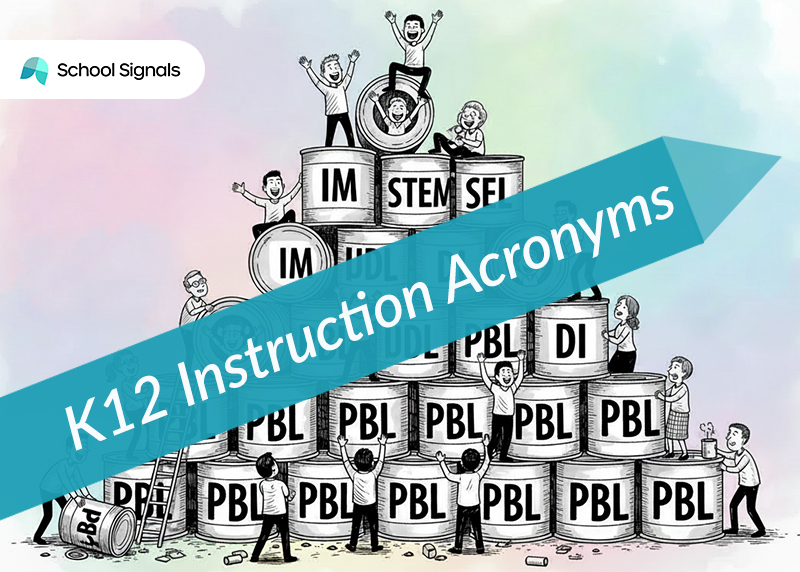
5EEngage, Explore, Explain, Elaborate, Evaluate, an inquiry-based instructional model often used in science education that guides students through investigation and understanding.
CARRContent, Activity, Reflection, Review, an instructional approach where students learn through meaningful tasks that may involve problem solving or real-world communication.
CBIContent-Based Instruction, an approach where students learn language through subject matter content such as science or history rather than isolated language drills.
CBLChallenge-Based Learning, a framework where students solve real-world challenges through phases such as engage, investigate, and act.
CLTCommunicative Language Teaching, an instructional approach focused on helping students communicate meaningfully in real-life situations rather than emphasizing grammar rules alone.
DIDifferentiated Instruction, a teaching approach where instruction is adapted to meet the different learning needs of students.
DLIDual Language Immersion, a program where students learn academic subjects in two languages to develop bilingualism and biliteracy.
ExpLExperiential Learning, an instructional approach where students learn through direct experience and reflection.
HOTSHigher-Order Thinking Skills, instructional strategies that encourage analysis, evaluation, and creative thinking rather than simple memorization.
IBLInquiry-Based Learning, an instructional approach where students investigate questions and explore ideas through inquiry.
IMIllustrative Mathematics, a standards-aligned mathematics curriculum that focuses on conceptual understanding, problem solving, and student discussion.
PBLProject-Based Learning, a teaching approach where students learn by completing extended projects that address real-world questions or challenges.
PjBLProject-Based Learning, an alternate abbreviation for the instructional method where students learn through projects and real-world investigations.
PrBLProblem-Based Learning, an instructional approach focused on solving open-ended problems that require investigation and collaboration.
SEIStructured English Immersion, an instructional approach where lessons are delivered primarily in English while supporting language development.
SELSocial and Emotional Learning, an instructional approach that helps students develop self-awareness, relationship skills, and emotional regulation.
SIOPSheltered Instruction Observation Protocol, a framework used to support English learners in accessing grade-level academic content.
SLOStudent Learning Objective, a measurable academic goal used to evaluate student progress and instructional effectiveness.
STEMScience, Technology, Engineering, and Mathematics, an educational focus that integrates these four disciplines.
STEAMScience, Technology, Engineering, Arts, and Mathematics, an extension of STEM that incorporates creative and artistic disciplines.
TWITwo-Way Immersion, a dual language program where native English speakers and native speakers of another language learn together using both languages.
UDLUniversal Design for Learning, an educational framework that designs lessons to accommodate diverse learning needs and styles.
WBLWork-Based Learning, educational experiences that connect classroom learning with real-world work opportunities such as internships.
ZPDZone of Proximal Development, a learning theory concept describing the range where students can complete tasks with guidance but not yet independently.
| Acronym | Definition | Category | Use case |
|---|---|---|---|
| 5E | Engage, Explore, Explain, Elaborate, Evaluate (an inquiry-based instructional model commonly used in science education to guide students through investigation and understanding) | Teaching Method | The science teacher chose the 5E model to boost student engagement, critical thinking, and information retention. |
| CARR | Content, Activity, Reflection, Review (an instructional approach where students learn through completing meaningful tasks that often involve problem solving or real-world communication) | Teaching Method | In the TBL lesson, students worked in groups to complete a real-world problem-solving task, how to improve classroom recycling. |
| CBI | Content-Based Instruction, an approach where students learn language through subject matter content (e.g., science, history) rather than isolated language drills | Language Support | The ESL teacher used CBI to teach vocabulary and reading skills through a unit on ecosystems. |
| CBL | Challenge-Based Learning, where students solve real-world challenges. The framework includes three interconnected phases: Engage, Investigate and Act | Teaching Method | The class follows a CBL framework for projects. |
| CLT | Communicative Language Teaching, an instructional approach that focuses on developing students’ ability to communicate meaningfully in real-life situations rather than emphasizing grammar rules in isolation | Language Support | The teacher used CLT to have ELL students practice real-life conversations in pairs. |
| DI | Differentiated Instruction | Teaching Method | Teachers use DI to meet student needs. |
| DLI | Dual Language Immersion, a program where students learn in two languages (e.g., English and Spanish) to develop bilingualism and biliteracy | Learning Program | The school offers a DLI program where students learn math and science in Spanish and English. |
| ExpL | Experiential Learning, learning through direct experience and reflection | Teaching Method | The program emphasizes ExpL through outdoor activities. |
| HOTS | Higher-Order Thinking Skills, instructional strategies that encourage analysis, evaluation, and creation rather than simple recall | Teaching Method | Students who don't like memorizing facts enjoy HOTS that emphasizes critical thinking and problem-solving. |
| IBL | Inquiry-Based Learning, where students explore questions and investigations | Teaching Method | Teachers use IBL to encourage student curiosity. |
| IM | Illustrative Mathematics, a standards-aligned math curriculum used in middle and high schools that focuses on conceptual understanding, problem-solving, and student discourse | Curriculum | The teacher is using the IM curriculum to guide daily math lessons and student discussions. |
| PBL | Project-Based Learning | Teaching Method | The class uses PBL. |
| PjBL | Project-Based Learning (alternate abbreviation) | Teaching Method | The school uses PjBL across multiple subjects. |
| PrBL | Problem-Based Learning, focused on solving open-ended problems | Teaching Method | Students engage in PrBL activities in science class. |
| SEI | Structured English Immersion, an approach where instruction is delivered primarily in English with strategies to support language development | Language Support | The teacher used SEI strategies to make grade-level content understandable in English. |
| SEL | Social and Emotional Learning, an instructional approach that develops students’ self-awareness, relationship skills, and emotional regulation | Learning Program | Students learned self-regulation techniques in their SEL class. |
| SIOP | Sheltered Instruction Observation Protocol | Language Support | Teachers use SIOP strategies. |
| SLO | Student Learning Objective | Assessment | Teachers track SLO progress. |
| STEM | Science, Technology, Engineering, Math | Learning Program | The school promotes STEM. |
| STEAM | STEM with Arts | Learning Program | Students engage in STEAM projects. |
| TWI | Two-Way Immersion, a type of dual language program that includes both native English speakers and native speakers of another language learning together | Learning Program | In the TWI classroom, English and Spanish speakers learn together using both languages daily. |
| UDL | Universal Design for Learning | Learning Program | Lessons follow UDL principles developed by CAST (Center for Applied Special Technology). |
| WBL | Work-Based Learning, connecting classroom learning to real-world work experience | Learning Program | Students participate in WBL through internships. |
| ZPD | Zone of Proximal Development | Learning Theory | Lessons target the student’s ZPD. |
Family Engagement, Committees, and Liaison Acronyms (A–Z)
The Elementary and Secondary Education Act (ESEA) in 1965 grew out of the Civil Rights movement, War on Poverty programs, and federal policy shifts that called for greater transparency and accountability. It was the first major federal program to connect funding with school responsibility and family involvement.
Later updates to ESEA, now known as ESSA, include Title I provisions that require schools to involve parents in planning and decision-making.
School committees, advisory councils, and liaison roles are visible ways for parents to participate in shaping schools. Each program brings its own structure and its own acronym.
BOEBoard of Education, the governing body that sets district policy, approves budgets, and oversees school district leadership.
CBOCCommunity-Based Oversight Committee, a group that monitors how district funds, such as bond measures, are spent.
CICCampus Improvement Committee, a school-level group that reviews data and helps develop and monitor improvement goals.
CLCommunity Liaison, a staff member who connects schools with families and community resources and supports outreach efforts.
DACDistrict Advisory Committee, a district-level group that provides input on programs, policies, and improvement priorities.
DEICDistrict Educational Improvement Council, a committee that oversees district-wide planning and alignment with improvement goals.
DELACDistrict English Learner Advisory Committee, a district-level committee that advises on programs and services for multilingual learners.
ELACEnglish Learner Advisory Committee, a school-level group that provides input on programs and support for English learners.
FACFacilities Advisory Committee, a committee that advises on school buildings, maintenance needs, and capital improvement projects.
FACEFamily and Community Engagement, an office or initiative focused on strengthening partnerships between schools, families, and the community.
FECFamily Engagement Coordinator, a staff member responsible for organizing family outreach, events, and communication efforts.
HBHomeless Education designation, a role connected to the McKinney-Vento Act that supports students experiencing housing instability.
ILTInstructional Leadership Team, a group of school leaders and teachers focused on improving instruction and curriculum alignment.
LPCLong-Range Planning Committee, a committee that focuses on enrollment trends, facilities planning, and future district needs.
LSCLocal School Council, a school-based governance committee made up of parents, teachers, community members, and the principal that oversees school leadership, improvement plans, and budgets.
PACParent Advisory Committee, a group of parents who provide feedback and input on school programs and initiatives.
PBISPositive Behavioral Interventions and Supports, a framework and team that promotes positive behavior and supports a healthy school climate.
PICParent Involvement Coordinator, a staff member who supports family engagement activities, often connected to Title I programs.
PTAParent Teacher Association, a national organization that supports schools through volunteering, advocacy, and fundraising.
PTOParent Teacher Organization, a school-based parent group similar to a PTA but independently operated.
SACSchool Advisory Council, a committee that advises school leadership on policies, goals, and improvement efforts.
SBDMSite-Based Decision Making, a committee structure that allows school-level input on policies, curriculum, and operations.
SHACSchool Health Advisory Council, a committee that advises districts on health education, wellness policies, and student well-being programs.
SITSchool Improvement Team, a group responsible for implementing and monitoring school improvement strategies.
SSCSchool Site Council, a committee that oversees school plans, budgets, and compliance requirements in certain states.
| Acronym | Description | Category | Use case |
|---|---|---|---|
| BOE | Board of Education, governing body that sets district policy, approves budgets, and oversees leadership | School Planning, Funding, and Compliance | The BOE approved the district budget. |
| CBOC | Community-Based Oversight Committee, group that monitors how district funds, such as bond measures, are spent | School Planning, Funding, and Compliance | The CBOC reviews expenditures from recent bond projects. |
| CIC | Campus Improvement Committee, school-level group that reviews data and helps develop and monitor improvement goals | School Improvement Planning | The CIC reviewed student performance data. |
| CL | Community Liaison, staff member who connects schools with families and community resources and supports outreach efforts | School Operations | The CL helps families access local services. |
| DAC | District Advisory Committee, district-level group that provides input on programs, policies, and improvement priorities | School Planning, Funding, and Compliance | The DAC reviewed district priorities for the upcoming year. |
| DEIC | District Educational Improvement Council, oversees district-wide planning and alignment with improvement goals | School Improvement Planning | The DEIC approved updates to the district plan. |
| DELAC | District English Learner Advisory Committee, advises on services and programs for multilingual learners at the district level | School Planning, Funding, and Compliance | DELAC reviews district programs for multilingual learners. |
| ELAC | English Learner Advisory Committee, school-level group that provides input on services and support for English learners | School Planning, Funding, and Compliance | ELAC provides input on services for English learners. |
| FAC | Facilities Advisory Committee, advises on school buildings, maintenance needs, and capital improvement projects | School Planning, Funding, and Compliance | The FAC reviewed campus renovation plans. |
| FACE | Family and Community Engagement, office or initiative focused on strengthening partnerships between schools, families, and the community | School Operations | The FACE team supports outreach to families. |
| FEC | Family Engagement Coordinator, staff member responsible for organizing family outreach, events, and communication efforts | School Operations | The FEC is organizing a parent workshop. |
| HB | Homeless Education designation under McKinney-Vento, often used in roles supporting students experiencing housing instability | School Planning, Funding, and Compliance | The HB coordinator supports eligible students. |
| ILT | Instructional Leadership Team, group of school leaders and teachers focused on improving instruction and curriculum alignment | Academic Programs | The ILT reviews instructional strategies. |
| LPC | Long-Range Planning Committee, focuses on enrollment trends, facilities planning, and future district needs | School Planning, Funding, and Compliance | The LPC discussed future campus expansion. |
| LSC | Local School Council, a school-based governance committee, commonly used in districts such as Chicago Public Schools, made up of parents, teachers, community members, and the principal. The council helps oversee school leadership, approves the school improvement plan and budget, and represents the voice of the school community. | School Planning, Funding, and Compliance | The LSC participates in school governance decisions. |
| PAC | Parent Advisory Committee, group of parents who provide feedback and input on school programs and initiatives | School Operations | The PAC meets to discuss school programs. |
| PBIS | Positive Behavioral Interventions and Supports, framework and team that promotes positive behavior and supports school climate | School Operations | The PBIS team tracks behavior data. |
| PIC | Parent Involvement Coordinator, staff member who supports family engagement activities, often connected to Title I programs | School Planning, Funding, and Compliance | The PIC shared updates on family engagement events. |
| PTA | Parent Teacher Association, national organization that supports schools through volunteering, advocacy, and fundraising | School Operations | The PTA organized the fundraiser. |
| PTO | Parent Teacher Organization, school-based parent group similar to PTA but independently operated | School Operations | The PTO coordinates volunteer efforts. |
| SAC | School Advisory Council, committee that advises school leadership on policies, goals, and improvement efforts | School Planning, Funding, and Compliance | The SAC reviews school policies. |
| SBDM | Site-Based Decision Making, committee structure that allows school-level input on policies, curriculum, and operations | School Planning, Funding, and Compliance | The SBDM approved curriculum updates. |
| SHAC | School Health Advisory Council, advises districts on health education, wellness policies, and student well-being programs | School Planning, Funding, and Compliance | The SHAC reviewed updates to the health curriculum. |
| SIT | School Improvement Team, group responsible for implementing and monitoring school improvement strategies | School Improvement Planning | The SIT monitors progress on school goals. |
| SSC | School Site Council, committee that oversees school plans, budgets, and compliance requirements in certain states | School Planning, Funding, and Compliance | The SSC oversees school plans and budgets. |
Major U.S. K–12 Education Laws (Historical Overview)
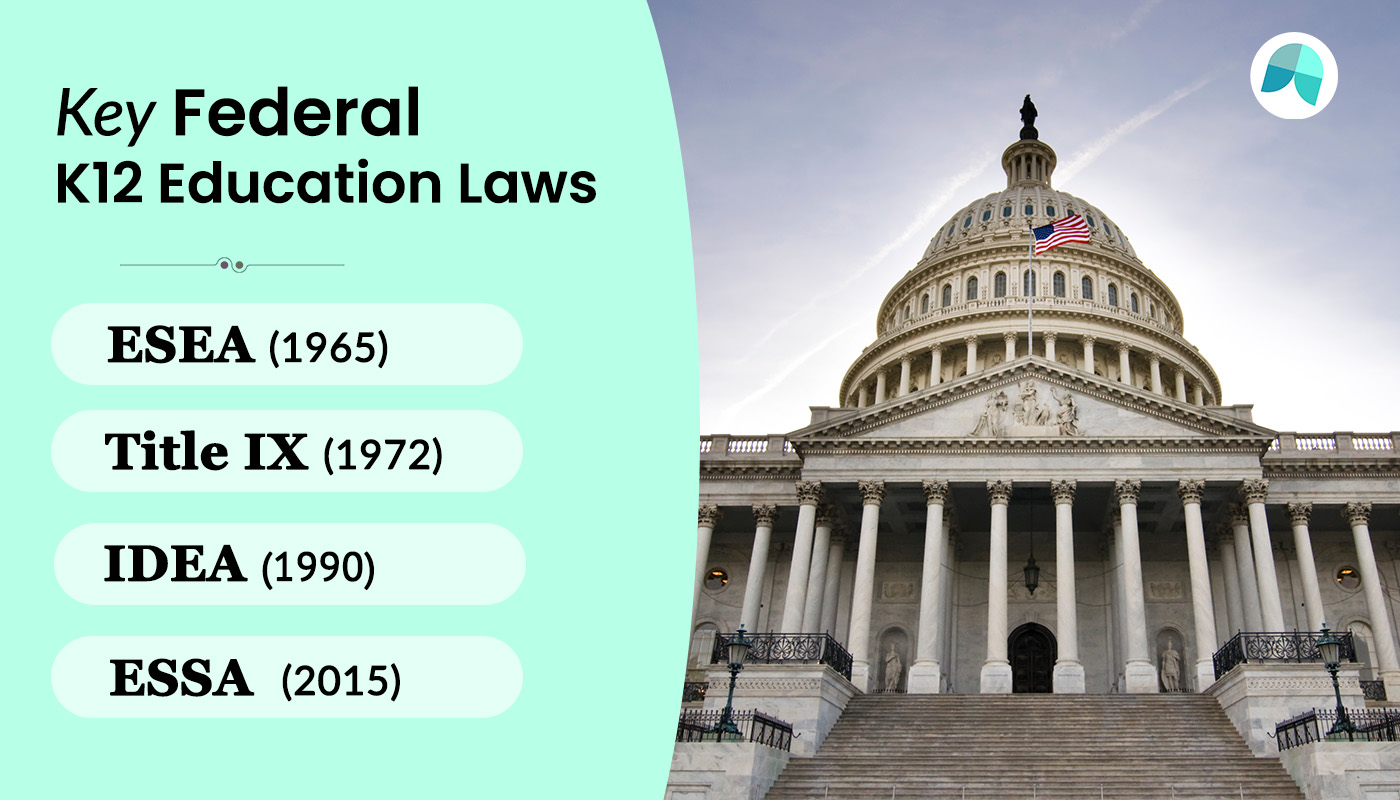
CRACivil Rights Act of 1964, a federal law establishing protections against discrimination based on race, color, religion, sex, or national origin in federally funded programs.
ESEAElementary and Secondary Education Act, the foundational federal law establishing funding and support for K–12 education programs.
Title ITitle I, Part A (ESEA), a federal funding program that supports schools with high percentages of low-income students.
Title IITitle II, Part A (ESEA), a federal funding program focused on teacher and staff development and improving educator effectiveness.
Title IIITitle III, Part A (ESEA), a federal funding program that supports English learners and language instruction programs.
Title IVTitle IV, Part A (ESEA), a federal funding program that supports student enrichment, well-rounded education, and safe and healthy schools.
Title IXTitle IX of the Education Amendments of 1972, a federal law establishing protections against sex-based discrimination in education programs and activities.
Section 504Section 504 of the Rehabilitation Act of 1973, a federal civil rights law establishing protections and accommodations for individuals with disabilities in federally funded programs.
FERPAFamily Educational Rights and Privacy Act, a federal law establishing privacy protections and access rights for student education records.
EHAEducation for All Handicapped Children Act, a federal law that established the right to a free appropriate public education for students with disabilities and later evolved into IDEA.
MVAMcKinney-Vento Act, a federal law that protects the educational rights of students experiencing homelessness.
ADAAmericans with Disabilities Act, a federal law requiring accessibility and equal opportunities for individuals with disabilities in public services.
IDEAIndividuals with Disabilities Education Act, a federal law that ensures special education services and individualized planning for students with disabilities.
NCLBNo Child Left Behind Act, a federal law that established nationwide accountability requirements based on standardized testing and school performance.
ESSAEvery Student Succeeds Act, the current federal law governing K–12 education that reauthorized ESEA and gave states more flexibility in accountability systems.
| Law Acronym | Year Passed | Definition of the Law | Category | To Note | Use example |
|---|---|---|---|---|---|
| CRA | 1964 | Civil Rights Act, a federal law establishing protections against discrimination based on race, color, religion, sex, or national origin in federally funded programs | Civil Rights Law | Foundation for federal nondiscrimination requirements in education. | Schools must ensure equal access to programs and services under CRA protections. |
| ESEA | 1965 | Elementary and Secondary Education Act, the foundational federal law establishing funding and support for K–12 education programs | Federal Education Law | Reauthorized multiple times; current version is ESSA (2015). | Federal education funding and programs are structured under ESEA. |
| Title I | 1965 | Title I, Part A (ESEA), a federal funding program supporting schools with high percentages of low-income students | Federal Funding Law | Core equity-focused funding stream under ESEA. | The school uses Title I funds to provide additional academic support. |
| Title II | 2015 | Title II, Part A (ESEA), a federal funding program focused on teacher and staff development and effectiveness | Federal Funding Law | Current structure defined under ESSA. | The district uses Title II funds for professional development. |
| Title III | 2015 | Title III, Part A (ESEA), a federal funding program supporting English learners and language instruction programs | Federal Funding Law | Supports language acquisition and multilingual communication. | The district uses Title III funds to support multilingual learners. |
| Title IV | 2015 | Title IV, Part A (ESEA), a federal funding program supporting student enrichment, well-rounded education, and safe and healthy schools | Federal Funding Law | Expanded under ESSA to support whole-child initiatives. | The school uses Title IV funds for student support programs. |
| Title IX | 1972 | Title IX of the Education Amendments, a federal law establishing protections against sex-based discrimination in education programs and activities | Civil Rights Law | Enforced by OCR. | Schools must comply with Title IX in athletics, programs, and student protections. |
| Section 504 | 1973 | Section 504 of the Rehabilitation Act, a federal civil rights law establishing protections and accommodations for individuals with disabilities in federally funded programs | Civil Rights Law | Broader than IDEA; applies to any qualifying disability. | Schools provide accommodations through Section 504 plans. |
| FERPA | 1974 | Family Educational Rights and Privacy Act, a federal law establishing privacy rights for student education records and access for parents | Student Privacy Law | Governs data sharing and parent access. | Schools must protect and manage access to student records under FERPA. |
| EHA | 1975 | Education for All Handicapped Children Act, a federal law establishing the right to a free appropriate public education for students with disabilities (later reauthorized as IDEA) | Special Education Law | Predecessor to IDEA. | This law laid the foundation for modern special education services. |
| MVA | 1987 | McKinney-Vento Act, a federal law establishing educational access and stability protections for students experiencing homelessness | Student Support Law | Ensures school of origin stability. | Schools must provide enrollment and transportation support under MVA. |
| ADA | 1990 | Americans with Disabilities Act, a federal law establishing accessibility requirements and protections for individuals with disabilities in public services | Civil Rights Law | Applies beyond education to all public services. | Schools must ensure facilities and programs are accessible under ADA. |
| IDEA | 1990 | Individuals with Disabilities Education Act, a federal law establishing special education services and individualized planning for students with disabilities | Special Education Law | Requires IEPs and procedural safeguards. | Schools develop and implement IEPs under IDEA. |
| NCLB | 2001 | No Child Left Behind Act, a federal law establishing nationwide accountability requirements based on standardized testing and school performance | Federal Education Law | Replaced by ESSA in 2015. | Schools were required to meet performance targets and implement improvement plans under NCLB. |
| ESSA | 2015 | Every Student Succeeds Act, a federal law reauthorizing ESEA and establishing a more flexible, state-led approach to accountability and school improvement | Federal Education Law | Current governing framework under ESEA. | States set accountability systems and oversee school improvement under ESSA. |
National Education Organizations (A–Z)
AASAAmerican Association of School Administrators, an organization that supports school system leaders through advocacy, leadership development, and professional resources.
ACEAmerican Council on Education, an organization that represents higher education institutions and provides policy guidance for colleges and universities.
AACTEAmerican Association of Colleges for Teacher Education, an organization that supports universities and colleges that prepare future teachers and school leaders.
AERAAmerican Educational Research Association, an organization that advances education research and publishes scholarly journals and conferences.
AMIAssociation Montessori Internationale, an organization that supports authentic Montessori education and teacher certification worldwide.
AMSAmerican Montessori Society, an organization that provides teacher training, accreditation, and professional resources for Montessori schools.
ANSIAmerican National Standards Institute, an organization that oversees standards used across industries, including standards for continuing education programs.
ASCDAssociation for Supervision and Curriculum Development, an organization that provides professional learning and leadership resources for educators.
CASECouncil of Administrators of Special Education, an organization that supports leadership and administration in special education programs.
CASELCollaborative for Academic, Social, and Emotional Learning, an organization that develops frameworks and resources for implementing social-emotional learning in schools.
CCSSOCouncil of Chief State School Officers, an organization that brings together state education leaders to coordinate national education initiatives.
CECCouncil for Exceptional Children, an organization that provides professional development and advocacy for special education teachers.
COPAACouncil of Parent Attorneys and Advocates, an organization that helps families advocate for students with disabilities.
EDU.S. Department of Education, the federal agency responsible for national education policy, funding programs, and civil rights enforcement in schools.
ECSEducation Commission of the States, an organization that provides policy research and guidance to state education leaders.
IACETInternational Association for Continuing Education and Training, an organization that accredits providers offering continuing education units (CEUs).
IBInternational Baccalaureate, an organization that provides globally recognized academic programs for K–12 students.
EMAEnrollment Management Association, an organization that supports independent schools with admissions, enrollment, and marketing strategies.
MACTEMontessori Accreditation Council for Teacher Education, an organization that accredits Montessori teacher training programs in the United States.
NAEYCNational Association for the Education of Young Children, an organization that sets standards and accreditation for early childhood education programs.
NAFSCENational Association for Family, School, and Community Engagement, an organization that promotes family engagement practices in education.
NCFLNational Center for Families Learning, an organization that develops family literacy programs for children and families.
NCEANational Catholic Educational Association, an organization that supports Catholic schools through leadership, research, and professional development.
NEANational Education Association, the largest labor union representing public school educators in the United States.
NFINational Fatherhood Initiative, an organization that promotes father involvement in children’s education and development.
NIEERNational Institute for Early Education Research, an organization that conducts research on early childhood education policy and program effectiveness.
OCROffice for Civil Rights, a division of the U.S. Department of Education that enforces federal civil rights laws in schools.
ZERO TO THREEZERO TO THREE, a nonprofit organization focused on early childhood development from birth to age three.
| Acronym | Name | Type | Use example |
|---|---|---|---|
| AASA | American Association of School Administrators | Organization | AASA supports school system leaders with advocacy and professional resources. |
| ACE | American Council on Education | Organization | ACE represents higher education institutions and provides policy guidance for colleges and universities. |
| ACTE | American Association of Colleges for Teacher Education | Organization | AACTE supports universities and colleges that prepare future teachers and school leaders. |
| AERA | American Educational Research Association | Organization | AERA publishes research and organizes conferences focused on advancing education research. |
| AMI | Association Montessori Internationale | Organization | AMI supports authentic Montessori education and teacher certification worldwide. |
| AMS | American Montessori Society | Organization | AMS provides teacher training, accreditation, and resources for Montessori schools. |
| ANSI | American National Standards Institute | Organization | ANSI oversees standards used across industries, including the ANSI/IACET standard for continuing education programs. |
| ASCD | Association for Supervision and Curriculum Development | Organization | ASCD provides professional development resources for teachers and school leaders. |
| CASE | Council of Administrators of Special Education | Organization | CASE supports leadership and administration in special education programs. |
| CASEL | Collaborative for Academic, Social, and Emotional Learning | Organization | CASEL develops frameworks and resources for implementing social-emotional learning in schools. |
| CCSSO | Council of Chief State School Officers | Organization | CCSSO brings together state education leaders to coordinate national education initiatives. |
| CEC | Council for Exceptional Children | Organization | CEC provides professional development and advocacy for special education teachers. |
| COPAA | Council of Parent Attorneys and Advocates | Organization | COPAA helps families advocate for students with disabilities. |
| ED | U.S. Department of Education, the federal agency responsible for national education policy, funding programs, and civil rights enforcement in schools | Government Agency | The district follows guidance from ED on federal education programs and compliance requirements. |
| ECS | Education Commission of the States | Organization | ECS provides policy research and guidance to state education leaders across the United States. |
| IACET | International Association for Continuing Education and Training | Organization | IACET accredits organizations that offer professional learning and continuing education units (CEUs). |
| IB | International Baccalaureate, an organization that provides globally recognized academic programs for K–12 students | Organization | The school offers IB programs to provide an internationally focused curriculum. |
| EMA | Enrollment Management Association, an organization that supports independent schools with enrollment, admissions, and marketing strategies | Organization | Independent schools may use EMA resources to guide admissions and enrollment planning. |
| MACTE | Montessori Accreditation Council for Teacher Education, an organization that accredits Montessori teacher training programs in the United States | Organization | Montessori teacher education programs may be accredited by MACTE. |
| NAEYC | National Association for the Education of Young Children | Organization | NAEYC sets standards and accreditation for early childhood education programs. |
| NAFSCE | National Association for Family, School, and Community Engagement | Organization | NAFSCE promotes family engagement practices in education. |
| NCFL | National Center for Families Learning | Organization | NCFL develops family literacy programs for children and families. |
| NCEA | National Catholic Educational Association, an organization that supports Catholic schools through leadership, research, and professional development | Organization | Catholic schools may work with NCEA for resources and national guidance. |
| NEA | National Education Association, the largest labor union representing public school educators in the United States | Organization | Teachers may be members of the NEA for professional support and advocacy. |
| NFI | National Fatherhood Initiative | Organization | NFI promotes father involvement in children’s education and development. |
| NIEER | National Institute for Early Education Research | Organization | NIEER conducts research on early childhood education policy and program effectiveness. |
| OCR | Office for Civil Rights, a division of the U.S. Department of Education that enforces federal civil rights laws in schools | Government Agency | Schools must follow OCR guidance to ensure students are not discriminated against. |
| ZERO TO THREE | ZERO TO THREE, a nonprofit focused on early childhood development from birth to age three | Organization | ZERO TO THREE provides resources on early learning and child development. |
School Planning, Compliance, and Policy Acronyms (A–Z)
| Acronym | Definition | Category | Example use |
|---|---|---|---|
| ADA | Americans with Disabilities Act (law requiring accessibility and equal access) | Compliance | The school follows ADA. |
| AUP | Acceptable Use Policy, guidelines that define how students and staff may use school technology and internet access | School Policy / Technology | Students and their parents/guardians must sign the AUP before students receive device access. |
| CAN-SPAM | Controlling the Assault of Non-Solicited Pornography and Marketing Act (law governing email communication and opt-out requirements) | Communication Compliance | School emails must comply with CAN-SPAM, including providing unsubscribe options. |
| CIP | Campus Improvement Plan (campus-level plan used to set goals and guide school improvement efforts) | Planning | The CIP includes academic goals. |
| COPPA | Children’s Online Privacy Protection Act (law regulating student data collection online) | Compliance | The app complies with COPPA. |
| CSIP | Comprehensive School Improvement Plan (broader plan including academics, operations, and climate) | Planning | The CSIP outlines strategies. |
| ESEA | Elementary and Secondary Education Act (federal law governing K–12 education programs and funding in the United States) Note: The Elementary and Secondary Education Act (ESEA) is the original federal education law passed in 1965. It has been updated several times over the years. The current version is called the Every Student Succeeds Act (ESSA). It passed in 2015. | Federal Policy | Title I is part of ESEA and supports schools serving low-income students. |
| ESSA | Every Student Succeeds Act (federal law governing accountability and school performance) | Federal Policy | The district follows ESSA. |
| FCC | Federal Communications Commission (agency regulating communication systems including phone and messaging) | Regulatory Agency | The FCC enforces communication rules. |
| FERPA | Family Educational Rights and Privacy Act (law protecting student records and privacy) | Compliance | FERPA protects records. |
| OCR | The Office for Civil Rights | Compliance | OCR investigates complaints. |
| PPRA | Protection of Pupil Rights Amendment (law governing student surveys and sensitive information) | Compliance | Surveys follow PPRA. |
| RUP | Responsible Use Policy, an alternative term for Acceptable Use Policy (AUP) | School Policy / Technology | Some schools refer to their device usage agreement as a RUP instead of an AUP. |
| SBDM | Site-Based Decision Making (a governance model where school-level teams make decisions about policies, budgets, and instruction) | School Governance / Policy | The SBDM council meets to review school priorities, with staff and parent representatives providing input on budget and instructional decisions. |
| SCEP | School Comprehensive Education Plan (state-required plan including academic and support strategies) | Planning | The SCEP includes school goals. |
| SCP | School Climate Plan (plan focused on improving school culture, safety, and environment) | Planning | The school developed an SCP. |
| SEA | State Education Agency , the state-level body responsible for overseeing public education and implementing federal and state policies | Governance | The SEA sets state policy. |
| SIP | School Improvement Plan (a school-level plan outlining goals and strategies to improve student outcomes; required for underperforming schools and commonly required across public schools) | Planning | The SIP outlines improvement goals. |
| TCPA | Telephone Consumer Protection Act (law regulating calls and text messages, requiring consent for automated messaging) | Communication Compliance | Under TCPA, schools must obtain consent before sending automated text messages or calls. |
ADAAmericans with Disabilities Act, a federal law requiring accessibility and equal access for individuals with disabilities in public services and facilities.
AUPAcceptable Use Policy, guidelines that define how students and staff may use school technology and internet access.
CAN-SPAMControlling the Assault of Non-Solicited Pornography and Marketing Act, a federal law governing email communication and requiring opt-out options for recipients.
CIPCampus Improvement Plan, a campus-level plan used to set goals and guide school improvement efforts.
COPPAChildren’s Online Privacy Protection Act, a federal law regulating the collection of personal information from children online.
CSIPComprehensive School Improvement Plan, a broader planning document that includes goals for academics, operations, and school climate.
ESEAElementary and Secondary Education Act, the foundational federal law governing K–12 education programs and funding in the United States. The current version of this law is the Every Student Succeeds Act (ESSA), passed in 2015.
ESSAEvery Student Succeeds Act, the current federal law governing accountability, school performance, and education funding in the United States.
FCCFederal Communications Commission, the federal agency that regulates communication systems including phone, internet, and messaging services.
FERPAFamily Educational Rights and Privacy Act, a federal law protecting the privacy of student education records and providing parents access rights.
OCROffice for Civil Rights, a division of the U.S. Department of Education responsible for enforcing federal civil rights laws in schools.
PPRAProtection of Pupil Rights Amendment, a federal law governing student surveys and the collection of sensitive personal information.
RUPResponsible Use Policy, an alternative term for an Acceptable Use Policy that defines appropriate use of school technology and digital resources.
SBDMSite-Based Decision Making, a governance model where school-level teams make decisions about policies, budgets, and instructional priorities.
SCEPSchool Comprehensive Education Plan, a state-required plan that outlines academic goals and strategies to support student success.
SCPSchool Climate Plan, a plan focused on improving school culture, safety, and the overall learning environment.
SEAState Education Agency, the state-level body responsible for overseeing public education and implementing federal and state policies.
SIPSchool Improvement Plan, a school-level plan outlining goals and strategies to improve student outcomes.
TCPATelephone Consumer Protection Act, a federal law regulating phone calls and text messages, including requirements for consent before automated communications are sent.
School Improvement Planning Acronyms
ESSA (Every Student Succeeds Act) is a federal law signed into law by President Obama in December 2015, replacing the No Child Left Behind Act (NCLB). It governs how public schools in the United States are held accountable for student outcomes.
ESSA requires states to identify underperforming schools and ensure those schools develop and implement improvement plans. These plans must include evidence-based strategies, involve stakeholders such as families, and be monitored over time for progress.
ESSA does not provide a specific template for improvement plans. Instead, it sets the requirement, and states translate that requirement into structured planning frameworks. These plans are commonly referred to as School Improvement Plans (SIP), but the names vary by state as shown in the table below.
SIPSchool Improvement Plan, a state-required school-level plan outlining goals, strategies, and actions to improve student outcomes.
LCAPLocal Control and Accountability Plan, California’s planning framework that links district goals, funding priorities, and stakeholder engagement.
MICIPMichigan Integrated Continuous Improvement Process, Michigan’s statewide framework guiding schools through a continuous improvement cycle of assessing needs, planning strategies, implementing actions, and evaluating results.
One PlanConsolidated Improvement Plan, Ohio’s unified planning process that combines multiple funding and school improvement requirements into one plan.
SCEPSchool Comprehensive Education Plan, New York’s required school improvement plan that outlines goals, strategies, and stakeholder involvement for identified schools.
TIPTexas Improvement Plan, a Texas-required improvement plan for identified schools that includes needs assessment, strategies, and progress monitoring.
Title ITitle I, Part A (ESEA), a federal funding program that supports schools with high percentages of low-income students and includes requirements for family engagement planning.
| Acronym | Description | Category | Use example |
|---|---|---|---|
| SIP | School Improvement Plan (state-required school-level plan outlining goals, strategies, and actions to improve student outcomes; commonly used across many states including Florida, Georgia, Illinois, Massachusetts, North Carolina, Pennsylvania, Tennessee) | Planning / Compliance | The school’s SIP includes strategies to strengthen family engagement. |
| LCAP | Local Control and Accountability Plan (California’s planning framework linking goals, funding, and stakeholder engagement across districts and schools) | Planning / Compliance | The district’s LCAP outlines goals for improving student outcomes and family engagement. |
| MICIP | Michigan Integrated Continuous Improvement Process (Michigan’s statewide framework guiding schools through a continuous improvement cycle of assess, plan, implement, and evaluate) | Planning / Compliance | The school uses MICIP to guide its improvement planning and stakeholder engagement. |
| One Plan | Consolidated Improvement Plan (Ohio’s unified planning process that combines multiple funding and improvement requirements into one plan) | Planning / Compliance | The district completes the One Plan to align improvement strategies across programs. |
| SCEP | School Comprehensive Education Plan (New York’s required school improvement plan for identified schools, including goals, strategies, and stakeholder involvement) | Planning / Compliance | The school developed its SCEP to address performance gaps and improve engagement. |
| TIP | Texas Improvement Plan (Texas-required improvement plan for identified schools, including needs assessment, strategies, and monitoring) | Planning / Compliance | The school’s TIP includes actions to improve attendance and family communication. |
| Title I | Federal funding program under ESEA supporting schools with high percentages of low-income students, including requirements for family engagement planning | Federal Programs | Title I requires schools to develop and implement a family engagement plan. |
School Funding Programs and Grants (A–Z)
Use this table as a reference to understand the funding programs and grants that support K–12 education, school operations, and student services.
21st CCLC21st Century Community Learning Centers, a federal funding program that supports after-school and extended learning opportunities for students.
ADA (Funding)Average Daily Attendance, a student attendance measure used in some states, such as Texas, to determine school funding levels.
ADMAverage Daily Membership, a student enrollment count used by many states to calculate school funding allocations.
CEPCommunity Eligibility Provision, a federal program that allows schools to provide free meals to all students without collecting individual meal applications.
ESEAElementary and Secondary Education Act, the federal law that authorizes major K–12 education funding programs including Title I through Title IV.
ESSERElementary and Secondary School Emergency Relief, federal emergency funding provided to schools to address the impact of COVID-19 and support learning recovery.
FRLFree and Reduced-Price Lunch, a federal meal program providing free or reduced-cost meals to eligible students and commonly used as an indicator of economic need in schools.
GEERGovernor’s Emergency Education Relief, state-administered federal emergency funding created to support education during COVID-19 disruptions.
IDEAIndividuals with Disabilities Education Act, a federal law that provides funding to support special education services for eligible students.
NSLPNational School Lunch Program, a federal program that provides free or reduced-price meals to eligible students.
SBPSchool Breakfast Program, a federal program that provides breakfast to students, often at free or reduced cost.
SIGSchool Improvement Grant, a federal program active primarily from 2009 to 2015 that funded turnaround efforts in the lowest-performing schools.
SWPSchoolwide Program, a Title I model that allows eligible schools to use federal funds to support all students.
TASTargeted Assistance School, a Title I model where services are provided only to students identified as needing additional academic support.
Title ITitle I, Part A (ESEA), a federal funding program that supports schools with high percentages of low-income students.
Title IITitle II, Part A (ESEA), a federal funding program that supports teacher recruitment, training, and professional development.
Title IIITitle III, Part A (ESEA), a federal funding program that supports multilingual learners and language instruction programs.
Title IVTitle IV, Part A (ESEA), a federal funding program that supports well-rounded education, safe schools, and student support services.
| Acronym | Description | Category | Use case |
|---|---|---|---|
| 21st CCLC | 21st Century Community Learning Centers (federal funding program supporting after-school and extended learning programs) | Federal Funding | The school offers after-school programs funded by 21st CCLC. |
| ADA (Funding) | Average Daily Attendance (student attendance measure used in some states, such as Texas, to determine school funding levels). Calculated as: Sum of Attendance Counts ÷ Days of Instruction. | State Funding | ADA impacts how much funding the school receives. |
| ADM | Average Daily Membership (student enrollment count used by many states to calculate school funding allocations) | State Funding | ADM is used to determine district funding levels. |
| CEP | Community Eligibility Provision (federal program allowing schools to provide free meals to all students without collecting applications) | Federal Program | The school uses CEP to provide free meals to all students. |
| ESEA | Elementary and Secondary Education Act (federal law that authorizes major K–12 funding programs, including Title I–IV) | Federal Law / Funding | The district receives ESEA funds to support multiple education programs. |
| ESSER | Elementary and Secondary School Emergency Relief (federal COVID-19 relief funding provided to support schools and learning recovery) | Federal Funding | The district used ESSER funds to upgrade technology and support instruction. |
| FR | Free and Reduced-Price Lunch (a federal meal program that provides free or reduced-cost meals to students based on household income; widely used by schools as an indicator for funding eligibility and economic need) | Federal Program | The school uses FRL data to determine eligibility for meal programs and to identify students and campuses that may qualify for additional funding and support. |
| GEER | Governor’s Emergency Education Relief (state-administered federal emergency funding to support education during COVID-19 disruptions) | Federal Funding | GEER funds supported remote learning initiatives. |
| IDEA | Individuals with Disabilities Education Act (federal law that provides funding to support special education services for eligible students) | Federal Funding / Special Education | IDEA funds support special education staffing and services. |
| NSLP | National School Lunch Program (federal program that provides free or reduced-price meals to eligible students) | Federal Program | Students qualify for meals through the NSLP. |
| SBP | School Breakfast Program (federal program that provides breakfast to students, often at free or reduced cost) | Federal Program | The school participates in the SBP to support student nutrition. |
| SIG | School Improvement Grant (federal program active primarily 2009–2015 that funded turnaround efforts in the lowest-performing schools, later replaced under ESSA by Title I Section 1003 funds) | Federal Program / School Improvement | The district received SIG funding to implement turnaround strategies. |
| SWP | Schoolwide Program (Title I model allowing schools to use federal funds to support all students in eligible schools) | Federal Funding | The school operates as a SWP to support all students. |
| TAS | Targeted Assistance School (Title I model where services are provided only to identified students who need additional support) | Federal Funding | The school uses a TAS model to support selected students. |
| Title I | Federal funding program supporting schools with high percentages of low-income students to improve academic outcomes | Federal Funding | Title I funds support additional academic services for students. |
| Title II | Federal funding program that supports teacher training, recruitment, and professional development | Federal Funding | Title II funds are used for teacher training and support. |
| Title III | Federal funding program that supports multilingual learners and language instruction programs | Federal Funding | Title III funding supports services for multilingual learners. |
| Title IV | Federal funding program that supports well-rounded education, safe schools, and student support services | Federal Funding | Title IV funds support counseling and enrichment programs. |
Federal Reporting & Accountability Acronyms in Education (A–Z)
These federal reporting and accountability acronyms are most often used by district leaders, federal program coordinators, and state reporting teams to analyze school performance, program effectiveness, and compliance with federal requirements.
Acronyms such as ACGR (Adjusted Cohort Graduation Rate) and CRDC (Civil Rights Data Collection) refer to data reported to the federal government. Acronyms such as CSPR (Consolidates State Performance Report) describe reports that organize and submit that data, while MOE (Maintenance of Effort) and EDGAR (Education Department General Requirements) define funding and compliance requirements tied to federal programs.
ACGRAdjusted Cohort Graduation Rate, the federally required method used to calculate high school graduation rates.
CSPRConsolidated State Performance Report, a federal report submitted by states that summarizes education program outcomes and compliance data.
CRDCCivil Rights Data Collection, a national dataset collected by the U.S. Department of Education that tracks equity, access, and civil rights indicators in schools.
EDGAREducation Department General Administrative Regulations, federal regulations that govern how education grants and funding programs must be administered.
GEPAGeneral Education Provisions Act, a federal law that outlines rules and requirements for administering federal education programs.
MOEMaintenance of Effort, a funding requirement that ensures states and districts maintain consistent education spending levels in order to receive federal funds.
NAEPNational Assessment of Educational Progress, a nationwide assessment often called the “Nation’s Report Card” that measures student achievement across the United States.
REAPRural Education Achievement Program, a federal funding program designed to support rural school districts.
SLDSStatewide Longitudinal Data System, a statewide data system used to track student information and outcomes over time.
SPPState Performance Plan, a federally required plan outlining how states improve outcomes for students receiving special education services.
AMAOAnnual Measurable Achievement Objectives, targets used in federal programs to track progress and performance of English learners.
| Acronym | Definition | Category | Example |
|---|---|---|---|
| ACGR | Adjusted Cohort Graduation Rate, the federally required method for calculating high school graduation rates | Assessment / Accountability | The district reported its ACGR in the annual performance report. |
| CSPR | Consolidated State Performance Report, a federal report submitted by states on education programs and outcomes | Compliance / Reporting | Data from multiple programs is compiled into the CSPR each year. |
| CRDC | Civil Rights Data Collection, a national dataset on equity and access in schools collected by the U.S. Department of Education | Compliance / Equity | The district reviewed CRDC data to assess disparities. |
| EDGAR | Education Department General Administrative Regulations, federal rules governing education grants | Policy / Compliance | Funding requirements are outlined in EDGAR. |
| GEPA | General Education Provisions Act, federal law governing education program administration | Federal Law | GEPA applies to most federally funded education programs. |
| MOE | Maintenance of Effort, a requirement that districts maintain consistent funding levels to receive federal aid | School Finance / Compliance | The district met MOE requirements to retain funding. |
| NAEP | National Assessment of Educational Progress, a nationwide assessment often called the “Nation’s Report Card” | Assessment | NAEP results provide a national comparison of student performance. |
| REAP | Rural Education Achievement Program, federal funding designed to support rural districts | Federal Programs | The district qualified for REAP funding. |
| SLDS | Statewide Longitudinal Data System, a system used to track student data over time | Data Systems | The SLDS helps monitor long-term student outcomes. |
| SPP | State Performance Plan, a required plan outlining how states improve special education outcomes | Special Education | The state updates its SPP annually. |
| AMAO | Annual Measurable Achievement Objectives, targets for English learner progress under federal programs | Federal Programs | Schools monitored AMAO targets for language development. |
Teacher Professional Development Acronyms (A–Z)

Professional development provides teachers opportunities to learn about new teaching and classroom management methods, styles and techniques. From required training hours to collaborative planning and instructional strategies, these acronyms show up in meetings, emails, and evaluation systems.
Teachers complete PD through a mix of scheduled in-service days (INSET), ongoing collaboration in PLCs, and required training tracked through systems like an LMS.
They may also work toward certification requirements such as CPE hours or CEUs, often guided by your PDP or IPDP and evaluated through frameworks like TTESS. In public schools, professional development may add up to 30 hours each year, depending on state requirements and district expectations.
With so many acronyms related to teachers’ professional development, it can feel overwhelming to keep up, so let’s review them.
PDProfessional Development, structured learning opportunities that help educators improve their teaching practice and instructional strategies.
CPDContinuing Professional Development, ongoing learning activities that support educator growth beyond initial certification.
CPEContinuing Professional Education, required training hours that educators must complete in some states to maintain certification.
CEUContinuing Education Unit, a credit awarded for completing approved professional development or continuing education activities.
PLCProfessional Learning Community, a group of educators who collaborate regularly to improve instruction and student outcomes.
PLNProfessional Learning Network, an informal network of educators who share resources, strategies, and ideas, often through online communities.
PDPProfessional Development Plan, an individualized plan outlining a teacher’s professional learning goals and growth areas.
IPDPIndividual Professional Development Plan, a formal version of a teacher’s growth plan used in some states or districts.
INSETIn-Service Training, scheduled professional development days during the school year when teachers participate in training activities.
LMSLearning Management System, a digital platform used to deliver training, courses, and instructional content.
UDLUniversal Design for Learning, an instructional framework that helps teachers design lessons accessible to all learners.
DIDifferentiated Instruction, a teaching approach that adapts content, instruction, and assessment to meet diverse student needs.
SIOPSheltered Instruction Observation Protocol, a framework used to support instruction for English learners.
AVIDAdvancement Via Individual Determination, a college readiness program that includes teacher training and instructional strategies.
NBCTNational Board Certified Teacher, a designation earned through advanced certification that recognizes accomplished teaching practice.
ESL PDEnglish as a Second Language Professional Development, training designed to help teachers support multilingual learners.
GT PDGifted and Talented Professional Development, training focused on instructional strategies for supporting advanced learners.
| Acronym | Definition | Category | Use case |
|---|---|---|---|
| PD | Professional Development, structured learning opportunities for educators to improve teaching practice | Instructional Frameworks and Program Models | The teacher attended PD on differentiated instruction. |
| CPD | Continuing Professional Development, ongoing learning activities that support teacher growth beyond initial certification | Instructional Frameworks and Program Models | The district requires CPD hours each semester. |
| CPE | Continuing Professional Education, required training hours for maintaining educator certification in some states | School Planning, Compliance, and Policy | Teachers must complete CPE hours each year. |
| CEU | Continuing Education Unit, credit earned for completing approved professional development activities | School Planning, Compliance, and Policy | The workshop provided CEUs for certification renewal. |
| PLC | Professional Learning Community, group of educators who collaborate regularly to improve instruction and student outcomes | Instructional Frameworks and Program Models | The PLC focused on improving reading strategies. |
| PLN | Professional Learning Network, informal network of educators who share resources and ideas, often online | Instructional Frameworks and Program Models | She expanded her PLN through online educator groups. |
| PDP | Professional Development Plan, individualized plan outlining a teacher’s learning goals and growth areas | School Planning, Compliance, and Policy | The teacher updated her PDP with new goals. |
| IPDP | Individual Professional Development Plan, formal version of a teacher’s growth plan used in some states or districts | School Planning, Compliance, and Policy | The teacher submitted her IPDP for review. |
| INSET | In-Service Training, scheduled professional development days during the school year | Instructional Frameworks and Program Models | The school held an INSET day before the semester started. |
| LMS | Learning Management System, digital platform used to deliver training, courses, and instructional content | School Communication and EdTech | The PD modules are available in the LMS. |
| UDL | Universal Design for Learning, instructional framework that helps teachers design lessons accessible to all learners | Instructional Frameworks and Program Models | The teacher applied UDL strategies after the training. |
| DI | Differentiated Instruction, teaching approach that adapts content and methods to meet diverse student needs | Instructional Frameworks and Program Models | The PD session focused on DI strategies for mixed-ability classrooms. |
| SIOP | Sheltered Instruction Observation Protocol, framework used to support instruction for English learners | Instructional Frameworks and Program Models | The teacher used SIOP strategies introduced during PD. |
| AVID | Advancement Via Individual Determination, college readiness program that includes teacher training and instructional strategies | Academic Programs | Teachers attended AVID training over the summer. |
| NBCT | National Board Certified Teacher, designation earned through advanced certification demonstrating accomplished teaching practice | School Planning, Compliance, and Policy | The district recognized several NBCT teachers this year. |
| ESL PD | English as a Second Language Professional Development, training focused on supporting multilingual learners | Academic Programs | The teacher completed ESL PD to better support language learners. |
| GT PD | Gifted and Talented Professional Development, training focused on meeting the needs of advanced learners | Academic Programs | Teachers are required to complete GT PD hours annually. |
Education Technology Acronyms (A–Z)
AADAzure Active Directory, now called Microsoft Entra ID, a cloud-based identity service used for authentication and access control.
ADActive Directory, a directory service used to manage users, devices, and permissions within a network.
APIApplication Programming Interface, a system that allows different software platforms, such as SIS and LMS systems, to exchange data.
CMSContent Management System, software used to create, manage, and publish digital content such as web pages.
CSVComma-Separated Values, a file format commonly used for importing and exporting structured data between systems.
Ed-FiEd-Fi Data Standard, a framework used to integrate and unify education data across different software systems.
GAMGoogle Apps Manager, a command-line tool used to manage users and settings in Google Workspace environments.
GCDSGoogle Cloud Directory Sync, a tool used to synchronize directory data from Active Directory to Google Workspace.
GCGoogle Classroom, a platform used by teachers to manage assignments, communication, and classroom activities.
IAMIdentity and Access Management, a framework used to manage user identities and permissions across systems.
IdPIdentity Provider, a system that authenticates users and provides access to applications through Single Sign-On.
LMSLearning Management System, a platform used to manage coursework, assignments, and digital learning resources.
LTILearning Tools Interoperability, a standard that allows third-party tools to integrate with learning management systems.
M365Microsoft 365, a suite of cloud-based productivity and collaboration tools used by many schools and organizations.
MDMMobile Device Management, a system used to manage, secure, and monitor school-issued devices.
MFAMulti-Factor Authentication, a security method that requires additional verification beyond a password to access systems.
MMSMultimedia Messaging Service, a messaging format that allows images and media to be sent through mobile messages.
QRQuick Response Code, a scannable code that quickly directs users to a website, form, or digital resource.
RFIRequest for Information, a process used by organizations to gather details from vendors before beginning procurement.
RFPRequest for Proposal, a formal procurement process used to evaluate and select vendors.
RFQRequest for Quote, a process used to obtain pricing information from vendors.
SaaSSoftware as a Service, a cloud-based software delivery model where applications are accessed through the internet.
SAMLSecurity Assertion Markup Language, an authentication protocol used to enable Single Sign-On across multiple systems.
SCIMSystem for Cross-domain Identity Management, an open standard used to automate user account provisioning and updates between systems.
SDSSchool Data Sync, a Microsoft tool used to synchronize SIS data with Microsoft 365 systems.
SFTPSecure File Transfer Protocol, a method used to securely transfer files between systems.
SISStudent Information System, the central system used to manage student data such as enrollment, attendance, schedules, and grades.
SMSShort Message Service, text messaging used for alerts and communication with families and staff.
SSOSingle Sign-On, an authentication method that allows users to access multiple systems with one login.
TOSTerms of Service, an agreement that outlines platform usage rules, responsibilities, and data handling policies.
TTSText-to-Speech, technology that converts written text into spoken voice messages.
UGCUser Generated Content, content created and shared by users of a platform rather than by the organization itself.
| Acronym | Definition | Category | Use example |
|---|---|---|---|
| AAD | Azure Active Directory (now Microsoft Entra ID), cloud-based identity service used for authentication and access control | Security | The district manages authentication through AAD. |
| AD | Active Directory, directory service used to manage users, devices, and permissions in a network | Security | Staff accounts are managed in AD. |
| API | Application Programming Interface, enables systems such as SIS, LMS, and communication platforms to exchange data | Technology | The platform uses an API to sync roster data. |
| CMS | A content management system (CMS) is an integrated software that helps users create and manage digital content. | Technology | I create new web pages by using the CMS. |
| CSV | Comma-Separated Values, file format used for bulk data import and export between systems | Technology | Data is uploaded using a CSV file. |
| Ed-Fi | Ed-Fi data standard used to integrate and unify education data across systems | Technology | The SIS integrates using Ed-Fi standards. |
| GAM | Google Apps Manager, command-line tool used to manage users and settings in Google Workspace | Technology | IT uses GAM to automate account management. |
| GCDS | Google Cloud Directory Sync, tool used to sync directory data from Active Directory to Google Workspace | Technology | GCDS syncs staff accounts nightly. |
| GC | Google Classroom, platform used for assignments, communication, and classroom management | Academic Technology | Teachers post assignments in GC. |
| IAM | Identity and Access Management, framework for managing user identities and permissions across systems | Security | IAM controls access to school systems. |
| IdP | Identity Provider, system that authenticates users for access to applications through SSO | Security | The district uses an IdP for authentication. |
| LMS | Learning Management System, platform used for managing coursework, assignments, and communication | Academic Technology | Teachers manage coursework in the LMS. |
| LTI | Learning Tools Interoperability, standard that allows third-party tools to integrate with LMS platforms | Technology | LTI connects tools to the LMS. |
| M365 | Microsoft 365, suite of productivity and collaboration tools used by schools | Technology | Staff collaborate using M365. |
| MDM | Mobile Device Management, system used to manage, secure, and monitor school-issued devices | Technology | Devices are controlled through MDM. |
| MFA | Multi-Factor Authentication, security method requiring additional verification for login | Security | MFA provides added security to school communication. |
| MMS | Multimedia Messaging Service, messaging format that supports images and media but is less reliable and typically not recommended for school-wide communication | Communication | MMS messages may not be consistently delivered to all recipients. |
| QR | Quick Response code | Technology | Parents scan a QR code to get an access link to the group page. |
| RFI | Request for Information, process used to gather details from vendors before procurement | Procurement | The district issued an RFI to explore solutions. |
| RFP | Request for Proposal, formal process used to evaluate and select vendors | Procurement | The district released an RFP for a communication platform. |
| RFQ | Request for Quote, process used to obtain pricing from vendors | Procurement | Vendors responded to the RFQ with pricing. |
| SaaS | Software as a Service | Technology | The platform is SaaS-based. |
| SAML | Security Assertion Markup Language, an authentication protocol used to enable Single Sign-On (SSO) across multiple systems without requiring separate credentials. | Identity Management / Automation | The district uses SAML to enable SSO across the SIS, LMS, and communication platform. |
| SCIM | System for Cross-domain Identity Management, an open standard used to automate user provisioning, updates, and deprovisioning between an identity provider (IdP) and connected systems. | Identity Management / Automation | The district uses SCIM to sync user accounts from the IdP to the LMS and SIS. |
| SDS | School Data Sync, Microsoft tool that syncs SIS data with Microsoft 365 systems | Technology | SDS syncs student rosters into the system. |
| SFTP | Secure File Transfer Protocol, used for securely transferring data between systems | Technology | Data exports are transferred via SFTP. |
| SIS | Student Information System, central system for managing student data such as enrollment, attendance, and grades | Technology | The SIS serves as the system of record. |
| SMS | Short Message Service, text messaging used for school alerts and communication | Communication | The system sends alerts via SMS. |
| SSO | Single Sign-On, authentication method allowing access to multiple systems with one login | Security | Users access systems through SSO. |
| TOS | Terms of Service, agreement outlining platform usage, data handling, and responsibilities | Compliance | The district reviewed the vendor’s TOS. |
| TTS | Text-to-Speech, technology that converts written communication into voice messages | Communication Technology | The system uses TTS for voice messages. |
| UGC | User Generated Content | Technology | We can translate parent's UGC content by using AI. |
K–12 Athletics Acronyms (A–Z)
School athletics comes with its own set of acronyms used in describing schedules, eligibility updates, and team communication. This list focuses on the most commonly used athletics acronyms in K–12 schools, with clear definitions and examples to help make communication easier to follow.
ADAthletic Director, the school administrator responsible for overseeing athletic programs, schedules, and compliance.
ATHAthlete, a multi-position designation sometimes used on sports rosters.
CIFCalifornia Interscholastic Federation, the organization that governs high school athletics in California.
DNPDid Not Play, a designation indicating that an athlete did not participate in a game.
ECNLElite Clubs National League, a competitive youth sports league often referenced in school athletics and recruiting.
ELIGEligibility, the status indicating whether a student meets academic and participation requirements to compete in athletics.
FHSAAFlorida High School Athletic Association, the governing body for high school athletics in Florida.
GHSAGeorgia High School Association, the organization that governs interscholastic athletics in Georgia.
GPGames Played, a statistic indicating the number of games in which an athlete has participated.
HSAAHigh School Athletic Association, a general term used for state organizations that govern high school athletics.
IHSAIllinois High School Association, the governing body for high school athletics in Illinois.
ISLIndependent School League, a private school athletic league used in some regions.
JVJunior Varsity, a secondary-level team typically composed of developing players.
MAPLMid-Atlantic Prep League, a private school athletic league in the Mid-Atlantic region.
NCAANational Collegiate Athletic Association, the organization that regulates college athletics and eligibility rules.
NCISAANorth Carolina Independent Schools Athletic Association, the organization governing athletics for independent schools in North Carolina.
NEPSACNew England Preparatory School Athletic Council, the governing body for many private school athletic programs in New England.
NFHSNational Federation of State High School Associations, an organization that sets rules and guidelines for high school athletics nationwide.
NILName, Image, and Likeness, policies that allow athletes to earn compensation from the use of their name, image, or likeness.
PBPersonal Best, the best performance an athlete has achieved in a specific event.
PHYSSports Physical, a required medical clearance allowing a student to participate in athletics.
PRPersonal Record, the best result an athlete has achieved in a specific event or performance.
PTSPoints, the number of points scored by an athlete in a game.
RBIsRuns Batted In, a baseball or softball statistic indicating how many runs a player helped score with a hit.
ROSTERTeam Roster, the official list of players assigned to a team.
SBStolen Bases, a baseball or softball statistic indicating how many bases a player successfully stole.
SECSoutheastern Conference, a major collegiate athletic conference often referenced in recruiting discussions.
SOSStrength of Schedule, a metric used to evaluate the difficulty of a team’s competition.
SPCSouthwest Preparatory Conference, a private school athletic league in Texas.
TAPPSTexas Association of Private and Parochial Schools, the organization that governs athletics and academic competitions for many private schools in Texas.
TBDTo Be Determined, a placeholder indicating that a detail such as date or time has not yet been finalized.
TCALTexas Christian Athletic League, an athletic organization supporting smaller private and Christian schools in Texas.
UILUniversity Interscholastic League, the organization that governs public school athletics and academic competitions in Texas.
VVarsity, the primary competitive team representing a school.
VISAAVirginia Independent Schools Athletic Association, the governing body for independent school athletics in Virginia.
W-LWin–Loss Record, a statistic that summarizes the number of games a team has won and lost.
| Acronym | Description | Category | Use case |
|---|---|---|---|
| AD | Athletic Director, oversees school sports programs | Athletics Operations | The AD shared an update about the game schedule. |
| ATH | Athlete (multi-position designation in some sports) | Athletics Programs | The player is listed as an ATH on the roster. |
| CIF | California Interscholastic Federation, governs high school athletics in California | Athletics Governance | The team advanced to CIF playoffs. |
| DNP | Did Not Play | Athletics Operations | The student was marked as DNP for the game. |
| ECNL | Elite Clubs National League, a competitive youth league often referenced in school athletics | Athletics Programs | Several players also compete in ECNL. |
| ELIG | Eligibility status for participation | Athletics Operations | Students must maintain ELIG to compete. |
| FHSAA | Florida High School Athletic Association | Athletics Governance | FHSAA rules apply to postseason eligibility. |
| GHSA | Georgia High School Association | Athletics Governance | The school follows GHSA guidelines. |
| GP | Games Played | Athletics Metrics | The athlete has 10 GP this season. |
| HSAA | High School Athletic Association (general term used by states) | Athletics Governance | The HSAA sets competition rules. |
| IHSA | Illinois High School Association | Athletics Governance | IHSA regulations apply to the tournament. |
| ISL | Independent School League (private school league, varies by state) | Athletics Governance | The team competes in the ISL. |
| JV | Junior Varsity, secondary-level team | Athletics Programs | The student plays on the JV team. |
| MAPL | Mid-Atlantic Prep League, private school athletic league | Athletics Governance | The school participates in MAPL events. |
| NCAA | National Collegiate Athletic Association, referenced in recruiting | Athletics Governance | Coaches discussed NCAA requirements. |
| NCISAA | North Carolina Independent Schools Athletic Association | Athletics Governance | The team qualified for NCISAA playoffs. |
| NEPSAC | New England Preparatory School Athletic Council | Athletics Governance | NEPSAC oversees postseason play. |
| NFHS | National Federation of State High School Associations | Athletics Governance | NFHS rules guide officiating. |
| NIL | Name, Image, and Likeness rights for athletes | Athletics Governance | Seniors attended a session on NIL opportunities. |
| PB | Personal Best | Athletics Metrics | She achieved a PB in the race. |
| PHYS | Required sports physical clearance | Athletics Operations | A current PHYS form is required before tryouts. |
| PR | Personal Record | Athletics Metrics | He set a PR in the 200 meters. |
| PTS | Points scored | Athletics Metrics | She scored 18 PTS in the game. |
| RBIs | Runs Batted In (baseball/softball) | Athletics Metrics | The player recorded 3 RBIs. |
| ROSTER | Official team list of players | Athletics Operations | The final roster will be posted Friday. |
| SB | Stolen Bases (baseball/softball) | Athletics Metrics | She had 2 SB in the game. |
| SEC | Southeastern Conference, often referenced in recruiting | Athletics Governance | The athlete committed to an SEC school. |
| SOS | Strength of Schedule | Athletics Metrics | The team improved its SOS this season. |
| SPC | Southwest Preparatory Conference, private school league in Texas | Athletics Governance | The team competes in the SPC. |
| TAPPS | Texas Association of Private and Parochial Schools | Athletics Governance | TAPPS rules apply to eligibility. |
| TBD | To Be Determined | Athletics Operations | The game time is TBD. |
| TCAL | Texas Christian Athletic League, supports smaller private schools | Athletics Governance | The school joined TCAL for competition. |
| UIL | University Interscholastic League, governs public school athletics in Texas | Athletics Governance | UIL rules apply across the district. |
| V | Varsity, primary competitive team | Athletics Programs | She earned a varsity position. |
| VISAA | Virginia Independent Schools Athletic Association | Athletics Governance | VISAA determines playoff eligibility. |
| W-L | Win-Loss record | Athletics Metrics | The team has an 8–2 W-L record. |
California K–12 School Acronyms (A–Z)
If you’re working with or in a California school, you’ll encounter California-specific systems, programs, and standards that shape local decision-making, funding allocation, and family inclusion. This K12 California school acronyms list helps make sense of the landscape.
ACSA
Association of California School Administrators, an organization that supports and advocates for school leaders and administrators in California.
CAC
Community Advisory Committee, a required committee within Special Education Local Plan Areas (SELPAs) that gathers input from families and community members on special education services.
CAASPP
California Assessment of Student Performance and Progress, the statewide testing system used to measure student academic achievement.
CALPADS
California Longitudinal Pupil Achievement Data System, the statewide system used to collect and report student data for funding, accountability, and compliance.
CAIS
California Association of Independent Schools, an accrediting and support organization for independent schools in California.
CAPSO
California Association of Private School Organizations, a coalition that represents private schools in California policy and advocacy discussions.
CDE
California Department of Education, the state agency responsible for overseeing public education programs and policy in California.
COE
County Office of Education, regional agencies that provide support, services, and oversight to school districts.
DELAC
District English Learner Advisory Committee, a district-level committee that advises school districts on programs and services for English learners.
DIS
Designated Instruction and Services, specialized support services provided through an Individualized Education Program (IEP), such as speech therapy or counseling.
ELAC
English Learner Advisory Committee, a school-level committee that provides input on programs and services for English learners.
ELD
English Language Development, instructional standards and programs designed to help English learners develop language proficiency.
ELPAC
English Language Proficiency Assessments for California, the statewide assessment used to measure English learner proficiency.
GATE
Gifted and Talented Education, programs and services designed to support advanced learners through enrichment and accelerated instruction.
LCAP
Local Control and Accountability Plan, a required plan outlining district goals, actions, and spending priorities.
LCFF
Local Control Funding Formula, California’s school funding system that allocates funds based on student needs.
NPA
Nonpublic Agency, a certified private provider that delivers specialized services such as therapy or behavioral support to students with disabilities.
NPS
Nonpublic School, a private school placement used when a public school cannot meet a student’s needs as specified in the IEP.
OAH
Office of Administrative Hearings, the California agency responsible for handling special education due process hearings and legal disputes.
PSA
Private School Affidavit, an annual filing required for private schools operating in California.
RSP
Resource Specialist Program, a service model where students receive targeted academic support from a resource specialist teacher for part of the school day.
SAI
Specialized Academic Instruction, individualized instruction designed to support students with disabilities in accessing the general education curriculum.
SARC
School Accountability Report Card, an annual report that provides information about a school’s performance and programs.
SELPA
Special Education Local Plan Area, a regional consortium that coordinates special education services for participating districts.
SPSA
Single Plan for Student Achievement, a required school-level improvement plan outlining goals and strategies for student success.
SSC
School Site Council, a committee of staff, parents, and community members that oversees school plans and budgets.
WASC
Western Association of Schools and Colleges, a regional accrediting organization widely used by schools in California and the western United States.
| Acronym | Definition | Category | Use case |
|---|---|---|---|
| ACSA | Association of California School Administrators (ACSA). | Organization | ACSA is the largest umbrella organization for school leaders in the United States. |
| CAC | Community Advisory Committee, a required group within SELPAs that provides input from families and community members on special education services and priorities | Family Engagement, Committees, and Liaison | The SELPA CAC reviewed parent feedback on special education services. |
| CAASPP | California Assessment of Student Performance and Progress, statewide testing system measuring student achievement | Assessment Metrics | Students participate in CAASPP testing each spring. |
| CALPADS | California Longitudinal Pupil Achievement Data System, statewide system used to collect and report student data for funding, accountability, and compliance | School Planning, Compliance, and Policy | The district submits enrollment and program data to CALPADS. |
| CAIS | California Association of Independent Schools, accrediting and support organization for independent schools in California | School Planning, Compliance, and Policy | The school is accredited through CAIS. |
| CAPSO | California Association of Private School Organizations, group representing private schools in state policy and advocacy | School Planning, Compliance, and Policy | CAPSO provides guidance on private school regulations. |
| CDE | California Department of Education, state agency overseeing public education | School Planning, Compliance, and Policy | The CDE provides guidance on curriculum and accountability. |
| COE | County Office of Education, regional agencies that support districts and provide services | School Planning, Compliance, and Policy | The COE offers professional development for educators. |
| DELAC | District English Learner Advisory Committee, required district-level committee advising on services for English learners | Family Engagement, Committees, and Liaison | DELAC reviews programs supporting multilingual students. |
| DIS | Designated Instruction and Services, now commonly referred to as related services, includes supports such as speech therapy, counseling, or occupational therapy provided through an IEP | Special Education Programs and Student Support | The student receives DIS services as part of the IEP. |
| ELAC | English Learner Advisory Committee, school-level group advising on English learner programs | Family Engagement, Committees, and Liaison | ELAC provides input on services for English learners. |
| ELD | English Language Development, California standards and instruction for English learners | Academic Programs | Teachers integrate ELD standards into instruction. |
| ELPAC | English Language Proficiency Assessments for California, test used to assess English learner proficiency | Assessment Metrics | Students take the ELPAC to measure language development. |
| GATE | Gifted and Talented Education, term commonly used in California to describe programs and services for advanced learners, including identification, enrichment, and accelerated instruction | Academic Programs | he district offers a GATE program to support advanced learners with enrichment and accelerated coursework. |
| LCAP | Local Control and Accountability Plan, required plan outlining district goals, actions, and spending | School Improvement Planning | The district shared its LCAP with families for feedback. |
| LCFF | Local Control Funding Formula, California’s funding system based on student needs | School Funding Programs and Grants | The district receives additional LCFF funding for high-need students. |
| NPA | Nonpublic Agency, a certified private provider that delivers specialized services such as therapy or behavioral support to students with disabilities | Special Education Programs and Student Support | The district contracted an NPA to provide behavioral services. |
| NPS | Nonpublic School, a private school placement used when a public school cannot meet a student’s needs as outlined in the IEP | Special Education Programs and Student Support | The IEP team considered an NPS placement for the student. |
| OAH | Office of Administrative Hearings, the California agency that handles special education due process hearings and legal disputes between families and school districts | School Planning, Compliance, and Policy | The case was filed with OAH for a due process hearing. |
| PSA | Private School Affidavit, required annual filing for private schools in California | School Planning, Compliance, and Policy | The school submitted its PSA to the state. |
| RSP | Resource Specialist Program, a service model where students receive targeted academic support from a resource specialist teacher for part of the day | Special Education Programs and Student Support | The student receives reading support through RSP services. |
| SAI | Specialized Academic Instruction, individualized instruction provided to students with disabilities to support access to the general education curriculum | Special Education Programs and Student Support | The student receives SAI for math and writing support. |
| SARC | School Accountability Report Card, annual report providing school performance data | School Planning, Compliance, and Policy | Parents can review the SARC for school information. |
| SELPA | Special Education Local Plan Area, regional consortium coordinating special education services | Special Education Programs and Student Support | The district works with its SELPA to deliver services. |
| SPSA | Single Plan for Student Achievement, required school-level improvement plan | School Improvement Planning | The SPSA outlines goals and actions for student success. |
| SSC | School Site Council, committee that oversees school plans and budgets | School Planning, Compliance, and Policy | The SSC approved the school’s SPSA. |
| WASC | Western Association of Schools and Colleges, regional accrediting body used widely by California schools | School Planning, Compliance, and Policy | The school is preparing for its WASC accreditation review. |
Florida K–12 School Acronyms (A–Z)
Florida uses several state-wide programs tied closely to student instruction and assessment. Systems such as Just Read, Florida!, Progress Monitoring and Reporting Network (PMRN), and Florida Assessments for Instruction in Reading – Florida Standards (FAIR-FS) monitor students’ reading progress. Benchmarks for Excellent Student Thinking (B.E.S.T.) and Florida Assessment of Student Thinking (FAST) define student expectations and assessment across the year. And how about NGSSS (Next Generation Sunshine State Standards)? The sunshine state sure loves long creative names and acronyms that come along with them!
A–F School GradesFlorida’s school accountability system, which assigns letter grades based on student performance and academic growth.
B.E.S.T.Benchmarks for Excellent Student Thinking, Florida’s academic standards for English language arts and mathematics.
CPALMSCollaborate, Plan, Align, Learn, Motivate, Share, Florida’s official platform providing access to standards, instructional resources, and tools aligned with state learning standards.
EOCEnd-of-Course Exam, a state-required assessment given after completing certain high school courses.
EPEducational Plan, a plan used in Florida for gifted students outlining services, goals, and instructional supports.
ESAEducation Savings Account, a funding model that allows families to use public funds for approved educational expenses such as tuition or tutoring.
ESEExceptional Student Education, Florida’s term for special education programs and services for students with disabilities.
FACCSFlorida Association of Christian Colleges and Schools, an accrediting organization supporting Christian schools in Florida.
FAESPFlorida Association of Elementary School Principals, an organization that provides leadership development and support for elementary school administrators.
FAIR-FSFlorida Assessments for Instruction in Reading – Florida Standards, a reading assessment system used to monitor student literacy progress.
FAPEFree Appropriate Public Education, a legal requirement ensuring that students with disabilities receive appropriate educational services at no cost.
FASAFlorida Association of School Administrators, an organization supporting school leaders through advocacy, networking, and professional development.
FASSPFlorida Association of Secondary School Principals, an organization that supports middle and high school administrators.
FASTFlorida Assessment of Student Thinking, Florida’s statewide assessment system aligned with B.E.S.T. standards.
FCISFlorida Council of Independent Schools, an accrediting and membership organization supporting independent private schools in Florida.
FCTAFlorida Classroom Teachers Association, a professional organization representing teachers and providing advocacy and legal support.
FDOEFlorida Department of Education, the state agency responsible for overseeing public education, standards, accountability, and funding.
FEAFlorida Education Association, the statewide teachers’ union that advocates for educators and public education policy.
FEFPFlorida Education Finance Program, the primary funding formula used to allocate state education funding to districts based on enrollment and student needs.
FESFamily Empowerment Scholarship, a state-funded scholarship program that provides families with options for private or specialized education.
FHSAAFlorida High School Athletic Association, the governing body for interscholastic athletics in Florida.
FPCOFlorida Private Schools Coalition, an organization that advocates for private school interests and policies in Florida.
FTEFull-Time Equivalent, a student enrollment measurement used in Florida to determine school funding allocations.
FTCFlorida Tax Credit Scholarship, a program that provides scholarships allowing eligible students to attend private schools.
IEPIndividualized Education Program, a legally required plan outlining services, accommodations, and learning goals for students with disabilities.
Just Read, Florida!Statewide literacy initiative, a program focused on improving reading outcomes through evidence-based instruction and early intervention.
MTSSMulti-Tiered System of Supports, a framework used to provide academic and behavioral support through multiple levels of intervention.
NGSSSNext Generation Sunshine State Standards, Florida’s previous academic standards still referenced in some legacy curriculum materials.
PBISPositive Behavioral Interventions and Supports, a framework used to promote positive behavior and improve school climate.
PMRNProgress Monitoring and Reporting Network, Florida’s system used to track student reading progress and assessment data.
SACSchool Advisory Council, a school-level committee that includes parents, staff, and community members in decision-making and school improvement planning.
SBEState Board of Education, the governing body that sets education policy and adopts academic standards in Florida.
SIPSchool Improvement Plan, a required plan outlining goals and strategies to improve student outcomes.
SP&PStatewide System of School Improvement and Performance, Florida’s framework for monitoring school accountability and performance.
| Acronym | Definition | Category | Use example |
|---|---|---|---|
| A–F School Grades | Florida’s accountability system assigning letter grades based on student performance and growth | Assessment / Accountability | The school received an A grade. |
| B.E.S.T. | Benchmarks for Excellent Student Thinking, Florida’s academic standards for English language arts and math | State Learning Standards | The curriculum aligns with B.E.S.T. standards. |
| CPALMS | Collaborate, Plan, Align, Learn, Motivate, Share, Florida’s official platform providing access to standards, resources, and instructional tools | State Learning Standards | Teachers use CPALMS to find aligned instructional resources. |
| EOC | End-of-Course Exam, state-required assessment given after specific high school courses | Assessment | Students must pass the Algebra 1 EOC to graduate. |
| EP | Educational Plan, a plan used in Florida for gifted students outlining services and goals | Special Education Programs and Student Support | The student has an EP for gifted services. |
| ESA | Education Savings Account, funding model allowing families to use public funds for approved educational expenses | School Funding Programs and Grants | Families use ESA funds for tuition and services. |
| ESE | Exceptional Student Education, Florida’s term for special education services and programs | Special Education Programs and Student Support | The student receives services through ESE. |
| FACCS | Florida Association of Christian Colleges and Schools, accrediting body for Christian schools in Florida | School Planning, Compliance, and Policy | The school maintains FACCS accreditation. |
| FAESP | Florida Association of Elementary School Principals, organization supporting elementary school leaders | School Operations | The principal participates in FAESP training. |
| FAIR-FS | Florida Assessments for Instruction in Reading – Florida Standards, reading assessment system used to monitor student progress and guide instruction | Assessment / Academic Programs | Students are assessed using FAIR-FS to track reading development. |
| FAPE | Free Appropriate Public Education, legal requirement ensuring students with disabilities receive appropriate services at no cost | Special Education Programs and Student Support | Services are provided under FAPE. |
| FASA | Florida Association of School Administrators, organization supporting school leaders through advocacy and leadership development | School Operations | The principal attended a FASA conference. |
| FASSP | Florida Association of Secondary School Principals, organization supporting middle and high school leaders | School Operations | The principal attended a FASSP event. |
| FAST | Florida Assessment of Student Thinking, statewide assessment system aligned to B.E.S.T. standards | Assessment | Students take FAST assessments during the school year. |
| FCIS | Florida Council of Independent Schools, accrediting and membership organization for independent private schools | School Planning, Compliance, and Policy | The school is accredited through FCIS. |
| FCTA | Florida Classroom Teachers Association, professional organization representing teachers with advocacy and legal support | School Operations | Teachers receive support through FCTA. |
| FDOE | Florida Department of Education, the state agency responsible for overseeing public education, standards, accountability, and funding | School Planning, Compliance, and Policy | The FDOE provides guidance on statewide requirements. |
| FEA | Florida Education Association, statewide teachers’ union advocating for educators and public education policy | School Operations | The FEA advocates for teacher support. |
| FEFP | Florida Education Finance Program, the primary formula used to allocate state funding to school districts based on enrollment and student needs | School Funding Programs and Grants | District funding is calculated through FEFP. |
| FES | Family Empowerment Scholarship, state-funded scholarship program supporting school choice including private and specialized education options | School Funding Programs and Grants | The student qualifies for FES funding. |
| FHSAA | Florida High School Athletic Association, governing body for interscholastic athletics across public and many private schools | Athletics Governance | The school follows FHSAA eligibility rules. |
| FPCO | Florida Private Schools Coalition, organization advocating for private school policy and interests | School Planning, Compliance, and Policy | The school participates in FPCO advocacy efforts. |
| FTE | Full-Time Equivalent, a student enrollment measure used in Florida to determine funding allocations | School Funding Programs and Grants | Funding is based on FTE counts. |
| FTC | Florida Tax Credit Scholarship, program providing scholarships for students to attend private schools | School Funding Programs and Grants | The student receives an FTC scholarship. |
| IEP | Individualized Education Program, a legally required plan outlining services and goals for students with disabilities | Special Education Programs and Student Support | The IEP outlines the student’s accommodations. |
| Just Read, Florida! | Statewide reading initiative focused on improving literacy outcomes through evidence-based instruction and early intervention | Academic Programs | Schools implement Just Read, Florida! strategies to support early literacy. |
| MTSS | Multi-Tiered System of Supports, framework used to provide academic and behavioral support at multiple levels | Student Support | The MTSS team reviewed the student’s progress. |
| NGSSS | Next Generation Sunshine State Standards, Florida’s previous academic standards still referenced in legacy curriculum and materials | State Learning Standards | Some older materials are aligned to NGSSS. |
| PBIS | Positive Behavioral Interventions and Supports, framework used to promote positive behavior and improve school climate | Student Support | The school implements PBIS to support behavior. |
| PMRN | Progress Monitoring and Reporting Network, Florida’s system used to track student reading progress and assessment data | Assessment / Academic Programs | Teachers use PMRN to monitor student reading growth. |
| SAC | School Advisory Council, school-level committee that includes parents, staff, and community members in decision-making | School Planning, Compliance, and Policy | The SAC reviewed school improvement goals. |
| SBE | State Board of Education, governing body that sets education policy and adopts standards in Florida | School Planning, Compliance, and Policy | The SBE approved updates to standards. |
| SIP | School Improvement Plan, a required plan outlining goals and strategies to improve student outcomes | School Planning, Compliance, and Policy | The SIP includes strategies to improve reading scores. |
| SP&P | Statewide System of School Improvement and Performance, Florida’s framework for monitoring school accountability and performance | School Planning, Compliance, and Policy | Schools are evaluated under the SP&P framework. |
Texas K–12 School Acronyms (A–Z)
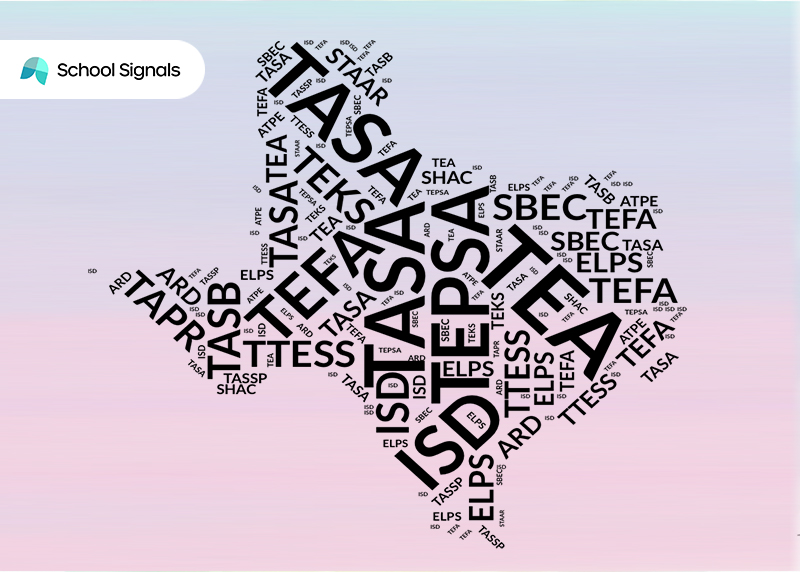
Texas schools use a distinct set of standards, assessments, funding programs, and compliance frameworks. The acronyms appear in state-level curriculum planning, reporting, and teacher evaluation.
In the Lone Star State, public school students take the two STAAR tests a year that measure academic readiness. The STAAR test format is planned to be replaced by a new, more frequent assessment system beginning in 2027–2028. The new testing system will likely have a new name (and acronym), too.
ADSY
Additional Days School Year, a Texas program that provides funding to extend the school year and improve student outcomes.
ARD
Admission, Review, and Dismissal, a Texas committee responsible for determining special education services and reviewing student Individualized Education Programs.
ATPE
Association of Texas Professional Educators, an organization that provides advocacy, professional development, and support for educators in Texas.
ATSI
Additional Targeted Support and Improvement, a federal designation used in Texas accountability for schools needing additional intervention for certain student groups.
CCMR
College, Career, and Military Readiness, a Texas accountability indicator measuring how well students are prepared for postsecondary pathways.
CDC
County-District-Campus Number, a unique identifier assigned to each Texas school and district for reporting and accountability purposes.
CPE
Continuing Professional Education, required training hours that Texas educators must complete to maintain certification.
CSI
Comprehensive Support and Improvement, a federal designation for schools identified for significant improvement under accountability systems.
DIP
District Improvement Plan, a district-level plan outlining goals, strategies, and actions to improve student outcomes across campuses.
EB
Emergent Bilingual, the term used in Texas to describe students developing English language proficiency.
ELPS
English Language Proficiency Standards, Texas standards that guide instruction and language supports for English learners.
EOC
End-of-Course Exam, required Texas high school assessments tied to the STAAR testing program.
ESC
Education Service Center, regional Texas agencies that provide training, resources, and support to school districts.
FIE
Full Individual Evaluation, a comprehensive evaluation used to determine a student’s eligibility for special education services.
FSP
Foundation School Program, Texas’s primary school funding system that allocates state funds based on attendance, student needs, and program participation.
IBC
Industry-Based Certification, a credential recognized in Texas accountability systems as an indicator of college and career readiness.
ISD
Independent School District, the term used in Texas for local public school districts.
PEIMS
Public Education Information Management System, the statewide system used by Texas schools to collect and report student, staff, and financial data.
PKG
Prekindergarten Guidelines, Texas standards outlining learning expectations for pre-kindergarten students.
PPCD
Preschool Program for Children with Disabilities, a Texas public school program providing special education services for children ages three to five.
SBEC
State Board for Educator Certification, the agency responsible for overseeing teacher certification in Texas.
SHAC
School Health Advisory Council, a Texas-required advisory group that provides recommendations on health education and wellness policies.
SHARS
School Health and Related Services, a Texas Medicaid program that reimburses districts for eligible health services provided to students with disabilities.
STAAR
State of Texas Assessments of Academic Readiness, the standardized testing program used to measure student achievement in Texas.
TAPR
Texas Academic Performance Report, an annual report summarizing district and campus academic performance and accountability data.
TASA
Texas Association of School Administrators, an organization that provides leadership development, advocacy, and resources for school leaders.
TASB
Texas Association of School Boards, an organization that supports school board governance, training, and policy development.
TASSP
Texas Association of Secondary School Principals, an organization that provides support and professional development for secondary school leaders.
TCTA
Texas Classroom Teachers Association, an organization that provides resources, advocacy, and professional support for teachers.
TEA
Texas Education Agency, the state agency responsible for overseeing public education, accountability, and funding in Texas.
TEC
Texas Education Code, the body of state law governing public education in Texas.
TEFA
Texas Education Freedom Account, a state program that allows public funds to be used for approved educational expenses outside traditional public schools.
TEKS
Texas Essential Knowledge and Skills, the statewide curriculum standards defining what students should learn in each subject and grade.
TELPAS
Texas English Language Proficiency Assessment System, the assessment used to measure English learner progress in listening, speaking, reading, and writing.
TEPSA
Texas Elementary Principals and Supervisors Association, an organization that provides training, leadership development, and resources for school administrators.
TPESS
Texas Principal Evaluation and Support System, the framework used to evaluate and support school leaders in Texas.
TPRI
Texas Primary Reading Inventory, an early literacy assessment used in Texas to measure reading development in kindergarten through second grade.
TSDS
Texas Student Data System, the statewide system used to collect and manage student data.
TSI
Texas Success Initiative, a state-required college readiness assessment used to determine readiness for college-level coursework.
TSI (Federal Accountability)
Targeted Support and Improvement, a federal accountability designation used in Texas for schools with underperforming student groups.
T-TESS
Texas Teacher Evaluation and Support System, the framework used to evaluate and support teacher performance.
| Acronym | Definition | Category | Use case |
|---|---|---|---|
| ADSY | Additional Days School Year, Texas program that provides funding for extending the school year to improve student outcomes | State Funding | The district implemented ADSY to provide extra instructional days. |
| ARD | Admission, Review, and Dismissal, Texas committee that determines special education services | Special Education Programs and Student Support | The ARD committee met to review the student’s IEP. |
| ATPE | Association of Texas Professional Educators, organization that provides professional development and advocacy for educators | School Operations | Teachers can access PD resources through ATPE. |
| ATSI | Additional Targeted Support and Improvement, federal designation used in Texas accountability requiring additional intervention for student group performance | School Planning, Compliance, and Policy | The district monitored ATSI campuses for progress and compliance. |
| CCMR | College, Career, and Military Readiness, indicator used in Texas accountability to measure students’ preparedness after high school | Assessment / Accountability | The school improved its CCMR score through dual credit and certifications. |
| CDC | County-District-Campus number, unique identifier assigned to each Texas school and district for reporting and accountability | School Planning, Compliance, and Policy | The campus was identified in reports by its CDC number. |
| CPE | Continuing Professional Education, required training hours for maintaining teacher certification in Texas | School Planning, Compliance, and Policy | Teachers must complete CPE hours to renew certification. |
| CSI | Comprehensive Support and Improvement, federal designation applied within Texas accountability for schools identified for significant improvement | School Planning, Compliance, and Policy | The campus was identified for CSI and must implement a turnaround plan. |
| DIP | District Improvement Plan (district-level plan that outlines goals, strategies, and actions to improve student outcomes across all campuses; aligns with state accountability requirements) | Planning / Compliance | The DIP outlines district-wide priorities for improving student achievement. |
| EB | Emergent Bilingual, term used in Texas to describe students developing English proficiency | Academic Programs | Teachers used EB strategies to support language development. |
| ELPS | English Language Proficiency Standards, Texas standards guiding instruction for English learners | Academic Programs | Teachers integrate ELPS into daily instruction for multilingual learners. |
| EOC | End-of-Course, required Texas high school exams tied to STAAR | Assessment Metrics | Students must pass EOC exams to meet graduation requirements. |
| ESC | Education Service Center, regional Texas agencies that provide training and support to school districts | School Planning, Compliance, and Policy | Teachers attend training sessions through their regional ESC. |
| FIE | Full Individual Evaluation, comprehensive assessment used in Texas to determine eligibility for special education services | Special Education Programs and Student Support | The school conducted an FIE before determining eligibility for services. |
| FSP | Foundation School Program (Texas school funding system that determines how state funds are allocated to districts based on attendance, student needs, and program participation) | State Funding | District funding is allocated through the FSP based on ADA and program weights. |
| IBC | Industry-Based Certification, credential recognized in Texas accountability as part of college and career readiness indicators | Academic Programs / Postsecondary Readiness | Students earned an IBC in welding as part of their program. |
| ISD | Independent School District, term used in Texas for local public school districts | School Planning, Compliance, and Policy | Denton ISD serves students in the local area. |
| PEIMS | Public Education Information Management System, statewide system used by Texas schools to collect and report student, staff, and financial data for funding, accountability, and compliance | School Planning, Compliance, and Policy | School Planning, Compliance, and Policy | The district submits attendance, enrollment, and program data through PEIMS. |
| PKG | Prekindergarten Guidelines, Texas standards outlining learning expectations for Pre-K students | Academic Programs | The curriculum follows Texas PKG for early learning. |
| PPCD | Preschool Program for Children with Disabilities, a public school program in Texas that provides special education services to children ages 3–5 with identified disabilities | Special Education (Early Childhood) | The student is enrolled in a PPCD program to receive early intervention and support before entering kindergarten. |
| SBEC | State Board for Educator Certification, agency that oversees teacher certification in Texas | School Planning, Compliance, and Policy | SBEC sets certification requirements for educators. |
| SHAC | School Health Advisory Council, Texas-required advisory group for health education and wellness policies | School Planning, Compliance, and Policy | SHAC reviewed updates to the district’s health curriculum. |
| SHARS | School Health and Related Services, a Texas Medicaid program that reimburses school districts for providing eligible health and related services (such as therapy, nursing, and evaluations) to students with disabilities | State Program / Funding / Special Education | The district submits SHARS claims to receive Medicaid reimbursement for eligible student services. |
| STAAR | State of Texas Assessments of Academic Readiness, standardized test used to measure student achievement | Assessment Metrics | Students take the STAAR test each spring. |
| TAPR | Texas Academic Performance Report, annual report summarizing district and campus performance | School Planning, Compliance, and Policy | Parents can review TAPR for school performance data. |
| TASA | Texas Association of School Administrators, organization providing leadership development and conferences | School Planning, Compliance, and Policy | The superintendent attended the TASA Midwinter Conference. |
| TASB | Texas Association of School Boards, organization supporting school board governance and training | School Planning, Compliance, and Policy | Board members completed training through TASB. |
| TASSP | Texas Association of Secondary School Principals, organization supporting secondary school leaders | School Planning, Compliance, and Policy | The assistant principal attended the TASSP workshop. |
| TCTA | Texas Classroom Teachers Association, organization providing resources and advocacy for teachers | School Operations | The teacher attended a TCTA workshop. |
| TEA | Texas Education Agency, state agency overseeing public education in Texas | School Planning, Compliance, and Policy | TEA provides guidance on state requirements. |
| TEC | Texas Education Code, state law governing public education in Texas | School Planning, Compliance, and Policy | District policies must align with the Texas Education Code (TEC). |
| TEFA | Texas Education Freedom Account, state program allowing public funds to be used for approved educational expenses outside traditional public schools. Applications opened February 4, 2026 for 2026–27. | School Funding Programs and Grants | Families can use TEFA funds for tuition and approved services. |
| TEKS | Texas Essential Knowledge and Skills, statewide curriculum standards defining what students should learn | State Standards | Teachers align lessons to TEKS for each subject and grade level. |
| TELPAS | Texas English Language Proficiency Assessment System, assessment used to measure English learner progress in listening, speaking, reading, and writing | Assessment Metrics | Students take TELPAS each year to measure English proficiency growth. |
| TEPSA | Texas Elementary Principals and Supervisors Association, organization providing training and resources for school leaders | School Planning, Compliance, and Policy | The principal participated in a TEPSA leadership session. |
| TPESS | Texas Principal Evaluation and Support System, framework used to evaluate school leaders | School Planning, Compliance, and Policy | The principal was evaluated using TPESS criteria. |
| TPRI | Texas Primary Reading Inventory, early literacy assessment used in Texas to measure reading development in K–2 students | Assessment Metrics | Teachers administer TPRI to monitor early reading skills and progress. |
| TSDS | Texas Student Data System, statewide system for collecting and managing student data | School Planning, Compliance, and Policy | Attendance and grades are reported through TSDS. |
| TSI | Texas Success Initiative (state-required college readiness assessment used to determine whether students are prepared for college-level coursework in reading, writing, and math) | Assessment / Postsecondary Readiness | Students must meet TSI requirements before enrolling in dual credit courses. |
| TSI (Federal Accountability) | Targeted Support and Improvement, federal designation used in Texas accountability for schools with underperforming student groups | School Planning, Compliance, and Policy | The school was identified for TSI due to performance gaps among student groups. |
| T-TESS | Texas Teacher Evaluation and Support System, framework used to evaluate and support teacher performance | School Planning, Compliance, and Policy | The teacher received feedback through TTESS observations. |
Looking for a complete list of Texas education acronyms? The Texas Education Agency (TEA) maintains a full glossary with all official terms. Visit the page.
Additional Acronyms in K–12 (A–Z)
| Acronym | Definition | Category | Use case |
|---|---|---|---|
| ACRE | Assessment of Children/Youth Religious Education (national religion assessment used in Catholic schools) | Assessment | Students in grades 5 and 8 take the ACRE. |
| CRE | Coordinator of Religious Education (staff member supporting and organizing religious education programs) | Staff / Leadership | The CRE coordinates student preparation and scheduling. |
| DRE | Director of Religious Education (school or parish-based leader overseeing religion instruction and programs) | Staff / Leadership | The DRE shared updates on the religion curriculum. |
| ECC | Early Childhood Center (or Early Childhood Campus) | Program / School Type | The child attends the ECC for Pre-K and early learning programs. |
| ECE | Early Childhood Education | Program | The school offers ECE programs for young learners. |
| ES | Elementary School | School Level | The student attends Lincoln ES. |
| ESP | Education Support Professional, school staff who provide essential services such as paraprofessionals, clerical staff, custodians, transportation, and food services | School Operations | The district recognized an ESP of the Year for outstanding support to students and staff. |
| FAFSA | Financial aid application | Postsecondary | Families complete the FAFSA. |
| FTE | Full-Time Equivalent | Administration | Staffing is measured in FTE. |
| HS | High School | School Level | The student will transition to HS next year. |
| IPR | In-Progress Report | Academic Reporting | Parents received an IPR. |
| KPI | Key Performance Indicator | Administration | Attendance is tracked as a KPI. |
| LEA | Local Education Agency, typically a school district or public authority responsible for operating schools and implementing policies locally | Governance | The LEA oversees district schools. |
| MOOC | Massive Open Online Course | Online Learning | Students explored a MOOC. |
| MS | Middle School | School Level | She will start MS in the fall. |
| PLC | Professional Learning Community | Staff | The PLC meets weekly. |
| PK | Pre-Kindergarten | School Level | The child is enrolled in PK this year. |
| PTC | Parent-Teacher Conference | Engagement | Families attend PTC meetings. |
| TA | Teacher Assistant | Staff / Support | The TA helps the teacher manage classroom activities. |
ACREAssessment of Children/Youth Religious Education, a national assessment used in many Catholic schools to measure students’ understanding of religious education.
CRECoordinator of Religious Education, a staff member who supports and organizes religious education programs.
DREDirector of Religious Education, a school or parish-based leader responsible for overseeing religion instruction and programs.
ECCEarly Childhood Center, a school campus or program that serves young children, often including preschool and pre-kindergarten.
ECEEarly Childhood Education, educational programs designed for young learners before kindergarten.
ESElementary School, the school level typically serving students in kindergarten through fifth or sixth grade.
ESPEducation Support Professional, school staff who provide essential services such as paraprofessionals, clerical staff, custodians, transportation personnel, and food service staff.
FAFSAFree Application for Federal Student Aid, the form used by families to apply for federal financial aid for college.
FTEFull-Time Equivalent, a staffing or enrollment measure used to represent the workload of employees or the enrollment level of students.
HSHigh School, the school level typically serving students in grades nine through twelve.
IPRIn-Progress Report, a report provided during a grading period to inform families about a student’s academic progress.
KPIKey Performance Indicator, a measurable value used to evaluate the success of a program, organization, or initiative.
LEALocal Education Agency, a public authority, usually a school district, responsible for operating schools and implementing education policies locally.
MOOCMassive Open Online Course, an online course designed for large-scale participation and open access through the internet.
MSMiddle School, the school level typically serving students in grades six through eight.
PLCProfessional Learning Community, a group of educators who collaborate regularly to improve instruction and student learning.
PKPre-Kindergarten, an early education program for children before they enter kindergarten.
PTCParent-Teacher Conference, a meeting between teachers and families to discuss a student’s academic progress and development.
TATeacher Assistant, a staff member who supports teachers by helping manage classroom activities and assisting students.

Why Are Acronyms So Popular in K–12 Education?
Acronyms have been widely used across government, military, and large organizations for decades as a way to simplify complex language and communicate more efficiently. In the United States especially, agencies and programs often have long formal names, and acronyms became a practical shorthand for everyday use.
The intention of acronyms is to make it easier to refer to complex programs, laws, and processes quickly. In K–12 education, initiatives such as IEP, MTSS, and ESSA have long, formal names; their acronyms enable educators to communicate more efficiently in daily work.
Federal programs, state requirements, and specialized services shape and support education programs, each with its own terminology. Acronyms have become a form of shorthand across schools and districts.
What works as shorthand within schools does not always translate into clear communication for families.
However, what works as shorthand for educators can confuse families. Without clear definitions and context, acronyms can make communication harder to understand, especially for new or ESL families.
Reducing Jargon From Family Communication
How District and School Leaders Can Turn School Jargon into Clear Family Communication
District and school leaders use their own internal lingo and benchmarks to evaluate and plan school policies and practices. When communicating with families, leaders can ensure that all acronyms are explained to parents in clear, easily translated language.
| Topic | What Leader Might Say in a Staff Meeting | What to Say to Families |
|---|---|---|
| Planning & Goals | “We need to update the SIP before the board review.” | “We’re updating our school improvement plan to better support student learning this year.” |
| Accountability | “Our AYP targets weren’t met in reading.” | “We’re focusing on improving reading outcomes based on last year’s results.” |
| Funding | “This will be funded through Title I.” | “We’re using federal funding to provide additional academic support for students.” |
| Assessment | “We’re reviewing STAAR and EOC performance trends.” | “We’re reviewing student test results to see where extra support is needed.” |
| Data & Reporting | “Let’s pull the PEIMS data for enrollment trends.” | “We’re reviewing enrollment data to plan staffing and resources.” |
| Leadership & Instruction | “The ILT will align on instructional priorities.” | “Our school leadership team is working together to improve classroom instruction.” |
| Compliance | “We need to ensure FERPA compliance on this.” | “We’re making sure student information stays private and protected.” |
| Programs & Services | “This will go through MTSS Tier 2 support.” | “We’re providing additional support to help your child succeed in this area.” |
| Family Engagement | “We’ll bring this to the DAC for input.” | “We’re gathering input from families and community members before making decisions.” |
| Operations | “We need BOE approval before moving forward.” | “The school board will review and approve this before we move ahead.” |
How Teachers Can Remove Jargon to Communicate Clearly with Parents
Teachers need to make professional observations for classroom management and to record student progress. Assessment and plans are easier to record with precise language. When communicating with parents, rather than quickly providing these notes, it’s helpful to pause to reflect that parents will recognize the purpose behind these acronyms and how the programs and collaboration support their child.
| Topic | What Teacher Might Observe and Note | What to Say to Parents |
|---|---|---|
| Instruction & Support | “He’s Tier 2 right now.” | “He’s getting some extra support in small groups to strengthen his skills.” |
| Intervention Process | “Let’s bring this to MTSS.” | “We’ll review this with our support team to decide the best next steps.” |
| Student Plans | “She’s on a 504.” | “She has a plan that provides accommodations to support her learning.” |
| Intervention Process | “That’s an RTI case.” | “We’re monitoring progress and adding support to help her catch up.” |
| Collaboration | “Add it to the PLC agenda.” | “I’ll bring this up with our teaching team so we can support her together.” |
| Assessment | “His Lexile is below grade level.” | “He’s still building reading skills, and we’re working on that step by step.” |
| Assessment | “Her DRA went up two levels.” | “She’s making great progress in reading and moving to more advanced books.” |
| Behavior Support | “He has a BIP.” | “We’re using a structured plan to support positive behavior at school.” |
| Special Education | “This will go into the IEP goals.” | “We’re setting specific learning goals to support her progress.” |
| Progress Monitoring | “We’re collecting CBM data weekly.” | “We’re checking progress regularly to make sure the support is working.” |
| Lesson Planning | “I’m using UDL for this lesson.” | “I’m designing lessons so all students can access and engage with the material.” |
| Instruction | “We need more DI here.” | “I’m adjusting how I teach so it better fits your child’s learning needs.” |
How to Get Buy-in for Family Engagement with Clear Communication
School leaders are experts in acronyms – the challenge is to reflect on how to move from institutional language that reinforces hierarchies to a warm, communicative style that builds real family partnerships.
| Topic | What to Note at School | How to Communicate the Need to Families |
|---|---|---|
| Planning & Requirements | Title I, SIP, or LCAP requires documented family input | “We’re planning for the upcoming year and would value your input as part of this process.” |
| Events & Participation | Low turnout at family engagement events or PAC meetings | “We’re looking at ways to make events more useful and easier for families to attend—your feedback helps.” |
| Communication Gaps | Information shared via LMS, email, or SIS may not reach all families | “We want to make sure this information reached you—please let us know the best way to stay in touch.” |
| Decision Input | Input needed through DAC, ELAC, or SSC before decisions are finalized | “We’d like your input before we move forward with this decision.” |
| Committees & Roles | Participation needed for PTA, PTO, or advisory committees | “Families are invited to participate and help shape this work.” |
| Student Support | MTSS, RTI, or Tier 2/3 support requires coordination with families | “We’d like to work together to support your child both at school and at home.” |
| Academic Progress | PTCs scheduled to review progress, often alongside DRA, Lexile, or MAP data | “Let’s meet to talk about your child’s progress and next steps.” |
| Multilingual Communication | ELAC/DELAC expectations and ELD/EL programs require accessible communication | “We want to communicate with you in the language you’re most comfortable using.” |
| Feedback & Surveys | Required family feedback tied to Title I or LCAP reporting | “Your feedback helps us improve—what’s working and what could be better?” |
| Ongoing Engagement | Ongoing engagement tracked across programs and compliance requirements | “We look forward to staying connected and working together throughout the year.” |

- How To Increase Parent Attendance in PTA Meetings - October 5, 2026
- Getting School Communication Right During the First Weeks - September 27, 2026
- Building Trust with Inclusive School Communication - September 13, 2026