


The Parent-Teacher Conference Format: It’s Limits and Possibilities
The parent-teacher conferences are like quick briefings, usually starting with a positive, followed by the academic overview, and a few minutes for parent dialogue. Many parents recognize the format and adjust their expectations given the time constraint -the conference is often condensed to a mere 15 – 20 minutes. Still, some feel the conference is utterly negative, citing the power structure and the lack of opportunity to contribute their point of view. On the other hand, teachers may feel stressed about the experience in general, and regard that they need to follow the formula – academic progress review – considering the tight timeline. (Read more about the parent-teacher conference experience.)
When I reached out to parents in my small focus group study, the parents with the most positive parent-teacher conference experiences had an ongoing dialogue with their child’s teacher before the conference. These parents were actively communicating – emailing, messaging, and calling – with the teacher to stay on the same page, share their knowledge, and take on their child’s academic and social standing and dynamics. Additionally, most parents expressed that they were less interested in academic reviews, often citing that they already have the info, and were more interested in learning about how their child is doing socially.

Why Is Parent Input Important Before the Parent-Teacher Conference?
For parents and teachers to meet eye-to-eye at the conference, it’s important to align the expectations for the conference so that parents and teachers can sync and have a dialogue. A positive parent-teacher conference builds trust, and this trust-building begins before the conference, and continue after the conference.
When school approaches and perceives families as experts, it becomes evident that schools wants to naturally hear from them. Emphasizing that participants (teacher and parents) are both experts and learners levels the power structures and dynamics and creates space for dialogue: Families have important information to contribute and receive, and teachers have important information to learn and to share.
Why Is Parent Feedback Important After the Parent-Teacher Conference?
Parents are key stakeholders of school and their voice matters. Surveying parents systematically after the conferences sends a very clear message to families: Your feedback matters; How you experience the parent-teacher conference is important information to us so we can improve the experience; We are not perfect, the format is not perfect, we acknowledge that we can together shape the conference experience and make changes. Read more about communication guidelines for how to follow-up after parent-teacher conferences.
The Importance of Pre-Conference and Post-Conference Forms

Pre- and post-conference digital forms designed into the conference flow indicate to parents that the school cares about their experience, and works in partnership with home. As Epstein emphasizes with her school-home-community model, in true partnerships, the spheres overlap. Parent-teacher conferences are narrow in scope, but they have a place in keeping conversations and collaborations ongoing. Online parent-teacher conference forms for parent input and feedback are one tool to keep the channels open and school-home communication flowing.
Families can share questions, concerns, and background information in advance by filling out a pre-conference form. The answers can help teachers ensure that parent concerns and input will be addressed during the meeting.
With post-conference forms, on the other hand, schools may collect feedback anonymously about the conference experience, recognizing and communicating that the formula is not solidified but can be improved per parent feedback. The input may lead to positive changes, such as increasing the conference meeting time or including students by introducing a student-led conference model.
Designing Effective Pre-Conference Forms
Digital parent-teacher conference forms provided before the conference collect the family’s input on
1) family’s views on their child’s primary strengths;
2) areas in which family would like their child to improve or get more support; and
3) questions families wish to ask during the conference.
A checklist for designing a digital parent-teacher conference form:
- Indicate the form’s purpose clearly, and keep it precise.
- Maintain a positive tone to build partnerships.
- Frame questions to emphasize strengths and abilities. Ask, “What helps your child learn best?” rather than “What problems does your child have?”
- Use the Likert scale (“1–5” questions) to measure and get quick answers.
- Include n/a (not applicable) options.
- Keep the form short to make sure parents will complete it.
- Keep language direct and straightforward to avoid confusion.
- Include a few open “qualitative” questions to allow parents to provide input in their own words.
- Mark only the most essential and easy-to-answer questions as mandatory.
- Allow parents to return to edit their answers, especially when your parent-teacher conference form contains qualitative, open questions.
Pre-Conference Form Example Questions

Use following types of questions in your Before the Conference form:
Questions That Highlight Parents as Experts
- How does your child usually feel about school? (multiple choice)
- When your child talks about school, what do you hear most often? (multiple choice)
- How supported do you feel your child is in their learning this year? (multiple choice)
- Are there subjects or skills where your child feels less confident? (multiple choice)
- What’s one thing you hope your child learns this year? (open-ended)

Questions about Parent-Teacher Conference Expectations
- Which topics would you most like to discuss? (multiple choice)
- What would make this conference feel productive for you? (open-ended)
Questions about Parent’s Communication Preferences
- What’s the best way to reach you? (multiple choice)
- How often would you like general updates about your child’s learning and progress? (multiple choice)
- How can we communicate better with your family?
Parent-Teacher Conference Follow-up Form Example Questions

Consider the following questions and statement evaluations for your anonymous post-conference form:
- “I felt heard during the meeting.” (one choice)
- “I left with a clear understanding of your child’s progress.” (one choice)
- “The teacher shared ideas or resources I can use at home.” (one choice)
- “I had enough time to discuss what mattered most to me.” (Likert scale “1–5”)
- “It was easy to schedule and attend the conference.” (Likert scale “1–5”)
- How satisfied were you with the conference overall? (Likert scale “1–5”)
- Any other suggestions you’d like to share? (open-ended)
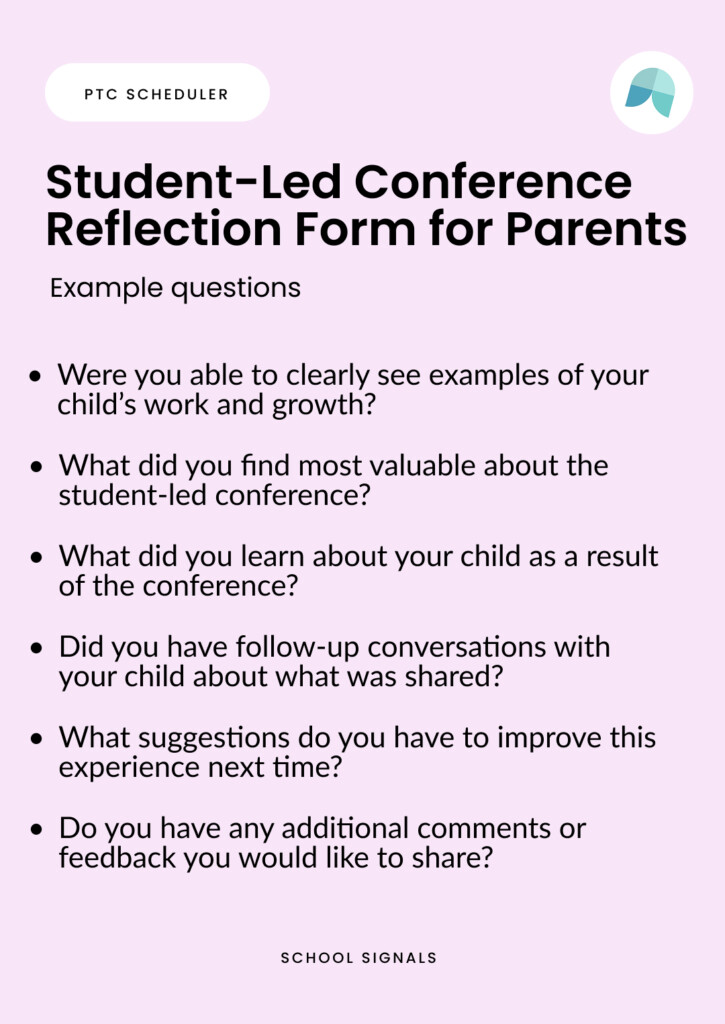
Student-Led Parent-Teacher Conference Reflection Form Example Questions
Providing parents with an opportunity to give feedback is highly recommended when introducing a new parent-teacher conference style such as the student-led conference model. The feedback is valuable for school leaders when evaluating the model’s effectiveness, and for teachers to receive reflective feedback on how to improve the experience for both students and parents. Thirdly, providing parents with an opportunity to reflect on their experience sends a clear message that the school is intentionally developing the conference format and values parents’ input.
Consider selecting up to five questions that cover students’ performance, and provided guidance and support, usefulness of the format, and provide feedback for improvements.
- On a scale of 1 to 5, how valuable did you find the student-led conference format? (1 = Not valuable at all, 5 = Extremely valuable)
- What did you find most valuable about the student-led conference format?
- How would you describe your overall experience with the conference?
- Did the conference feel well-organized and easy to follow?
- Did your child seem prepared?
- In what ways did the conference highlight your child’s strengths?
- What support would help your child feel even more confident leading future conferences?
- What did you learn about your child as a result of the conference?
- Did the conference help you better understand your child’s academic progress?
- Were you able to clearly see examples of your child’s work and growth?
- Did you have follow-up conversations with your child about what was shared?
- What suggestions do you have to improve student-led conferences next year?
- Would you prefer student-led conferences, traditional conferences, or a mix of both?
- Do you have any additional comments, compliments, or suggestions?
The Takeaway: Parent Communication is a Touch Point
When a teacher reaches out to parents before and after the conference, they send a clear message that they want to break out of a one-way, ritualistic conference format and establish a dialogue with the home. Digital parent-teacher conference forms signal that the school values listening as much as informing, and that the parent perspective matters.
FAQ
How do online conference forms help teachers prepare for meetings?
Collecting parent input before the conference gives teachers time to evaluate, plan, and personalize the meeting structure. Teachers can identify if they need extra support from another teacher or staff member during the meeting. For instance, the head of elementary could step for feedback and insight.
When is the best time to send pre-conference digital forms to parents?
School Signals recommends providing the form at the same time as the parent signs up digitally. The parent is already oriented to complete a task, and including a pre-conference form in the parent-teacher conference sign-up flow makes parents feel heard rather than burdened with another task they have to remember.
What information should schools survey after a parent-teacher conference?
Schools should approach families as important stakeholders whose experience of the conference matters. The survey should be quick to complete and include questions about logistics (Was the scheduling easy? Was childcare provided during the conference?) and the interaction with the teacher (Did the teacher discuss topics that are important to you? Did you feel heard during the meeting?) and the follow up (Has the teacher provided you a follow-up summary? Do you think you have improved understanding on how to support your child?) The collected information should be anonymous, with an option for a parent to leave their contact info, should they choose to do so.
Can parent-teacher conference forms be connected to online scheduling?
Digital parent-teacher conference forms can connect directly to conference scheduling workflows. Schools often link forms to the sign-up process or send them shortly after scheduling, so all conference-related information remains organized in one place. In School Signals, the online form submission appears next to the parent’s sign-up slot, making it very easy for teachers to access the form results.
Resources

- Building Trust with Inclusive School Communication - September 13, 2026
- School Signals Introduces Student Portfolios for Personalized Family Engagement - June 23, 2026
- 10 Communication Challenges We’re Hearing from School Leaders - June 6, 2026