

Introduction
From meet-the-teachers and ice-cream socials to curriculum evenings, the first days of school are often the first touchpoints for families. These inviting events provide concrete information and opportunities for families, teachers, and school staff to connect and get to know each other.
The school year is off to a great start. The weeks to follow set the spirit and expectations for the year: Learning and instruction begin, regular school-home communication starts flowing, and students come home with requirements and homework.
In the first weeks of the year, parents receive lots of information about school policies, learning and tests, classroom conduct, homework, volunteering, and more.
Parents sometimes describe this time as overwhelming, or as just trying to keep up. Frustration may build if information or expectations are hard to find, inconsistent, or lack the “why” and “how.”
So what can school leaders do to ensure, on one hand, that communication is sufficient and, on the other, that the community won’t feel overwhelmed?

How a Communication Plan Can Help
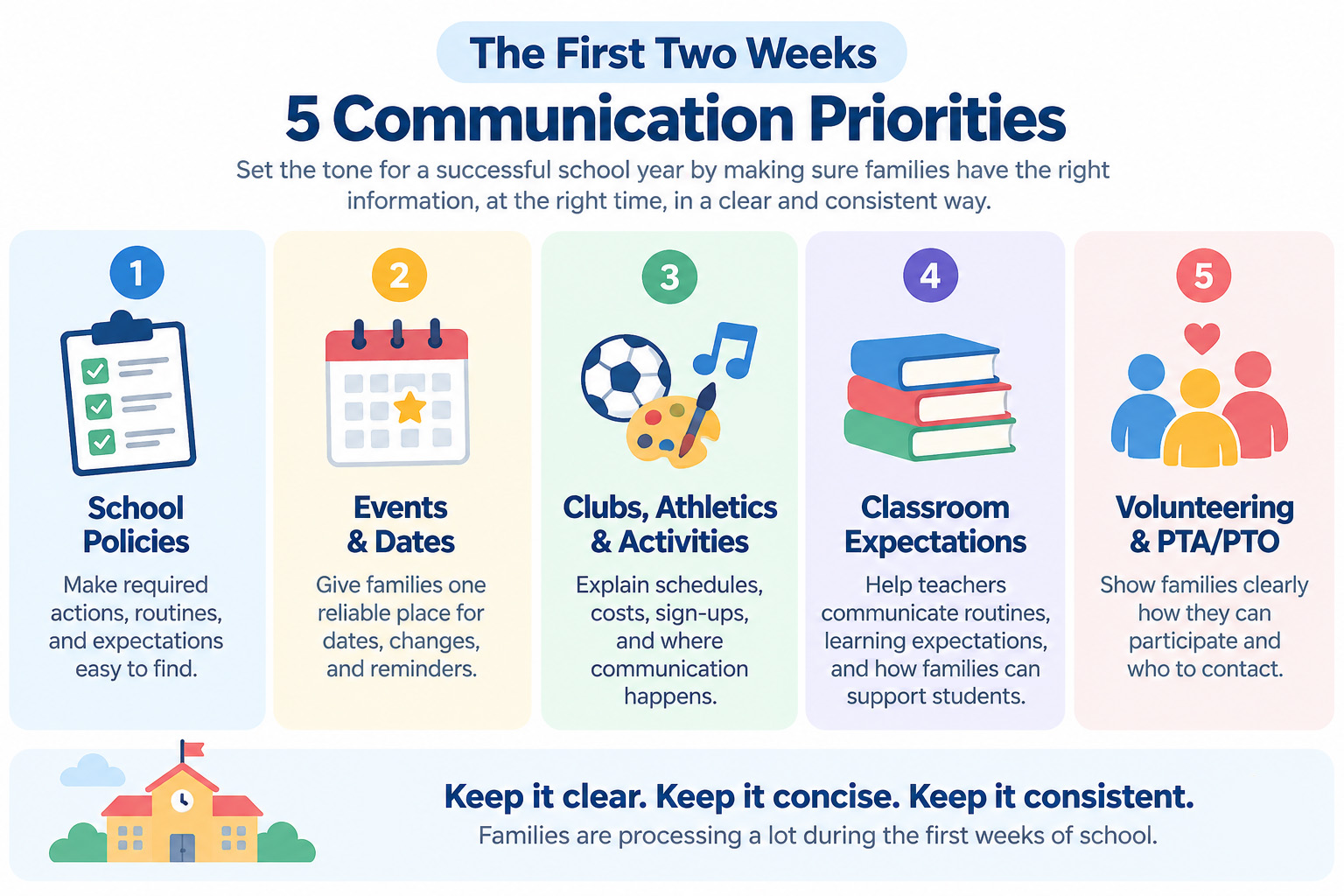
To understand everything that needs to be communicated in the coming weeks and all the stakeholders involved, it might be a good idea to plan the communication, such as writing down key communication pieces in a communication plan and allocating the work. School communication needs to address:
- School-wide policies and procedures
- School events and important dates
- Athletics and after-school clubs
- Classroom news and expectations
- Volunteering and joining PTA/PTO
A communication plan not only shows how many staff members need to be involved in communication, but also paints a picture from the parents’ viewpoint of how much information they will receive. You can learn more about communication planning in this article.
Think of the communication volume. Parents receive a lot of communication. Aim for concise, clear communication across the school to avoid overwhelming parents and ensure messages get read.
In School Signals, we see the most positive reactions to messages that feel human (rather than policy-driven), acknowledge parents as important community members, are informative and concise, and include pictures.
Communicate School Policies Clearly
Schools usually communicate policies and procedures early, during the first parent meetings. This is the core information every parent must know; some items, such as required forms, require action, while others, such as school pick-up policies, require compliance but not always direct acknowledgment.
Common topics that need to be communicated to parents include:
- Required medical forms and records
- Drop-off and pickup expectations
- How to report an absence or tardy
- School’s phone policy
- Lunch ordering and policies
- Bullying prevention and reporting bullying
- Campus visiting policies and procedures
- How to check grades and update family information
Schools might send many reminders until required actions are taken and campus life runs in unison with set policies. In addition to reminding parents, what can be helpful is to:
- Outline all requirements and policies in one place.
- Share with parents a to-do checklist.
- Check that reminders aren’t too generic and go only to parents who have not taken action.
- Designate a staff member to answer parents’ comments or questions.
- Always explain “why” the policy or procedures exist, rather than stating what parents “must” do.
- Cultivate respectful and positive language.
- Highlight key information clearly and concisely.
School Signals offers a place to provide context to all required policies. You can set online forms with due dates and send auto-reminders for parents who have not filled out a form. You can organize all documents in one place. Posts to the School Feed provide a place for reminders and communication. Parents can ask questions or leave comments; staff can monitor them and publish them after review.
Focus on Sharing School Events and Important Dates
School culture and community are built through school and classroom events where parents can join the community socially or through volunteering. It is not always easy to keep all the dates and information about school events, grade-level events, classroom events, and athletic meets in one place, especially if the school isn’t using a unified communication platform or if only a few people update the school’s event calendar.
What matters is letting families know how to get the information and how to get involved.
At the beginning of the school year, families can be shared with:
- What key events should parents attend
- How complete is the shared school calendar
- How and where events are announced
- How are classroom and athletics events announced and tracked
- How changes and cancellations are communicated
Yes, event reminders are needed, and they also create interest and buzz. Collecting RSVPs helps families notice the events, too.
School Signals provides a school calendar system that includes all events and entries from school life: school-wide events, grade-level events, PTA events and meetings, athletics and clubs practice times and meets, and classroom celebrations.
Parents can sync this calendar with their personal calendar, which can provide additional reminders based on their preferences.
Think of Clubs, Athletics, and After-School Activities Communication From the Parents’ Viewpoint
The first weeks of school also require families to decide on athletics and after-school program attendance. When deciding whether to sign up their child, parents consider not only the enrichment aspect but also practical questions about logistics, cost, and overlapping timetables.
Is aftercare or homework support offered?
What are the Track & Field practice times?
When are Cross Country competitions held?
Is previous experience required to attend volleyball?
What fees are associated with the Cheerleading club?
And simply, how do I sign up?
In other words, “Can we do this?” “Is this too much?” “Is this something we want to commit to?”
Athletics and after-school communication have traditionally been siloed into third-party apps, with little oversight from school administrators. Sometimes, even within a school, two programs might use separate apps.
By selecting a unified school communication platform that includes athletics and after-school communication components, schools can align after-school communication and let families know they are on top of it, easing decision-making.
Here is the checklist for schools:
- Communicate clearly all offered programs.
- Provide information on how communication is handled within each program.
- Attempt to unify communication systems so parents won’t have to navigate between different systems or apps.
School Signals provides a platform for all after-school and athletics communication. Schools don’t need to ask parents to use another app, and the extracurricular communication becomes part of the everyday communication parents follow.
Support Teachers to Communicate Classroom Expectations and Conduct
When is the spelling test?
When is the library day?
When do yellow folders need to be returned?
Is there a log I need to see daily?
As instruction begins, so do the questions. Families who want to support their children may ask these questions in good faith. Teachers need to inform parents when they are expected to help or supervise their children, and when students should handle the logistics independently.
Either way, teacher-parent communication is needed to share classroom expectations, homework, weekly tests, and how parents can best support their children.
Teachers can prevent early confusion by identifying the classroom information families need and letting families know about:
- How homework, tests, and important dates are shared
- What the classroom routines are that parents should be aware of
- How parents can track grades, assignments, or academic progress
- How often families can expect classroom updates
- How missing work or behavior concerns are communicated
- Where parents can ask questions
- How parents can support learning at home
A behavior message aligns with expectations when parents already know the classroom policies, the steps the teacher has taken, and what kind of support the teacher needs from home.
Families do not want communication only when something needs improvement. Positive posts about how well the class is doing or progressing are well-received among parents.
Parents also appreciate hearing when their child has made progress, handled a difficult situation well, or improved a classroom habit.
In School Signals, teachers use their classroom spaces to update families, share documents, and offer a glimpse into the classroom. A common practice is to share weekly news on Fridays. Student Portfolios provide a way to give individual updates on the student’s learning progress.
When questions and comments are in one place, teachers can reduce repetitive questions.
Integrate Volunteering and PTA/PTO Communication Into the First Weeks
Don’t assume returning families already know how volunteering or PTA/PTO works, or that new families know whom to ask. Coordinating communication with parent leaders is important. Focus on letting parents know:
- Where volunteer opportunities are communicated
- How parents can sign up for volunteer opportunities
- Is a background check required, and how is it submitted
- Is there training involved
- Are there permanent volunteer positions
- Who are the point people or coordinators of volunteer opportunities
- How do parents join PTA/PTO, and how is the PTA/PTO communication organized?
By making volunteering and parent-group communication part of the first-week communication, schools send an important message: family participation is welcomed, organized, and part of the school community.
Volunteering is central in schools using School Signals. Multiple community members often handle volunteering: a parent admin might add PTA-related volunteer opportunities; a coach might ask parents to volunteer at meetups; and an event coordinator may create volunteer opportunities for an upcoming event.
Great Communication Has to Be a Schoolwide Priority
How schools communicate during the first weeks—the tone, reliability, conciseness, and how parents feel heard —shapes the family-school relationship.
Acknowledging that communication can be a lot and supporting teachers during the first weeks can make expectations for teachers and families more predictable.
By communicating clearly and concisely and giving families opportunities to ask questions and contribute, schools strengthen trust between school and home.

- How To Increase Parent Attendance in PTA Meetings - October 5, 2026
- Getting School Communication Right During the First Weeks - September 27, 2026
- Building Trust with Inclusive School Communication - September 13, 2026