

Introduction
To play, or not to play, that is the question. Actually, it’s not really a question. Scientists, teachers, and parents overwhelmingly see play’s benefits for children.
Open-ended exploration in the great outdoors has long been the hallmark of childhood, though research shows this steadily slipping away.
The American Academy of Pediatrics continues to tell families to aim for 60 minutes of outdoor play each day. However, 30% of American kindergarteners don’t have recess, and 51% of children don’t play outdoors with their families once a day.

The Disconnect
Where’s the disconnect? It’s a multifaceted issue.
In his bestselling book, Last Child in the Woods, Richard Louv blames our children’s “nature-deficit disorder” on readily available technology, the lack of green spaces in modern-day urban planning, and parental perception of the dangers lurking outside.
In his 2024 book, The Anxious Generation, psychologist and researcher Jonathan Haidt highlights how the shift from a “play-based childhood,” defined by outdoor exploration and unstructured play, to a “digital childhood,” dominated by screens and social media, has rewired development.
While some of these things are actual issues in areas with prominent violent crime or the concrete jungles of big cities, that doesn’t eliminate the real effects that the lack of outdoor playtime has on children. The implications of outdoor play for children’s health, development, and achievement are too obvious to ignore.
Young Students and Outdoor Play’s Many Benefits
Being in nature has ample benefits for everyone’s bodies and minds. Scientists have long noted the link between sunshine and Vitamin D production, but also note the outdoors’ positive effects on our mental health, circadian rhythms, cardiovascular health, and muscle and bone strength. Research shows that outdoor experiences may even prevent myopia, or nearsightedness, offsetting some of the adverse effects of consistently looking at screens in early childhood.
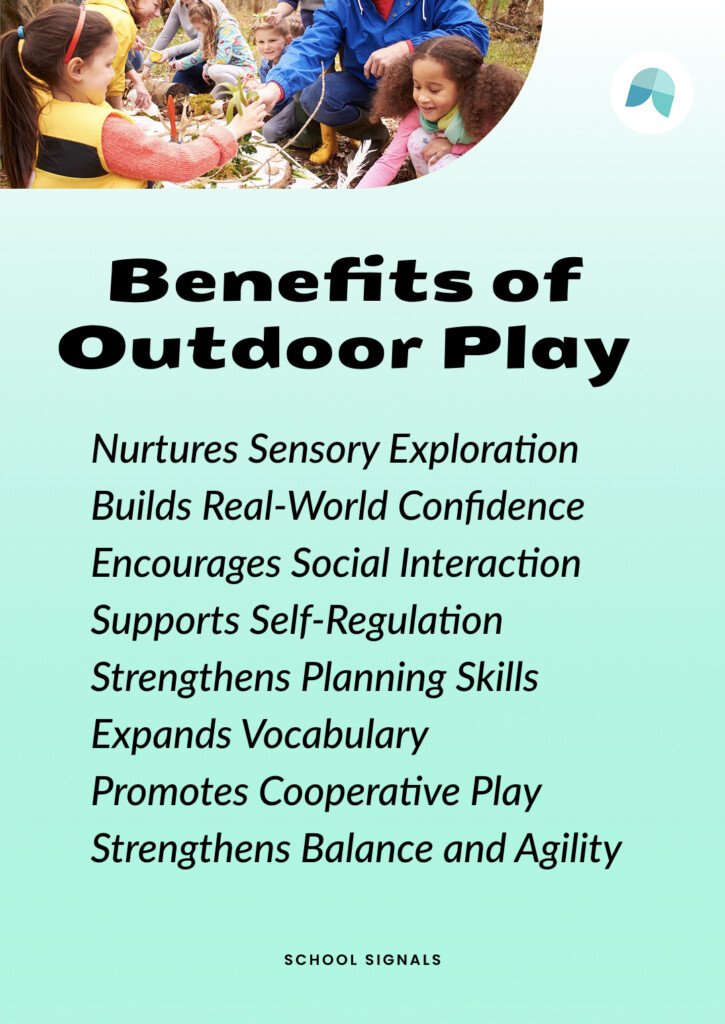
Promotes Sensory Integration & Spatial Awareness
For children, outdoor play promotes sensory integration, spatial awareness, and gross motor skills. Outdoor environments naturally encourage exploration of different textures, sights, sounds, and smells. Navigating uneven terrain and accessing different planes of play spaces enable children to develop their sense of balance and coordination. And, in a country where 1 in 5 children are considered obese, outdoor play is also essential for maintaining a healthy weight.
Builds Child’s Confidence
Outdoor play also contributes to young children’s social-emotional development in myriad ways. The naturally-occurring risks in outdoor play – like jumping from a tree stump or judging heights and distances when climbing on a jungle gym – build a child’s sense of confidence and competence. Furthermore, taking these risks within limits builds essential skills children need to judge their own safety as they grow.
Promotes Communication Skills
As children play together outdoors, and especially when their play is imaginative and open-ended, they have to develop communication, negotiation, and problem-solving skills. While these skills may seem trivial when applied to an outdoor game of “family” or tag, children are creating the foundations they need to later function as community members and develop healthy relationships.
Develops Child’s Self-Control
Even rough-and-tumble play has its merits. While this is often the type of play most restricted by adults, it’s one of the most beneficial as children learn to test their limits, recognize their strengths, and communicate about important topics like comfort, consent, and respect. Obviously, safety is paramount, but it may be worth talking with your team and parents about ways to allow this within reasonable limits.
Improves Executive Function Skills
Many teachers report that their students seem less able to focus in class than in years past. While this may be due to the effects of increased screen time in children’s lives, increased academic demands and decreased physical activity during the school day are also likely culprits.
Luckily, studies show that when children play outdoors before their academic learning time, they show improved executive functioning and are better able to remain attentive and demonstrate self-control in the classroom. Improved impulse control and more on-task behavior have a ripple effect on other students’ ability to learn in the classroom as well.
Increases Vocabulary and Background Knowledge
Nature is an ever-changing teacher, and regular time outside introduces children to a constant stream of new words and experiences. Exploring outdoors, talking with teachers and peers about what they see, and engaging in natural inquiry bolsters student vocabulary and provides them with new background knowledge to draw from. These two factors are widely understood to be linked to improved reading comprehension.
Outdoor Exploration and Its Positive Impact to Middle School and High School Students
While outdoor play is often associated with early childhood, its benefits extend well beyond the elementary years. Abbey Banta, with a background in teaching high school for at-risk students, saw firsthand how outdoor recreation experiences benefited the students, She emphasizes the following benefits:
Increased Social-Emotional Skills
Jonathan Haidt, the author of The Anxious Generation, points to the correlation between the rise of social media and screen time and increases in anxiety and depression among teens. Instead of having face-to-face interactions or playing outdoors, many teens search for connection, validation, and entertainment in the digital realm. Haidt argues that outdoor play is essential for normative development and fostering resilience, creativity, problem-solving, and social skills.
Improved Physical Fitness & Mental Health
Outdoor recreation provides a natural remedy to the sedentary and socially isolated lives many of our youth lead. The physical benefits of outdoor movement are well-documented, with studies showing that even moderate outdoor activity can significantly improve fitness and mental health. By stepping outside, moving their bodies, and connecting in meaningful ways, young people can rediscover their energy, focus, and community, allowing them to thrive academically and holistically.
Builds Group Connections
Group outdoor recreation also leads to cooperation and shared experience. Outdoor activities—whether it’s navigating a trail or river, setting up camp, or geocaching—have the potential to build trusting and genuine relationships. Facing challenges and witnessing the beauty of nature alongside one another, without distraction, feeds connection in a way that online interactions simply cannot replicate. Learn more: Campfires and Connection: How Outdoor Recreation in Education Sparks Community
Choosing Outdoor Recess and Play In Winter
Even teachers who herald the benefits of outdoor play may start doubting themselves when the air begins to chill. Across the nation, school districts establish their own rules about the cutoff temperature for recess, varying widely from state to state. Worldwide, the norms for playing outdoors in the cold vary even more widely.
While I am certainly not advocating for sending children out unprepared or in dangerous weather, there are many benefits stemming from outdoor play in all seasons. Let’s explore the why and how of getting your class outside this winter.
Connect Winter Exploration With Science
Children are naturally curious, and nature encourages them to ask questions about the world around them and experiment with their ideas. This makes science an organic connection point between outdoor play and academic learning. Children might begin to explore the properties of matter as they discover concepts like freezing and melting with ice and snow. They might also explore how to dress their bodies for the season and how different types of clothing help humans adapt to the weather like animals do.
Explore Seasonal Changes
The experience of the same outdoor space changes from season to season. We see this as children move from hunting for shadowy, cool spaces in the summer to creating leaf piles in the fall and picking flowers each spring.
The winter brings its own changes to your outdoor spaces, from the different animals that may visit, to the adaptations of the plants in the area.
Ask students what they notice changing, and perhaps even record it in a drawing or journal to revisit over the course of the year.
Link Outdoor Play With Literature
There are countless books that can inspire exploration and play in a winter landscape. From copying the stick markings that Peter makes in The Snowy Day to building burrows like the animals in Over and Under the Snow, children can engage in play linked to classic stories, building critical vocabulary and background knowledge along the way.
Embrace Unstructured Outdoor Play
Just because it is winter outside does not mean that children don’t have the same needs for movement. When children are given ample opportunities to move their bodies, they’re better able to refocus their attention as they return to learning activities. While many schools offer cool-weather solutions like indoor recess or P.E. in the gymnasium, the structured nature of these activities doesn’t provide the same benefits for attentiveness.
Challenging Norms
While the benefits of outdoor play, even in winter, are widely known, the red tape still limits many teachers and schools from doing what they know is most beneficial for their students. Whether you’re an educator who deeply values outdoor play or one who is just beginning to experiment with learning outdoors, it’s possible that you will be challenging the expected norms of your school.
In a nation where recess commonly has a particular time frame and preferred temperature range, I’ve found that the best way to begin offering this experience to your students is to demonstrate its importance. Come equipped to conversations with research-backed benefits of winter play, or pre-make a few lesson plans showing how your lessons will meet academic standards. You may consider specifically framing this time as “outdoor learning time” vs. “recess,” especially if you’re adding an additional period of your classroom day outdoors.
How to Communicate The Value of Outdoor Education and Recreation
Shannon McLeod, a teacher with expertise in adapting the curriculum for outdoor learning from Thrive with Outdoor Learning, provides the following advice on overcoming pushback or hesitancy from school administration or parents.
Share The Benefits of Outdoor Learning
For many, outdoor learning might seem like a frivolous “extra” or just an extended recess. However, sharing the rich benefits of outdoor learning can help convince parents or schools to give outdoor learning a shot. Some of the benefits you may wish to focus on are:
- Outdoor learning helps educe stress and anxiety in our students
- Students experience increased physical activity while outside
- Outdoor learning provides opportunities to boost social skills and work on team work skills
- Being outdoors helps students development of problem-solving skills
- Time in nature provides opportunities to build resilience and self-confidence
Share How Outdoor Learning Supports Academic Success
The benefits of outdoor learning extend into learning as well. There is no need to worry about missing out on valuable academic time in order to get outside. Outdoor learning provides our students with hands-on and experiential learning opportunities that can align with almost any subject. Additionally, students have been shown to have improved engagement and retention of the knowledge they have gained while outside. Not only will you be able to cover your curriculum, but you will do so in a way that sticks with your students.
The academic benefits of outdoor learning transfer to the classroom as well. After spending time outdoors students have an increased ability to focus and pay attention during classroom work. Outdoor learning also improves student behavior and classroom dynamics. All of this leads to students who are more ready to learn both indoors and outdoors.
Address Safety Concerns
Many people have misconceptions about the risks of working and playing outdoors. However, providing a plan for how you will mitigate those risks can go a long way in helping hesitant families or school administrators embrace outdoor learning. Take some time to create a risk management strategy and do a site assessment on how you will create a learning space that is safe and comfortable for your students and their families. Have this plan ready to share with anyone who wishes to see it.
You may also need to be ready to provide examples of other schools that safely conduct outdoor learning. Reach out to fellow teachers or schools in your area to see if they can provide you with some examples of their learning space, learning in action, routines, and safety protocols.
Invite Families and School Administrators to Get Involved
One of the quickest ways to get “buy-in” for outdoor learning is to get families and school administrators involved. When they see firsthand how outdoor learning is not only safe but also a rich, fun, and meaningful way to cover the curriculum, they will be hooked. Some easy ways to engage families and other school staff are:
- Keep school staff/families informed in advance of outdoor learning activities so they can be prepared
- Share photos, anecdotes, and learning with the school/families through your school-sharing app or social media
- Provide tips for outdoor learning at home
- Invite families to volunteer during outdoor learning time or to help in creating/revitalizing your outdoor learning space
- Provide avenues for families to advocate for outdoor learning for their students
Even with the best laid plans and clear communication, you may still experience hesitant administrators or family members. This is when it comes time to listen carefully to their concerns. Understanding where the concerns are coming from can help you make a plan to move forward and ensure that everyone feels comfortable with outdoor learning.
For instance, some families have reasonable concerns about being able to afford winter gear to keep their children safe and comfortable outside in cooler temperatures. If this is the case in your school, you might seek donations from other families or local community groups of items to keep in your classroom for those who need them. Going a step further, you could also write grants for winter gear to outfit your class or see if the PTA has additional funding that they could use to purchase a class set.
Encouraging Outdoor Play and Learning
Take steps to increase the time students spend outdoors, whether this looks as simple as holding morning storytime in the school garden, or as complex as a class-wide project classifying all of the bugs on the playground. Teachers can support children’s development in these areas by taking nature walks and “noticing” and “wondering” about the things they see (i.e., “I noticed that some leaves are green and some are yellow. I wonder why that is?”).
They can also select books related to seasons, weather patterns, and local animals that can inspire curiosity and engage children in outdoor play. Responding to children’s authentic inquiries about the natural world, and encouraging their exploration also go a long way to supporting their learning outdoors.
For older students, outdoor recreation can be integrated into the existing curriculum quite easily. Imagine photo walks for art classes, geocaching as part of an elective, hikes, bike rides for PE, or plant identification and water sampling for hands-on science learning. These activities are engaging and educational and provide a much-needed break from sitting in front of screens.
Research on Outdoor Play
Yogman, M., Garner, A., Hutchinson, J., Hirsh-Pasek, K., & Golinkoff, R. M., Committee on Psychosocial Aspects of Child and Family Health, & Council on Communications and Media. (2018). The power of play: A pediatric role in enhancing development in young children. Pediatrics, 142(3), e20182058. https://doi.org/10.1542/peds.2018-2058
Education Resources on Outdoor Play
National Association for the Education of Young Children: Eliminate Barriers to Risk Taking in Outdoor Play
National Association for the Education of Young Children: Rainy Day, Let’s Play! Outdoor Learning For All

- A Practical Guide to High School Parent Engagement - April 28, 2026
- How Schools Can Communicate the Value of Social-Emotional Learning (SEL) to Parents - March 10, 2026
- How to Talk to Parents About Student Behavior in Pre-K and K - February 28, 2026