

Introduction
In Catholic school communities missed communication or lack of engagement do not typically stem from lack of families’ motivation. Barriers to participation may be structural, and there can be ways to overcome them. The intent is there but sometimes leaders just need to connect the dots.
This post first identifies the reasons why Catholic families are motivated to participate in school life, why barriers might exist, and how a unified communication strategy can align the school’s efforts. We provide clear tools how to assess the communication practices and how to form a communication plan that supports a unified communication strategy that strengthens the Catholic school partnerships with families.

Why Being Actively Engaged with School is Important for Catholic School Families
Families Want to Build Community Connections
At its core, Catholic school is about connection. It is about bringing families into the life of the school and helping students see service and participation modeled every day. One of the key reasons families choose to enroll their children in Catholic school is the connection with like-minded families that builds a sense of community. Volunteering and joining a PTA give meaningful opportunities to connect with other Catholic families.

Families Want to Live the Mission of Catholic Schools
Volunteering and attending school events are meaningful ways for Catholic school families to live the school’s mission for stewardship and partnership. When families step in to serve, they show generosity and responsibility, setting a positive example for students. It beautifully highlights that school is something we all build together, fostering a warm and welcoming environment.
Families Want to Meet Shared Expectations
Many Catholic schools excel at openly sharing their vision and expectation for families. For example, in their Portrait of a Catholic School Family, Holy Family Catholic School in Topeka, Kansas, clearly and concisely states expectations for families to cheerfully complete the school’s volunteer program, including all hourly volunteer requirements, often exceeding the minimum.
Families Want to Support Student Learning
High academic standards are central to the mission of Catholic schools, and Catholic school leaders consistently emphasize the role families play in supporting that mission.
Vince Anch, Executive Director of the Catholic Education Foundation, speaks directly to this connection. He notes, “One of the key differentiators between Catholic schools and public schools across the country is the strength of the families and their involvement in their children’s education.”
He goes on to emphasize a research-backed reality many Catholic educators already recognize: when parents are engaged in their children’s education, grades are higher, attendance improves, and students develop a stronger appreciation for lifelong learning. Source: Engaged families are crucial to the success of Catholic schools. Published in 2024 in The Leaven
Families Want to Strengthen PTAs and Parent Voice
PTA or PTO groups serve as the beating heart of volunteer efforts at Catholic schools. They organize events, support various service projects, and help bring families closer together. Strong PTAs and PTOs give back to the school community by fundraising, showing appreciation for teachers, and supporting the school’s educational programs. Getting involved with the Catholic school’s PTO gives parents a clear path to contribute to the school community.
Challenges in Catholic School Communication and Engagement
Does the following sound familiar? As a Catholic school leader, you may face challenges such as multiple uncoordinated communication channels used by staff, volunteers, and programs. Your parent leaders may operate outside official systems due to a lack of suitable tools. Messaging has become inconsistent, especially on sensitive topics such as tuition assistance, school choice programs, and behavioral expectations. Language barriers have unintentionally excluded families. Leadership doesn’t have visibility into unofficial group communications, creating administrative blind spots. Let’s look into these challenges in detail.
Scattered Communication Channels
In many Catholic schools, the volume of communication is impressive. Families receive information through emails, classroom apps, paper folders, parish bulletins, text messages, social media posts, and informal parent groups. But communication can be hard to manage from the receiver’s perspective, given that so many teachers, staff members, and parents use different communication methods. Disconnected tools slow communication and increase the risk of error. Important messages grow longer and more repetitive as staff try to ensure nothing is missed. For families balancing work, parish life, and home responsibilities, this can feel overwhelming.
Increased Workload to Communicate
Teachers are busy creating classroom learning material and planning lessons. A contributing factor to teacher burnout is added stress and the time it takes to communicate with families. Fragmented communication systems inevitably create inefficiencies, especially if the school lacks a clearly implemented approach to school communication management. Teachers and administrators may be using systems that don’t sync, they may spend time copying and sharing messages across platforms, responding to the same questions repeatedly, and tracking whether information was received.
The cost of this inefficiency is not only time. It is emotional energy. Teachers use limited capacity to answer preventable questions. Leaders spend evenings addressing misunderstandings that could have been avoided. Families sense strain, even when no one names it.
Families Missing Events and Volunteer Opportunities
Schools may communicate a lot, but parents still miss events or volunteer opportunities. When sign-ups, PTA activities, and school messages are scattered across different platforms (website, social media, email, WhatsApp, text message, paper letter to home), even the most dedicated families can find it challenging to keep up with all the messages and hold their schedules organized. For instance, it is common for the school website to include all school-wide events but not to provide details on PTO-driven activities or teacher volunteer requests.
Language Barriers
Language barriers are real among first-generation immigrant families, where households may be run entirely in a language other than English. In the United States, more than 17.5 million people speak English less than “very well,” a reality that can affect parents’ ability to fully understand school communication, attend events, and volunteer when information is not accessible or clearly communicated (see Migration Policy Institute language data).
Limited Social Media Use
Many families are increasingly aware of their digital footprint and avoid non-secure systems or sign-up platforms that anyone beyond the school community can access. The use of social media is also shifting, and while “greater shares of Americans visit Facebook and YouTube daily than other sites”, according to Pew Research’s study from 2025, younger parents are moving away from Facebook to platforms like Instagram and TikTok.
The social media landscape is fragmented and commercialized, making it very hard for platforms to stand as official sources and information delivery systems. As social media usage has shifted toward consuming media rather than keeping up with social information, it’s no longer sustainable to post social events on social media and expect parents to find them. Social media sites do not offer a reliable way to send parent notifications on new content, and admins of social media groups have no access to delivery reports to see how notifications are received. Read about the consideration when using social media for internal school communication.
Demanding Schedules
A common issue for working parents is not just keeping up with school communication, but also attending meetings and volunteering. Many families juggle multiple jobs or non-traditional work hours. When schools see a lack of parents’ attendance, it’s best to explore whether more flexible meeting times might be the answer to increase the number of parents who attend PTO meetings and join teacher appreciation and fundraising efforts. Families with young children may also struggle with attending events that require childcare. Read more about how to increase attendance to school events.
How a Unified Communication and Parent Engagement Strategy Supports Catholic Schools
Catholic school leaders can look into creating a unified school communication strategy that enables two-way communication and provides a cohesive way to reach out and keep up with school updates. This strategy aligns closely with Dr. Karen L. Mapp’s emphasis on capacity building and helps schools shift from reactive messaging to intentional, relationship-centered communication.
Strengthens Community Through Parent Partnership
Systems that allow parents create and manage social and organizational groups within the same ecosystem as official school communication can be transformative.
When PTA leaders can organize events, fundraisers, and service projects without relying on external apps, and volunteer coordination occurs in a transparent, school-aligned environment, parents are included, supported, and trusted without working in silos.
Provides Clarity and Administrative Efficiency
Efficient Catholic school communication prioritizes unity and predictability. Rather than adding more channels for “just in case you missed the message,” schools align around shared communication practices rooted in mission and care. Administrators, teachers, staff, and parent organizations communicate and agree on a consistent structure, and families know where communication lives and what to expect. Messages are tied to clear contexts — classrooms, school events, service opportunities, or school-wide updates. Over time, this consistency reinforces trust within the school community.
A single platform reduces duplicate data entry, manual follow-ups, the need to learn third-party systems, and time spent answering repeated questions. Administrators gain a clear communication record that supports accountability, accreditation, and strategic planning.
Inclusive Communication Serves All Catholic Families
Supporting parent voice requires structured opportunities for dialogue while maintaining appropriate boundaries and oversight. Families — including those whose primary language is Spanish — need to feel invited to participate in ways that are accessible, respectful, and culturally responsive.
One outreach model worth noting comes from the University of Notre Dame’s Alliance for Catholic Education: the Madrinas Model, which supports Catholic schools in enrolling and engaging Latino families through trusted community relationships. The model emphasizes clear communication, personal invitation, and culturally responsive support. It offers a practical reminder that trust-building communication often works best when relationships come first.
Communication systems that provide automatic language translations help Catholic schools engage multilingual families with confidence. Targeted notifications ensure families receive relevant information without overload, so nothing important is missed.
Approach Grounded in Catholic Community Values
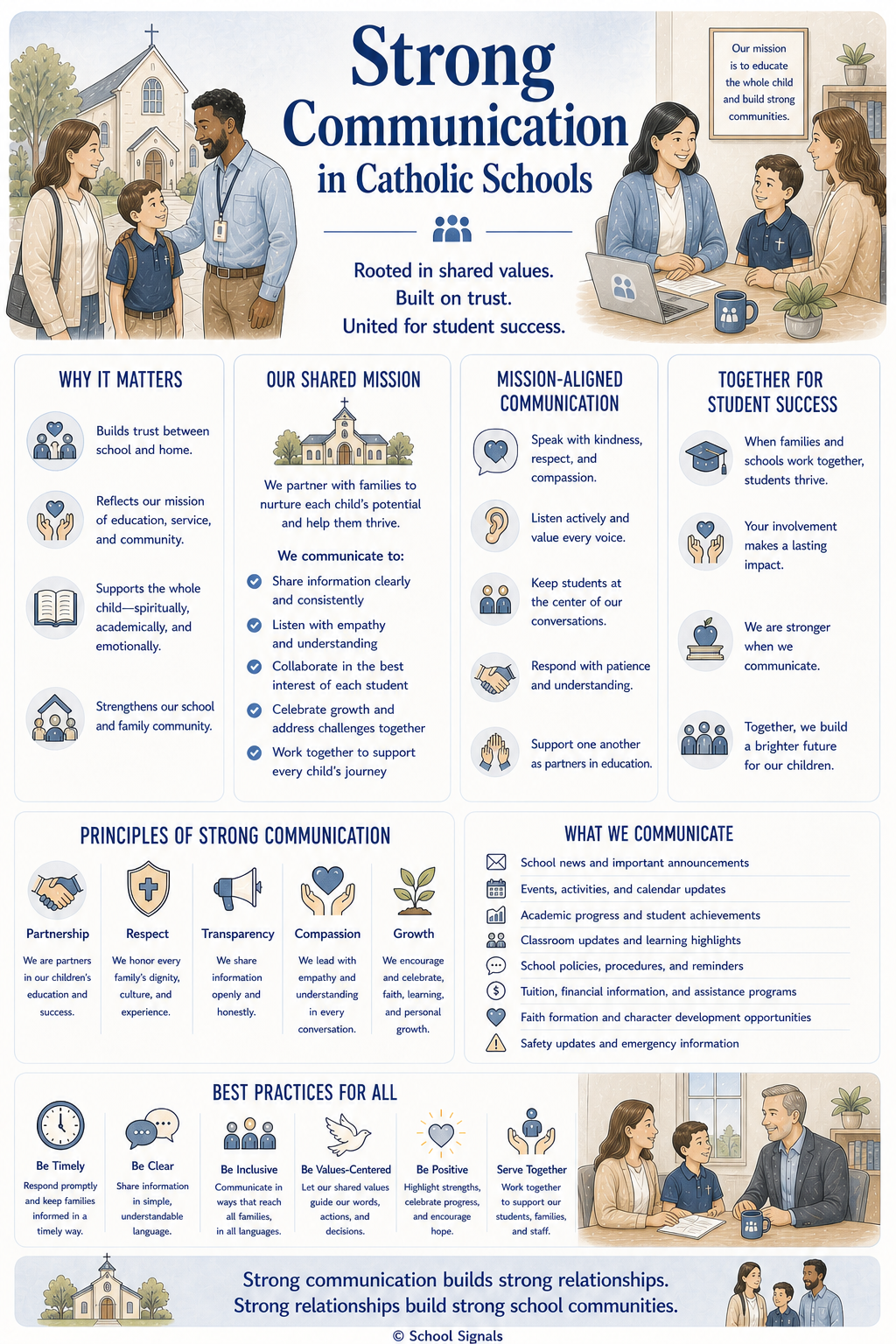
School–home partnerships grounded in truth, charity, community, and gratitude strengthen Catholic school life. Clarity is reflected in accurate, timely information from a trusted source. Respect guides the tone and delivery, ensuring communication promotes understanding rather than frustration. Inclusion and hospitality promote language access and cultural understanding to encourage participation, service, and shared responsibility.
A unified communication system supports these principles by creating a single source of truth, reducing misinformation, and ensuring that all families, regardless of language or schedule, can stay meaningfully connected.
Community-focused and aligned Catholic school communication and family engagement integrates the community:
- Families have a clear picture of school and parish life.
- Staff experience better coordination.
- Parent leaders receive communication tools that reflect the importance of their role in supporting the school’s mission.
- Parents’ concerns and comments are not dismissed; they are heard.
- Parents contribute their skills and knowledge to the community.
Two-way communication platforms and family engagement tools are a practical way to align communication, so the school community can stay in sync and strengthen its Catholic mission.

How to Assess Catholic School Communication: A Practical Assessment Checklist
Now that we have reviewed the types of school communication and family engagement that build Catholic school communities, let’s review the assessment questions that help analyze how well your Catholic school is meeting its communication goals. Consider that different stakeholders in your school may answer questions differently.
Reach out to all key stakeholders, including families, to gain a deeper understanding of how the communication is not just received but experienced. It’s recommended to form a communications team or committee to review and plan communication practices and strategies.

Invite members from office staff who are responsible for day-to-day parent communication, teachers who are at the center of two-way parent dialogue, the athletics director who needs to efficiently update families on changing schedules and practice times, and communication managers who bring technical and operational knowledge. In a Catholic school community, communication also helps connect families with the life of the school and its shared mission. Consult your school’s PTA/PTO parent leaders to coordinate communication around events and volunteering. With a focused team, you can ensure that the plan is practical, coordinated, and responsive to the needs of the whole school community.
Refer to this checklist to reflect your school’s communication practices and family engagement.
1. Communication Clarity & Consistency
☐ Families know where to find school’s mission statement.
☐ Families know where to find official school communication.
☐ Families know how to contact school administrators and teachers.
☐ Messaging practices and tools are consistent across school, classroom, and parent groups.
☐ Key information is not repeated across multiple platforms unnecessarily. Parents are not sent multiple messages about the same topic within a short time frame.
☐ Communication follows a predictable rhythm families can rely on.
2. Accessibility & Inclusion
☐ Communication is accessible to multilingual families.
☐ Translations are timely and consistent.
☐ Families do not need to join third-party informal parent groups to stay informed.
☐ Information is easy to locate without searching.
☐ Social media is not a primary place for information.
3. Engagement & Dialogue
☐ Families have clear ways to ask questions or respond.
☐ Parents understand what message is private and what message is shared with a group of adults.
☐ Two-way communication is encouraged, not avoided.
☐ Parent voice is welcomed within clear boundaries.
☐ Private conversations can happen when appropriate.
☐ Families understand who is who in the school community.
4. Staff & Leadership Capacity
☐ Teachers are not managing communication alone.
☐ Teachers are not spending their own money for communication systems.
☐ Staff are not duplicating messages across tools.
☐ Leadership has visibility into what is being communicated.
☐ Communication expectations are shared and understood.
5. Events, Volunteering & Community Life
☐ Event communication is easy to follow from start to finish.
☐ Volunteer coordination does not rely on side channels.
☐ Families understand how to participate and contribute.
☐ Community events strengthen trust rather than create confusion.
6. Overall Alignment
☐ Communication supports the school’s mission and values.
☐ Systems feel supportive, not overwhelming.
☐ Families feel informed, invited, and respected.
☐ Communication builds partnership. Parents’ voices are heard.
How to Make a Catholic School Communication Plan
Once you have assessed how well your Catholic school is doing with communication and engagement, and what the areas for improvement and changes might be, it is best to formalize the plan so that representatives from each stakeholder group can contribute to it and review it.
The below communication plan for Catholic schools is based on Lasswell’s 5W communication model that analyzes communication around five questions, five basic questions: “Who?”, “Says What?”, “In What Channel?”, “To Whom?”, and “With What Effect?”.

Learn about role-based school communication planning.
When developing the communication plan, agree with your communication team ahead of time on when you will review how communication is working, and to check what refinements to the plan need to made.
Download School Communication Plan Template (.xlsx)
Strengthening Catholic School Communication
Families choose Catholic education not only for academics but also for the opportunity to participate in a shared mission, serve the school community, and build relationships with other families.
Scattered communication across too many channels leads to missed events, overlooked volunteer opportunities, and confusion about important updates. Teachers face additional strain if communication lacks structure, and school leaders lose visibility into how information reaches families.
The Catholic school communications assessment is a practical way to analyze communication practices. Reflection questions within the school communications team and communication parent surveys provide a window into how families experience communication and highlight areas that require attention.
The next step is to form a clear communication plan that strengthens the Catholic school’s vision and lives its values. The plan defines responsibilities, channels, and expectations clearly.
A unified communication strategy, when implemented, brings clarity and coordination to school messaging. Families know where to find information, teachers and staff can follow shared communication practices and feel supported, and parent leaders receive tools that support events and volunteering.

- Building Trust with Inclusive School Communication - September 13, 2026
- School Signals Introduces Student Portfolios for Personalized Family Engagement - June 23, 2026
- 10 Communication Challenges We’re Hearing from School Leaders - June 6, 2026